WB result of HBZ Rabbit pAb
Primary antibody: HBZ Rabbit pAb at 1/1000 dilution
Lane 1: K562 whole cell lysate 20 µg
Secondary antibody: Goat Anti- rabbit IgG, (H+L), HRP conjugated at 1/10000 dilution
Predicted MW: 15 kDa
Observed MW: 14 kDa
HBZ Rabbit Polyclonal Antibody
HBZ Rabbit Polyclonal Antibody
Price:
Regular price
$100 USD
Regular price
Sale price
$100 USD
Unit price
per
For shipping services or bulk orders, you may request a quotation.
Secure checkout with

View full details
Product Details
Product Details
Product Specification
| Host | Rabbit |
| Antigen | HBZ |
| Synonyms | Hemoglobin subunit zeta; HBAZ; Hemoglobin zeta chain; Zeta-globin; HBZ2 |
| Immunogen | Synthetic Peptide |
| Accession | P02008 |
| Antibody Type | Polyclonal antibody |
| Isotype | IgG |
| Application | WB |
| Reactivity | Hu, Ms |
| Positive Sample | K562, mouse placenta, mouse spleen, mouse lung |
| Predicted Reactivity | Cz |
| Purification | Immunogen Affinity |
| Concentration | 0.5 mg/ml |
| Conjugation | Unconjugated |
| Physical Appearance | Liquid |
| Storage Buffer | PBS, 40% Glycerol, 0.05% BSA, 0.02% sodium azide |
| Stability & Storage | 12 months from date of receipt / reconstitution, -20 °C as supplied |
Dilution
| application | dilution | species |
| WB | 1:1000-1:5000 | Hu, Ms |
Background
Hemoglobin subunit zeta (HBZ) is an α-like globin chain encoded by the human HBZ gene, consisting of 142 amino acids with a molecular weight of approximately 16 kDa, and serves as an important component of the embryonic hemoglobin complexes. During early embryonic development (approximately weeks 3 to 8), it primarily combines with the ε chain to form embryonic hemoglobin Gower-1 (the ζ₂ε₂ tetramer composed of α-like ζ chains and β-like ε chains), and to a lesser extent associates with the γ chain to form embryonic hemoglobin Portland-1 (ζ₂γ₂). Its core physiological function is to provide effective oxygen transport and gas exchange for embryonic tissues during the stage when the embryonic circulatory system is not yet fully developed. As embryonic development proceeds, around 8 to 12 weeks of gestation, HBZ gene expression is gradually shut down, and its function is replaced by the adult α-globin genes (HBA1 and HBA2). In adult individuals, the HBZ gene is normally in a silent state, although under rare circumstances (such as large-scale deletions in the α-globin gene cluster), it may be re-expressed; however, its function and pathological significance in adults have not yet been fully elucidated. In clinical diagnostics, detection of HBZ expression can be used to identify abnormal persistent expression of embryonic hemoglobin, aiding in the diagnosis of certain hereditary hemoglobinopathies (such as α-thalassemia) and assessing fetal developmental status.
Picture
Picture
Western Blot
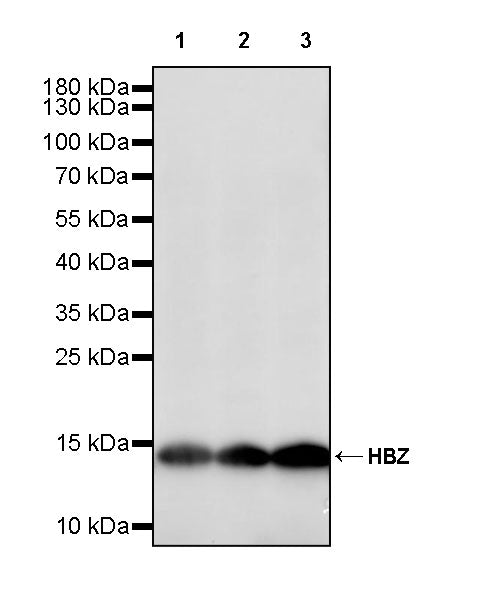
WB result of HBZ Rabbit pAb
Primary antibody: HBZ Rabbit pAb at 1/1000 dilution
Lane 1: mouse placenta lysate 20 µg
Lane 2: mouse spleen lysate 20 µg
Lane 3: mouse lung lysate 20 µg
Secondary antibody: Goat Anti- rabbit IgG, (H+L), HRP conjugated at 1/10000 dilution
Predicted MW: 15 kDa
Observed MW: 14 kDa