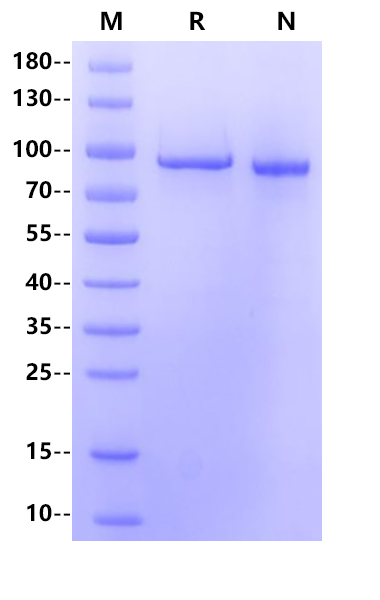
2μg (R: reducing condition, N: non-reducing condition).
HBS1L His Tag Protein, Human
HBS1L His Tag Protein, Human
Price:
Regular price
$1,250 USD
Regular price
Sale price
$1,250 USD
Unit price
per
For shipping services or bulk orders, you may request a quotation.
Secure checkout with

View full details
Product Details
Product Details
Product Specification
| Species | Human |
| Synonyms | HBS1L, ERFS, HBS1 |
| Accession | Q9Y450 |
| Amino Acid Sequence | Met1-Glu684 with His Tag at the N-Terminus |
| Expression System | Baculovirus-InsectCells |
| Molecular Weight | 70-100kDa (Reducing) |
| Purity | >95% by SDS-PAGE & HPLC |
| Conjugation | Unconjugated |
| Tag | His Tag |
| Physical Appearance | Liquid |
| Storage Buffer | 50mM Tris, 150mM NaCl, PH7.5, 1mM DTT, 10%Glycerol |
| Stability & Storage | Stable for 12 months upon stored at -80℃ from the date of receipt. And avoid repeated freeze-thaws cycles. |
| Reference | 1. Mammalian Hbs1L deficiency causes congenital anomalies and developmental delay associated with Pelota depletion and 80S monosome accumulation. PLoS Genetics, 19(5), e1010765. |
Background
The HBS1L (HBS1 like translational GTPase) gene encodes a cytoplasmic protein belonging to the GTP-binding elongation factor family. The gene is located on human chromosome 6 and is expressed in multiple tissues, with the highest expression in heart and skeletal muscle. The HBS1L protein contains 685 amino acids and comprises four conserved domains, including the HBS1 N-terminus and multiple Elongation Factor Tu (EF-Tu)-like domains. The protein is predominantly localized in the cytoplasm but is also detected in nuclear bodies, cytosolic ribosomes, and extracellular exosomes.
Core Function: HBS1L is the GTPase component of the Pelota-HBS1L complex. This complex recognizes stalled ribosomes and triggers the No-Go Decay (NGD) pathway, playing a critical role in ribosomal rescue. When ribosomes stall on mRNA, the HBS1L-PELO complex recognizes the stalled ribosome and promotes ribosome splitting, releasing the stalled translation complex.
Picture
Picture
SDS-PAGE