WB result of groEL Recombinant Rabbit mAb
Primary antibody: groEL Recombinant Rabbit mAb at 1/1000 dilution
Lane 1: PC-12 whole cell lysate 20 μg
Lane 2: Raw 264.7 whole cell lysate 20 μg
Lane 3: Jurkat whole cell lysate 20 μg
Lane 4: HeLa whole cell lysate 20 μg
Lane 5: E.coli (BL21(DE3)) lysate 20 μg
Negative control: PC-12 whole cell lysate; Raw 264.7 whole cell lysate; Jurkat whole cell lysate; HeLa whole cell lysate
Secondary antibody: Goat Anti-Rabbit IgG (H+L), HRP conjugated at 1/10000 dilution
Predicted MW: 57 kDa
Observed MW: 57 kDa
groEL Recombinant Rabbit mAb (S-4634-25)
groEL Recombinant Rabbit mAb (S-4634-25)
Price:
Regular price
$100 USD
Regular price
Sale price
$100 USD
Unit price
per
For shipping services or bulk orders, you may request a quotation.
Secure checkout with

View full details
Product Details
Product Details
Product Specification
| Host | Rabbit |
| Antigen | groEL |
| Synonyms | Chaperonin GroEL; 60 kDa chaperonin; Chaperonin-60; (Cpn60); GroEL protein; groL; mopA |
| Immunogen | Recombinant Protein |
| Location | Cytoplasm |
| Accession | P0A6F5 |
| Clone Number | S-4634-25 |
| Antibody Type | Recombinant mAb |
| Isotype | IgG |
| Application | WB |
| Purification | Protein A |
| Concentration | 0.5 mg/ml |
| Conjugation | Unconjugated |
| Physical Appearance | Liquid |
| Storage Buffer | PBS, 40% Glycerol, 0.05% BSA, 0.02% sodium azide |
| Stability & Storage | 12 months from date of receipt / reconstitution, -20 °C as supplied |
Dilution
| application | dilution | species |
| WB | 1:1000-1:5000 | E.coli |
Background
GroEL, the Escherichia coli homolog of heat shock protein 60 (Hsp60), is a key guardian of intracellular protein homeostasis, with its core function being to assist the correct folding of nascent polypeptide chains and to help denatured proteins regain their native conformation under stress conditions. It is assembled from 14 identical subunits into two back-to-back heptameric rings, forming an overall hollow barrel-like structure that provides an isolated microenvironment for protein folding. Its mechanism of action is a precisely regulated ATP-dependent cycle: first, unfolded target proteins bind to the apical domains of GroEL; subsequently, ATP and the co-chaperonin GroES bind to the same ring, triggering dramatic conformational changes in GroEL and releasing the target protein into the hydrophilic cavity enclosed by GroES, allowing it to fold independently in an undisturbed "safe chamber." During this process, GroEL exhibits broad "promiscuity" in substrate recognition, capable of binding to a variety of protein intermediates whose structures are destabilized due to mutations, high temperature, or other reasons, thereby effectively inhibiting their abnormal aggregation. In addition to assisting protein folding, GroEL also plays important roles in bacterial transmembrane transport and responses to environmental stress, and its gene expression is significantly upregulated under stress conditions such as heat shock to cope with the increased risk of protein misfolding.
Picture
Picture
Western Blot
Immunohistochemistry
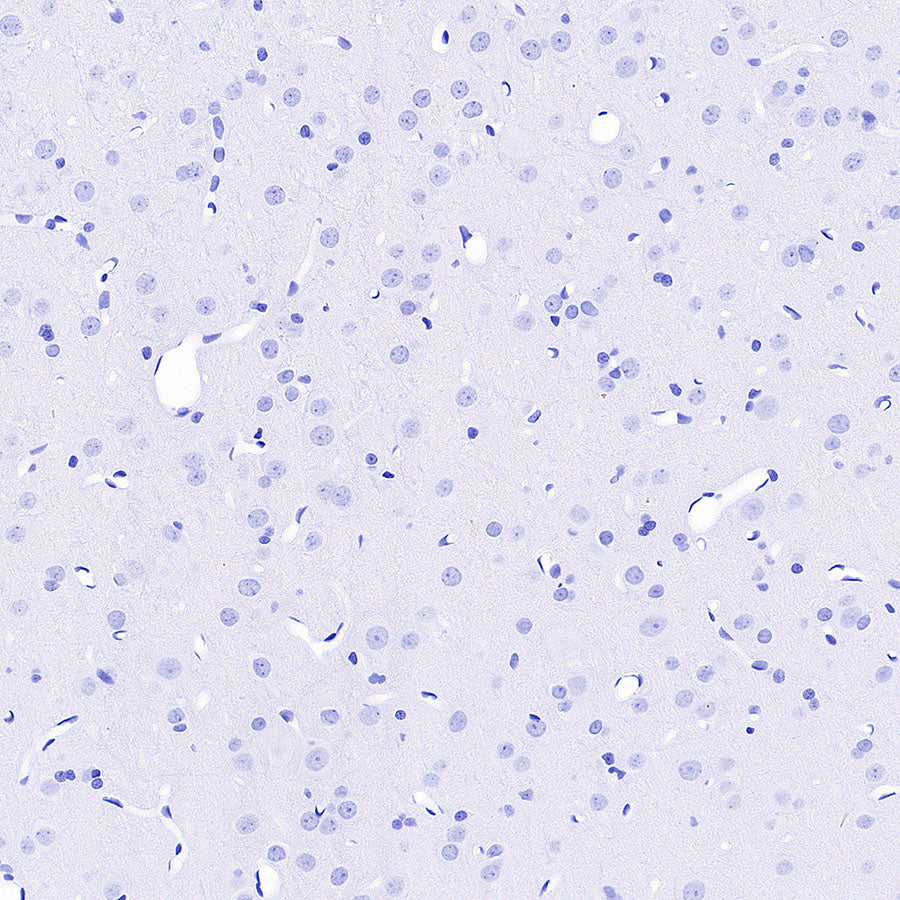
IHC shows negative staining in paraffin-embedded human brain. Anti-groEL antibody was used at 1/1000 dilution, followed by a HRP Polymer for Rabbit IgG (ready to use). Counterstained with hematoxylin. Heat mediated antigen retrieval with Tris/EDTA buffer pH9.0 was performed before commencing with IHC staining protocol.
IHC shows negative staining in paraffin-embedded mouse brain. Anti-groEL antibody was used at 1/1000 dilution, followed by a HRP Polymer for Rabbit IgG (ready to use). Counterstained with hematoxylin. Heat mediated antigen retrieval with Tris/EDTA buffer pH9.0 was performed before commencing with IHC staining protocol.
IHC shows negative staining in paraffin-embedded rat brain. Anti-groEL antibody was used at 1/1000 dilution, followed by a HRP Polymer for Rabbit IgG (ready to use). Counterstained with hematoxylin. Heat mediated antigen retrieval with Tris/EDTA buffer pH9.0 was performed before commencing with IHC staining protocol.