2μg (R: reducing condition, N:non-reducing condition).
Glypican 1/GPC1 Fc Chimera Protein, Human
Glypican 1/GPC1 Fc Chimera Protein, Human
Price:
Regular price
$235 USD
Regular price
Sale price
$235 USD
Unit price
per
For shipping services or bulk orders, you may request a quotation.
Secure checkout with

View full details
Product Details
Product Details
Product Specification
| Species | Human |
| Synonyms | Glypican 1 |
| Accession | P35052-1 |
| Amino Acid Sequence | Asp24- Ser530 with hIgG1 Fc at the C-Terminus |
| Expression System | HEK293 |
| Molecular Weight | 100-130kDa (Reducing) |
| Purity | >95% by SDS-PAGE & HPLC |
| Conjugation | Unconjugated |
| Tag | Human IgG1 Fc |
| Physical Appearance | Lyophilized powder |
| Storage Buffer | PBS, pH7.4, 5% trehalose |
| Reconstitution | Reconstitute at 0.1-1 mg/ml according to the size in ultrapure water after rapid centrifugation. |
| Stability & Storage |
· 12 months from date of receipt, lyophilized powder stored at -20 to -80℃. · 3 months, -20 to -80℃ under sterile conditions after reconstitution. · 1 week, 2 to 8℃ under sterile conditions after reconstitution. · Please avoid repeated freeze-thaw cycles. |
| Reference | 1. LI N, QUAN A, LI D, et al. The IgG4 hinge with CD28 transmembrane domain improves VHH-based CAR T cells targeting a membrane-distal epitope of GPC1 in pancreatic cancer[J]. Nature Communications, 2023, 14: 1986. |
Background
GPC1, also known as Glypican-1, is a heparan sulfate (HS) proteoglycan anchored to the cell membrane via a glycosylphosphatidylinositol (GPI) anchor, belonging to the glypican family. Its structure comprises a core protein of approximately 50 kDa and covalently attached HS glycosaminoglycan chains, which are tethered to the extracellular leaflet of the plasma membrane through the GPI anchor, enabling HS chains to interact with various growth factors, morphogens, and extracellular matrix proteins. GPC1 is broadly expressed in multiple tissues during embryonic development and in adulthood primarily in the brain, lung, liver, kidney, and pancreas, serving as a critical co-receptor for Wnt, fibroblast growth factor (FGF), and Hedgehog signaling pathways, thereby regulating cell proliferation, differentiation, migration, and tissue morphogenesis. Under pathological conditions, GPC1 is aberrantly overexpressed in multiple solid tumors, including pancreatic, breast, and lung cancers; notably, in pancreatic cancer, GPC1-positive exosomes have emerged as promising liquid biopsy biomarkers for early diagnosis. In recent years, GPC1 has become an emerging therapeutic target in tumor immunotherapy, with GPC1-targeted CAR-T cells, monoclonal antibodies, and antibody-drug conjugates demonstrating favorable anti-tumor activity in preclinical studies, offering new hope for the treatment of refractory malignancies such as pancreatic cancer.
Picture
Picture
SDS-PAGE
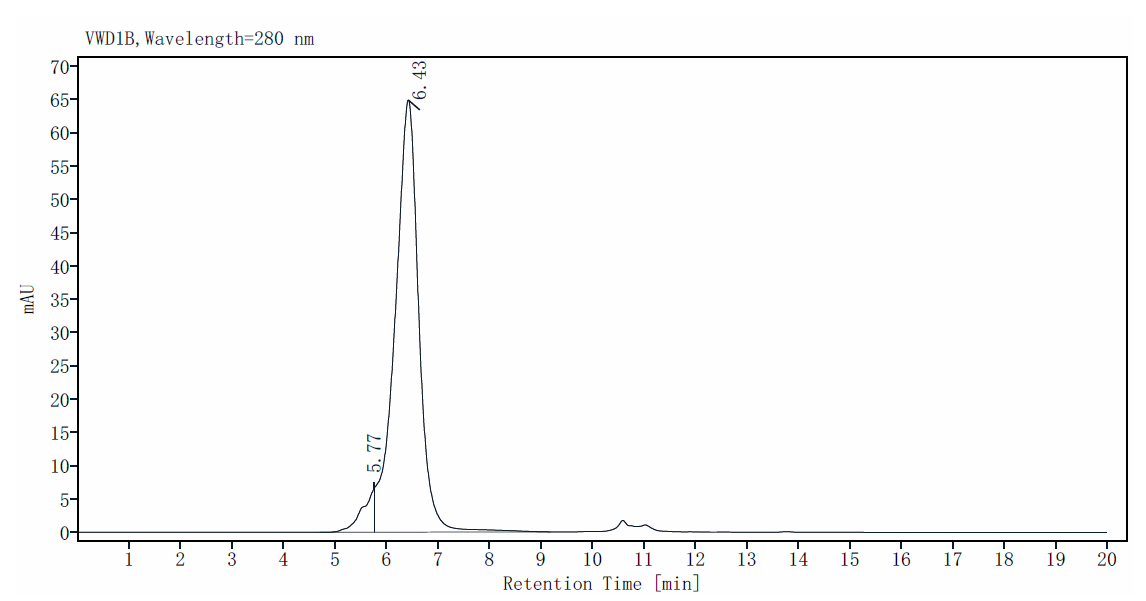
SEC-HPLC
The purity of Glypican 1/GPC1 Fc Chimera Protein, Human is more than 95% determined by SEC-HPLC.
ELISA
Immobilized FGF-basic(146aa) Protein, Human (Cat. No.UA040145) at 1 μg/mL (100 μL/well) can bind Glypican 1/GPC1 Fc Chimera Protein, Human (Cat. No. UA016018) with EC50 of 16.21-21.41 ng/mL.