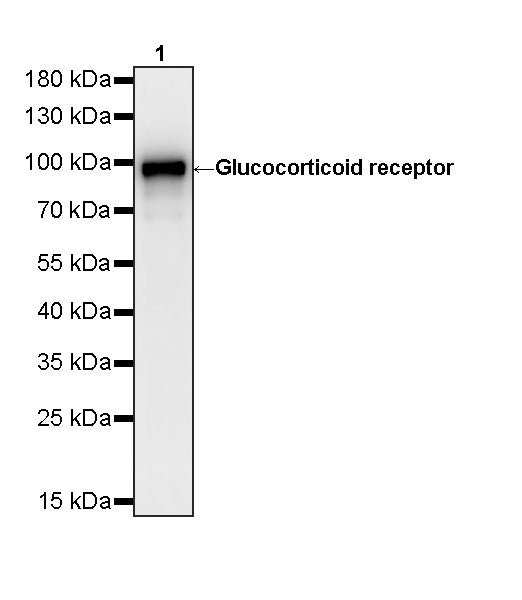
WB result of Glucocorticoid receptor Mouse mAb
Primary antibody: Glucocorticoid receptor Mouse mAb at 1/5000 dilution
Lane 1: HeLa whole cell lysate 20 µg
Lane 2: K-562 whole cell lysate 20 µg
Secondary antibody: Goat Anti-Mouse IgG, (H+L), HRP conjugated at 1/10000 dilution
Predicted MW: 86 kDa
Observed MW: 97 kDa
This blot was developed with high sensitivity substrate
Glucocorticoid receptor Mouse mAb
Glucocorticoid receptor Mouse mAb
Price:
Regular price
$100 USD
Regular price
Sale price
$100 USD
Unit price
per
For shipping services or bulk orders, you may request a quotation.
Secure checkout with

View full details
Product Details
Product Details
Product Specification
| Host | Mouse |
| Antigen | Glucocorticoid Receptor |
| Synonyms | GRL; NR3C1 |
| Location | Cytoplasm, Nucleus, Mitochondrion |
| Accession | P04150 |
| Antibody Type | Mouse mAb |
| Isotype | IgG1 |
| Application | WB |
| Reactivity | Hu, Ms, Rt |
| Positive Sample | HeLa, K-562, NIH/3T3, 4T1, PC-12 |
| Purification | Protein G |
| Concentration | 1 mg/ml |
| Conjugation | Unconjugated |
| Physical Appearance | Liquid |
| Storage Buffer | PBS, 40% Glycerol, 0.05% BSA, 0.02% sodium azide |
| Stability & Storage | 12 months from date of receipt / reconstitution, -20 °C as supplied |
Dilution
| application | dilution | species |
| WB | 1:1000-1:5000 | Hu, Ms, Rt |
Background
Glucocorticoid Receptor (GR) is a ligand-dependent transcription factor encoded by the NR3C1 gene, belonging to the nuclear receptor superfamily. It is expressed in almost all human tissues and serves as the core mediator of the physiological effects of endogenous glucocorticoids (such as cortisol) and commonly used clinical anti-inflammatory drugs (such as dexamethasone). In the absence of ligand, GR is primarily localized in the cytoplasm, associated with molecular chaperones such as heat shock proteins in an inactive complex. Upon glucocorticoid binding, GR undergoes conformational changes and dissociates from chaperone proteins, rapidly translocating into the nucleus, where it regulates gene expression through two major mechanisms: one is classical transactivation—GR binds as a homodimer to glucocorticoid response elements (GREs) in the promoter regions of target genes, directly activating the expression of anti-inflammatory proteins (such as annexin A1) and metabolic enzymes. The other and more important mechanism is transrepression—GR monomers interact with pro-inflammatory transcription factors such as NF-κB and AP-1 through protein-protein interactions, preventing them from activating the transcription of inflammatory cytokines, which forms the cornerstone of the potent anti-inflammatory and immunosuppressive effects of glucocorticoids. Additionally, GR exerts rapid cellular effects within minutes through non-genomic mechanisms (such as rapid activation of PI3K or MAPK signaling pathways). Its functional dysregulation is closely associated with Cushing's syndrome, glucocorticoid resistance, inflammatory diseases, and psychiatric disorders such as depression, making GR a enduring and classic drug target in the pharmaceutical field.
Picture
Picture
Western Blot
WB result of Glucocorticoid receptor Mouse mAb
Primary antibody: Glucocorticoid receptor Mouse mAb at 1/5000 dilution
Lane 1: 4T1 whole cell lysate 20 µg
Lane 2: NIH/3T3 whole cell lysate 20 µg
Lane 3: mouse brain lysate 20 µg
Secondary antibody: Goat Anti-Mouse IgG, (H+L), HRP conjugated at 1/10000 dilution
Predicted MW: 86 kDa
Observed MW: 97 kDa
This blot was developed with high sensitivity substrate
WB result of Glucocorticoid receptor Mouse mAb
Primary antibody: Glucocorticoid receptor Mouse mAb at 1/5000 dilution
Lane 1: PC-12 whole cell lysate 20 µg
Secondary antibody: Goat Anti-Mouse IgG, (H+L), HRP conjugated at 1/10000 dilution
Predicted MW: 86 kDa
Observed MW: 97 kDa
This blot was developed with high sensitivity substrate