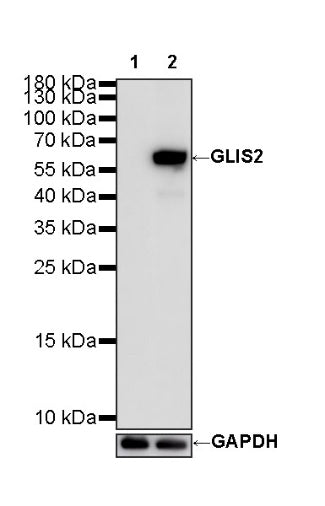
WB result of GLIS2 Recombinant Rabbit mAb
Primary antibody: GLIS2 Recombinant Rabbit mAb at 1/1000 dilution
Lane 1: 293F transfected with empty vector whole cell lysate 20 µg
Lane 2: 293F transfected with GLIS2 protein whole cell lysate 20 µg
Secondary antibody: Goat Anti-Rabbit IgG (H+L), HRP conjugated at 1/10000 dilution
Predicted MW: 56 kDa
Observed MW: 60 kDa
GLIS2 Recombinant Rabbit mAb (S-4139-44)
GLIS2 Recombinant Rabbit mAb (S-4139-44)
Price:
Regular price
$100 USD
Regular price
Sale price
$100 USD
Unit price
per
For shipping services or bulk orders, you may request a quotation.
Secure checkout with

View full details
Product Details
Product Details
Product Specification
| Host | Rabbit |
| Antigen | GLIS2 |
| Synonyms | Zinc finger protein GLIS2; GLI-similar 2; Neuronal Krueppel-like protein; Zinc finger protein GLI5; Gli5; Nkl; Glis2 |
| Immunogen | Synthetic Peptide |
| Location | Cytoplasm, Nucleus |
| Accession | Q8VDL9 |
| Clone Number | S-4139-44 |
| Antibody Type | Recombinant mAb |
| Isotype | IgG |
| Application | WB |
| Reactivity | Ms |
| Purification | Protein A |
| Concentration | 0.5 mg/ml |
| Conjugation | Unconjugated |
| Physical Appearance | Liquid |
| Storage Buffer | PBS, 40% Glycerol, 0.05% BSA, 0.02% sodium azide |
| Stability & Storage | 12 months from date of receipt / reconstitution, -20 °C as supplied |
Dilution
| application | dilution | species |
| WB | 1:1000 | Ms |
Background
GLIS2 (GLI-similar zinc finger protein 2) is a transcription factor belonging to the GLIS family, containing five C2H2-type zinc finger domains that enable it to function as either a transcriptional activator or repressor depending on the cellular context—for example, it maintains the differentiated phenotype of renal tubular cells by regulating the canonical Wnt/β-catenin signaling pathway. Under normal physiological conditions, it is highly expressed in the kidneys and is essential for renal morphogenesis and the maintenance of tubular epithelial cell homeostasis, while also promoting neuronal differentiation in the neural tube and peripheral nervous system. Loss of function or mutations in GLIS2 are a key cause of juvenile nephronophthisis (NPHP), characterized by disruption of the tubular basement membrane, interstitial fibrosis, and inflammation, with most patients progressing to end-stage renal disease in childhood or young adulthood. Furthermore, aberrations in GLIS2 also exhibit a dual role in the tumor context: its loss or functional deficiency may promote renal fibrosis, while on the other hand, circGLIS2 (circular RNA) or ETO2::GLIS2 fusion genes have been found to be aberrantly activated in leukemia and colorectal cancer, promoting tumor cell migration and leukemogenesis through the regulation of signaling pathways such as NF-κB.
Picture
Picture
Western Blot