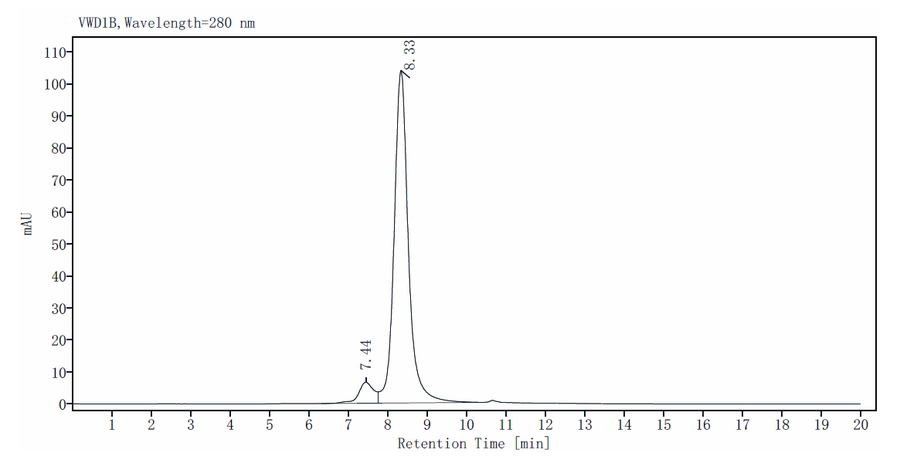
2μg (R: reducing condition, N: non-reducing condition).
GITR Ligand/TNFSF18 Trimer His Tag Protein, Human
GITR Ligand/TNFSF18 Trimer His Tag Protein, Human
Price:
Regular price
$195 USD
Regular price
Sale price
$195 USD
Unit price
per
For shipping services or bulk orders, you may request a quotation.
Secure checkout with

View full details
Product Details
Product Details
Product Specification
| Species | Human |
| Synonyms | AITRL, TL6, hGITRL |
| Accession | AAH69319.1 |
| Amino Acid Sequence | Gln50-Ser177with His Tag at the N-Terminus |
| Expression System | HEK293 |
| Molecular Weight | 45-60kDa (Reducing) |
| Endotoxin | <0.1EU/μg |
| Tag | His Tag |
| Physical Appearance | Lyophilized powder |
| Storage Buffer | PBS, pH7.4, 5% trehalose |
| Reconstitution | Reconstitute at 0.1-1 mg/ml according to the size in ultrapure water after rapid centrifugation |
| Stability & Storage |
· 12 months from date of receipt,lyophilized powder stored at -20 to -80℃. · 3 months, -20 to -80℃under sterile conditions after reconstitution. · 1 week, 2 to 8℃under sterile conditions after reconstitution. · Please avoid repeated freeze-thaw cycles. |
| Reference |
1. Avraham Y, Barth N, Yair Bar-On T, et al. Fc-optimized GITR antibody enhances a CD4 T cell-dendritic cell crosstalk to promote antitumor immunity[J]. Nature Cancer, 2026, 7(9): 1419-1435. 2. You W, Hu C, Zhang Y, et al. Reinvigorating COTL1^high NK cells via GITR signalling overcomes immune checkpoint blockade resistance in tsMHC-I-impaired tumours[J]. Nature Cell Biology, 2026, 28(5): 957-971. 3. Jung D, Goh A R, Kim K Y, et al. Enhanced anti-tumor efficacy of tumor-infiltrating lymphocytes by GITR agonist in ovarian cancer[J]. Frontiers in Immunology, 2025, 16: 167084. |
Background
GITR ligand (GITRL), also known as TNFSF18, AITRL, or TL6, is a member of the tumor necrosis factor superfamily and the cognate ligand of the costimulatory receptor GITR (TNFRSF18/CD357). GITRL is a type II transmembrane glycoprotein whose extracellular region adopts the characteristic TNF homology β-sandwich fold; in humans it assembles predominantly as a homotrimer. Trimeric GITRL engages GITR, inducing receptor clustering and signaling through TRAF2/5–NF-κB and MAPK pathways, while metalloprotease cleavage releases soluble GITRL. GITRL is expressed mainly on dendritic cells, macrophages, B cells, and endothelial cells. It promotes the proliferation, activation, and survival of CD4⁺ and CD8⁺ effector T cells while attenuating regulatory T-cell suppression, placing the GITRL–GITR axis at a central node of antitumor and autoimmune regulation. Clinically, GITR agonist antibodies, multimeric GITRL constructs, anti-PD-1–GITRL bispecific molecules, and GITRL-armored CAR-NK/CAR-T cells are being developed for cancer immunotherapy. Monotherapy has shown limited efficacy in early trials, so combination with PD-1 or CTLA-4 blockade is now the main strategy, with additional potential in autoimmune disease and HIV reservoir reactivation.
Picture
Picture
SDS-PAGE
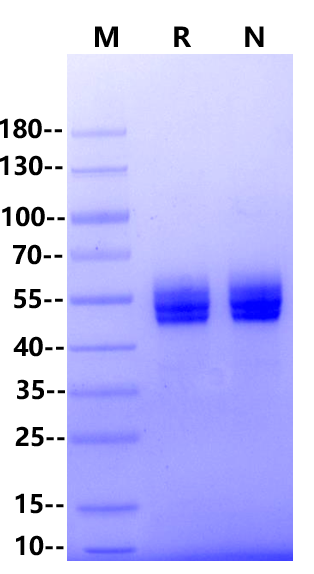
SEC-HPLC
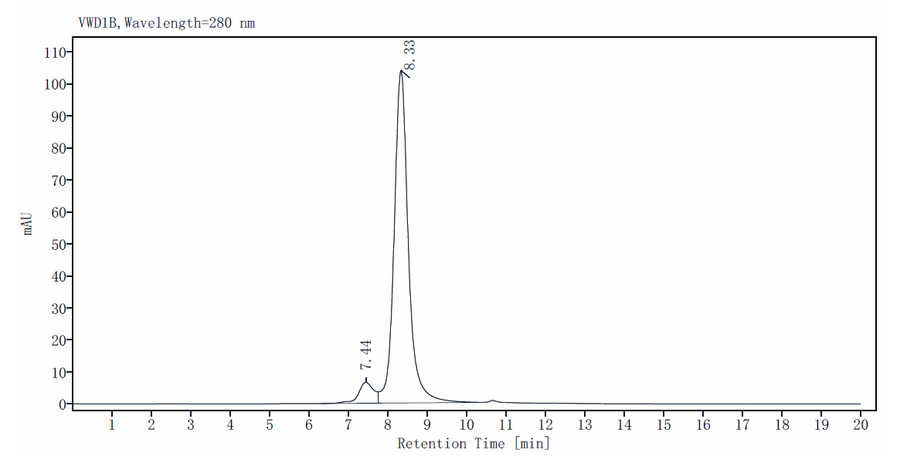
The purity of GITR Ligand/TNFSF18 Trimer His Tag Protein, Human is more than 90% determined by SEC-HPLC.
ELISA

Immobilized Human GITR / TNFRSF18 Protein, Fc Tag, low endotoxin at 5 μg/mL (100 μL/well) can bind GITR Ligand/TNFSF18 Trimer His Tag Protein, Human (Cat. No.UA016231) with a linear range of 4.1-6.5 ng/mL.