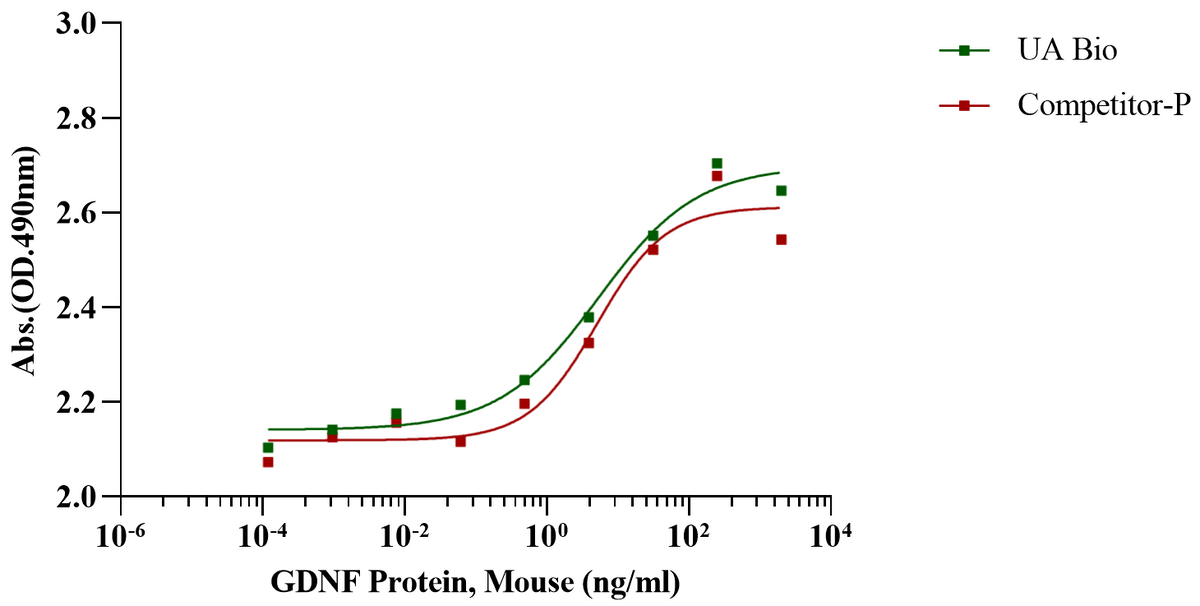
Measured in a cell proliferation assay using SHSY5Y human neuroblastoma cells. The EC50 for this effect is less than 2.9-9.8ng/ml.
GDNF Protein, Mouse
GDNF Protein, Mouse
Price:
Regular price
$215 USD
Regular price
Sale price
$215 USD
Unit price
per
For shipping services or bulk orders, you may request a quotation.
Secure checkout with

View full details
Product Details
Product Details
Product Specification
| Species | Mouse |
| Synonyms | Glial cell line-derived neurotrophic factor, mGDNF, Astrocyte-derived trophic factor (ATF) |
| Accession | P48540 |
| Amino Acid Sequence | Ser78-Ile211 |
| Expression System | E.coli |
| Molecular Weight | 12-14 kDa (Reducing) |
| Purity | >95% by SDS-PAGE |
| Endotoxin | <0.1EU/μg |
| Conjugation | Unconjugated |
| Tag | No Tag |
| Physical Appearance | Lyophilized Powder |
| Storage Buffer | PBS, pH7.4 |
| Reconstitution | Reconstitute at 0.1-1 mg/ml according to the size in ultrapure water after rapid centrifugation. |
| Stability & Storage | ·12 months from date of receipt, lyophilized powder stored at -20 to -80℃. |
| Reference | Science. 1993;260(5111):1130-1132. |
Background
Glial cell line-derived neurotrophic factor (GDNF) is a potent neurotrophic factor belonging to the TGF-β superfamily, first isolated in 1993 as a survival factor for midbrain dopaminergic neurons. In mice, GDNF is encoded by the Gdnf gene on chromosome 15 and expressed as a 211-amino acid preproprotein that undergoes proteolytic processing to form the active disulfide-linked homodimer. The mature mouse GDNF protein (Ser78-Ile211) signals through a multicomponent receptor system comprising the RET receptor tyrosine kinase and one of four GFRα co-receptors (GFRα1-4). This unique signaling architecture mediates GDNF's pleiotropic functions in neuronal survival, differentiation, dopamine uptake enhancement, and axonal guidance. Beyond the central nervous system, mouse GDNF is essential for kidney organogenesis, enteric nervous system development, and spermatogonial stem cell self-renewal, demonstrating evolutionary conserved roles across organ systems. Homozygous Gdnf knockout mice exhibit neonatal lethality with renal agenesis and intestinal atresia, while conditional knockouts reveal critical requirements for adult dopaminergic neuron maintenance and motor control.
Picture
Picture
Bioactivity
SDS-PAGE
2μg (R: reducing condition, N: non-reducing condition).
ELISA
Immobilized GDNF Protein, Mouse (Cat. No. UA040523) at 1.0μg/mL (100μL/well) can bind GFRA1 Fc Chimera Protein, Human (Cat. No. UA011102) with EC50 of 0.81-1.67ng/mL.