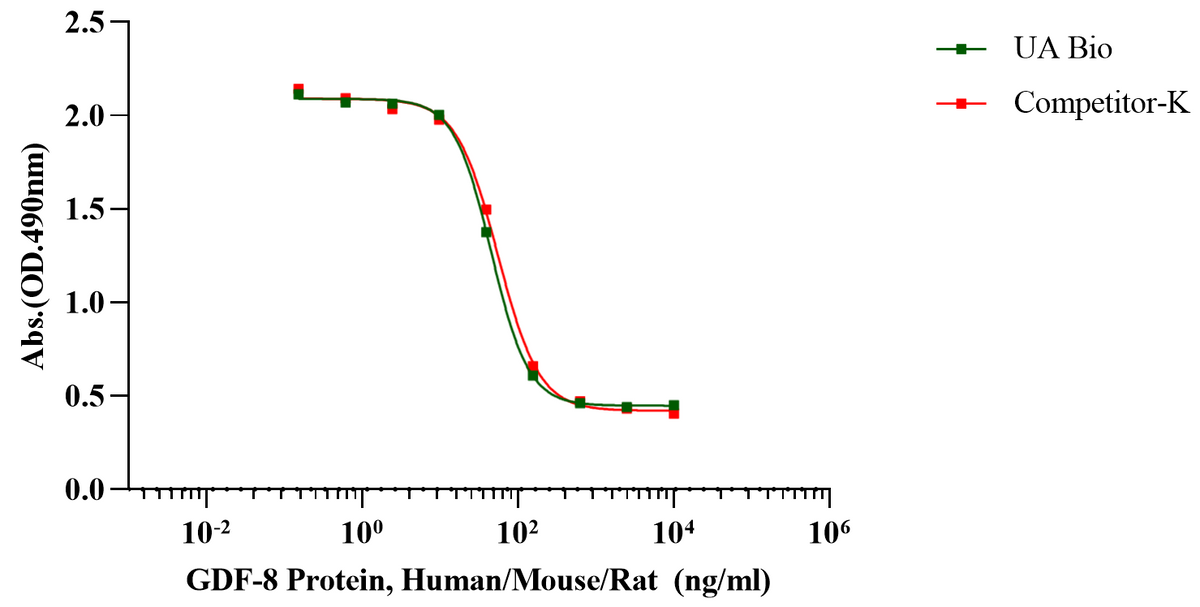
Determined by its ability to inhibit the proliferation of MPC-11 cells. The expected IC50 for this effect is 40-53 ng/ml.
GDF-8 Protein, Human/Mouse/Rat
GDF-8 Protein, Human/Mouse/Rat
Price:
Regular price
$310 USD
Regular price
Sale price
$310 USD
Unit price
per
For shipping services or bulk orders, you may request a quotation.
Secure checkout with

View full details
Product Details
Product Details
Product Specification
| Species | Human |
| Synonyms | Growth/differentiation factor 8, GDF-8, Myostatin |
| Accession | O14793 |
| Amino Acid Sequence | Asp267-Ser375 |
| Expression System | CHO |
| Molecular Weight | 12-13 kDa (Reducing) |
| Purity | >95% by SDS-PAGE & HPLC. |
| Endotoxin | <0.1EU/μg |
| Conjugation | Unconjugated |
| Tag | No Tag |
| Physical Appearance | Lyophilized Powder |
| Storage Buffer | 4 mM HCl |
| Reconstitution | Reconstitute at 0.1-1 mg/ml according to the size in Reconstitution Buffer after rapid centrifugation. |
| Stability & Storage | ·12 months from date of receipt, lyophilized powder stored at -20 to -80℃. |
| Reference | Nature. 1997;387(6628):83-90. |
Background
Growth differentiation factor-8 (GDF-8), commonly known as myostatin, is a ~25 kDa secreted glycoprotein belonging to the transforming growth factor-β (TGF-β) superfamily. GDF-8 is synthesized as a 376-amino acid prepropeptide, proteolytically processed to generate a latent prodomain-mature domain complex; activation requires further cleavage by tolloid-like proteases to release the biologically active mature dimer. The mature GDF-8 signals primarily through the activin type II receptor (ActRIIB), recruiting ALK4/ALK5 to activate Smad2/3 transcription factors, thereby suppressing myoblast proliferation, satellite cell activation, and muscle protein synthesis.
In 2004, a landmark case report described a human child with a homozygous myostatin mutation exhibiting gross muscle hypertrophy from infancy, providing direct proof-of-concept for therapeutic targeting in humans. Beyond muscle, GDF-8 influences adipogenesis (promoting fat accumulation), bone remodeling, cardiac hypertrophy, and tendon homeostasis.
Picture
Picture
Bioactivity
SDS-PAGE
2μg (R: reducing condition, N: non-reducing condition).
RP-HPLC
>95% as determined by RP-HPLC.