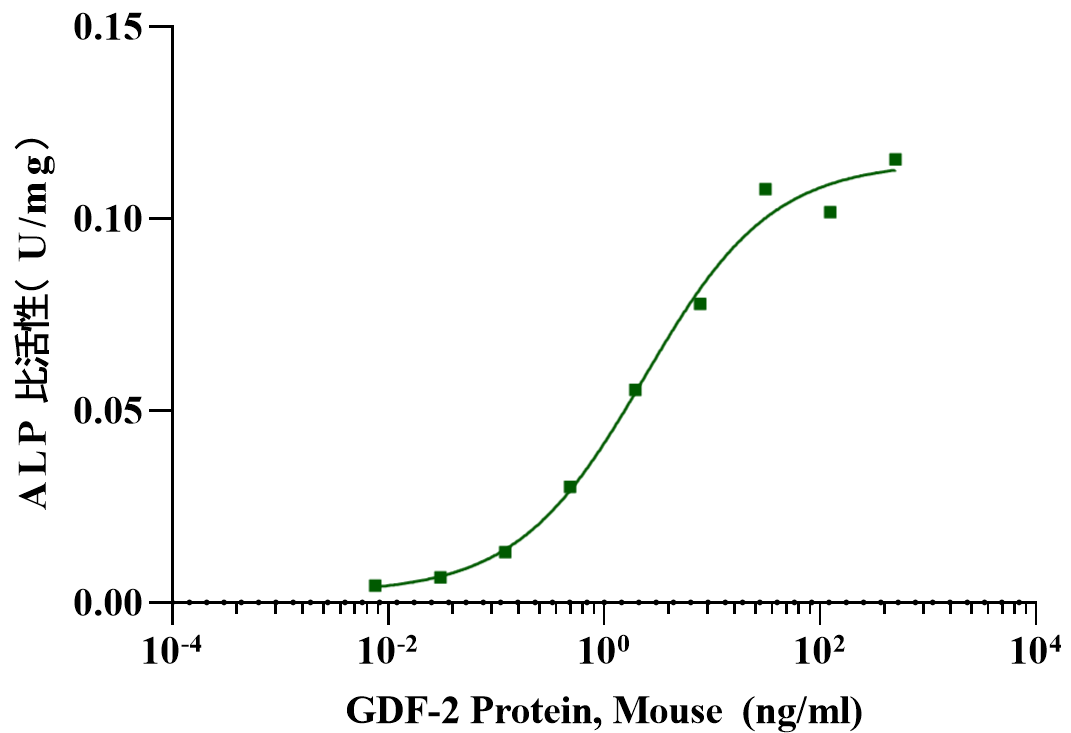
Determined by its ability to induce alkaline phosphatase production by ATDC-5 cells. The expected EC50 for this effect is 1.5-3.7 ng/ml.
GDF-2/BMP-9 Protein, Mouse
GDF-2/BMP-9 Protein, Mouse
Price:
Regular price
$225 USD
Regular price
Sale price
$225 USD
Unit price
per
For shipping services or bulk orders, you may request a quotation.
Secure checkout with

View full details
Product Details
Product Details
Product Specification
| Species | Mouse |
| Synonyms | Growth/differentiation factor 2, GDF-2, Bone morphogenetic protein 9 (BMP-9) |
| Accession | Q9WV56 |
| Amino Acid Sequence | Ser319-Arg428 |
| Expression System | CHO |
| Molecular Weight | 12-13 kDa (Reducing) |
| Purity | >95% by SDS-PAGE. |
| Endotoxin | <0.1EU/μg |
| Conjugation | Unconjugated |
| Tag | No Tag |
| Physical Appearance | Lyophilized Powder |
| Storage Buffer | 4mM HCl |
| Reconstitution | Reconstitute at 0.1-1 mg/ml according to the size in Reconstitution Buffer after rapid centrifugation. |
| Stability & Storage | ·12 months from date of receipt, lyophilized powder stored at -20 to -80℃. |
| Reference | Developmental Dynamics. 2022;251(1):178-197. |
Background
Growth differentiation factor 2 (GDF-2), also known as bone morphogenetic protein 9 (BMP9), is a secreted ligand of the transforming growth factor-beta (TGF-β) superfamily. The mouse Gdf2 gene is located on chromosome 14 and encodes a protein that signals primarily through the type I activin receptor ALK1 (ACVRL1). GDF-2/BMP9 was originally identified from fetal mouse liver cDNA libraries and is highly expressed in the liver and lungs of postnatal mice.
In the industrial and translational sectors, GDF-2/BMP9 is recognized as one of the most potent osteogenic factors for inducing mesenchymal stem cell differentiation, with applications in bone tissue engineering, fracture healing, cartilage formation, and spinal fusion. Its potent anti-angiogenic activity has also been explored therapeutically, including in age-related macular degeneration via the ALK1-Fc fusion protein ACE-041.
Picture
Picture
Bioactivity
SDS-PAGE
2μg (R: reducing condition, N: non-reducing condition).