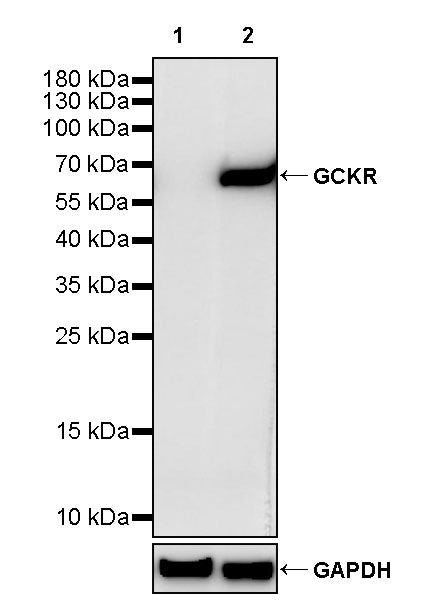
WB result of GCKR Recombinant Rabbit mAb
Primary antibody: GCKR Recombinant Rabbit mAb at 1/1000 dilution
Lane 1: mouse kidney lysate 20 µg
Lane 2: mouse liver lysate 20 µg
Negative control: mouse kidney lysate
Secondary antibody: Goat Anti- rabbit IgG, (H+L), HRP conjugated at 1/10000 dilution
Predicted MW: 69 kDa
Observed MW: 69 kDa
GCKR Recombinant Rabbit mAb (S-4472-64)
GCKR Recombinant Rabbit mAb (S-4472-64)
Price:
Regular price
$100 USD
Regular price
Sale price
$100 USD
Unit price
per
For shipping services or bulk orders, you may request a quotation.
Secure checkout with

View full details
Product Details
Product Details
Product Specification
| Host | Rabbit |
| Antigen | GCKR |
| Synonyms | Glucokinase regulatory protein; GKRP; Glucokinase regulator; Gckr |
| Immunogen | Synthetic Peptide |
| Location | Cytoplasm, Nucleus, Mitochondrion |
| Accession | Q91X44 |
| Clone Number | S-4472-64 |
| Antibody Type | Recombinant mAb |
| Isotype | IgG |
| Application | WB |
| Reactivity | Ms, Rt |
| Positive Sample | mouse liver, rat liver |
| Purification | Protein A |
| Concentration | 0.5 mg/ml |
| Conjugation | Unconjugated |
| Physical Appearance | Liquid |
| Storage Buffer | PBS, 40% Glycerol, 0.05% BSA, 0.02% sodium azide |
| Stability & Storage | 12 months from date of receipt / reconstitution, -20 °C as supplied |
Dilution
| application | dilution | species |
| WB | 1:1000-1:10000 | Ms, Rt |
Background
GCKR, namely glucokinase regulatory protein, is a regulatory protein predominantly expressed in the liver and pancreatic β-cells. Its core function is to form a heterodimeric complex through direct binding with glucokinase (GCK), thereby exerting reversible allosteric inhibition on GCK enzymatic activity. In the fasting state, GCKR stabilizes its interaction with GCK by binding fructose-6-phosphate (F6P), sequestering GCK within the nucleus and keeping its activity suppressed, thus preventing excessive glucose phosphorylation during hypoglycemia. When postprandial blood glucose rises, intracellular fructose-6-phosphate levels decrease while fructose-1-phosphate (F1P) levels increase; F1P binds to GCKR and induces a conformational change, causing GCK to dissociate from GCKR and translocate from the nucleus to the cytoplasm, restoring GCK catalytic activity and promoting glucose phosphorylation to drive glycogen synthesis and glycolysis. This dynamic mechanism makes GCKR a key regulator in the glucose metabolism "switch." Functionally, by modulating GCK activity, GCKR plays an irreplaceable role in maintaining systemic glucose homeostasis, connecting multiple metabolic pathways including glucose sensing, insulin secretion, and hepatic glucose metabolism. Clinically, various common polymorphisms of the GCKR gene, particularly the P446L missense mutation at the rs1260326 locus, have been confirmed by large-scale genome-wide association studies to be significantly associated with multiple metabolic traits, including fasting blood glucose levels, triglyceride concentrations, insulin resistance indices, and susceptibility to type 2 diabetes and metabolic syndrome. However, its effects manifest as complex and sometimes opposing bidirectional regulation—for example, while the P446L variant can slightly lower fasting blood glucose by enhancing GCK activity, it simultaneously elevates plasma triglyceride levels, thus neither purely protective nor purely pathogenic. Furthermore, abnormal expression and function of GCKR are also closely associated with liver diseases such as non-alcoholic fatty liver disease (NAFLD) and cirrhosis, making it a continuing hotspot molecule in genetic research of metabolic diseases and drug target development.
Picture
Picture
Western Blot
WB result of GCKR Recombinant Rabbit mAb
Primary antibody: GCKR Recombinant Rabbit mAb at 1/1000 dilution
Lane 1: rat kidney lysate 20 µg
Lane 2: rat liver lysate 20 µg
Negative control: rat kidney lysate
Secondary antibody: Goat Anti- rabbit IgG, (H+L), HRP conjugated at 1/10000 dilution
Predicted MW: 69 kDa
Observed MW: 69 kDa