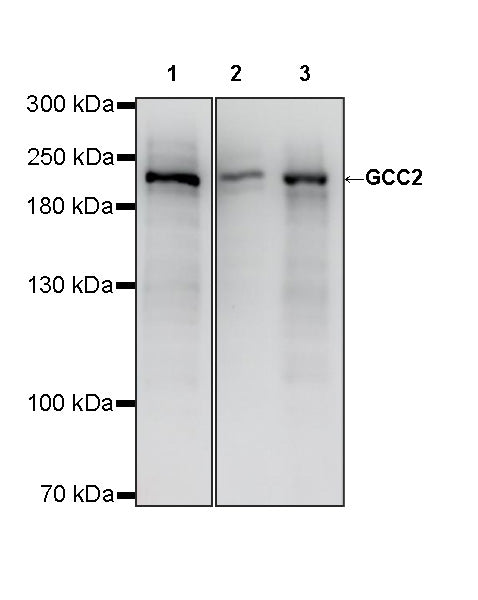
WB result of GCC2 Recombinant Rabbit mAb
Primary antibody: GCC2 Recombinant Rabbit mAb at 1/1000 dilution
Lane 1: 293T whole cell lysate 20 µg
Lane 2: HeLa whole cell lysate 20 µg
Lane 3: Jurkat whole cell lysate 20 µg
Secondary antibody: Goat Anti-Rabbit IgG, (H+L), HRP conjugated at 1/10000 dilution
Predicted MW: 196 kDa
Observed MW: 220 kDa
This blot was developed with high sensitivity substrate
GCC2 Recombinant Rabbit mAb (S-4458-19)
GCC2 Recombinant Rabbit mAb (S-4458-19)
Price:
Regular price
$100 USD
Regular price
Sale price
$100 USD
Unit price
per
For shipping services or bulk orders, you may request a quotation.
Secure checkout with

View full details
Product Details
Product Details
Product Specification
| Host | Rabbit |
| Antigen | GCC2 |
| Synonyms | GRIP and coiled-coil domain-containing protein 2; 185 kDa Golgi coiled-coil protein (GCC185); CLL-associated antigen KW-11; CTCL tumor antigen se1-1; Ran-binding protein 2-like 4 (RanBP2L4); Renal carcinoma antigen NY-REN-53; KIAA0336; RANBP2L4 |
| Location | Cytoplasm |
| Accession | Q8IWJ2 |
| Clone Number | S-4458-19 |
| Antibody Type | Recombinant mAb |
| Isotype | IgG |
| Application | WB |
| Reactivity | Hu |
| Positive Sample | 293T, HeLa, Jurkat |
| Purification | Protein A |
| Concentration | 2 mg/ml |
| Conjugation | Unconjugated |
| Physical Appearance | Liquid |
| Storage Buffer | PBS, 40% Glycerol, 0.05% BSA, 0.02% sodium azide |
| Stability & Storage | 12 months from date of receipt / reconstitution, -20 °C as supplied |
Dilution
| application | dilution | species |
| WB | 1:1000 | Hu |
Background
GCC2, also widely known by its alias GCC185, is a peripheral membrane protein localized to the trans-Golgi network (TGN) and belongs to the golgin protein family, playing a central role in material transport and structural maintenance within the endomembrane system. Its structural features include a C-terminal GRIP domain and extensive coiled-coil domains, which enable it to function as a molecular "tether" that specifically anchors transport vesicles to the TGN membrane. As an effector protein for small GTPases such as Rab9A and Rab6A, GCC2 participates in multiple critical vesicular trafficking pathways, including mediating the retrograde transport of mannose-6-phosphate receptors from late endosomes back to the TGN, as well as potentially facilitating cargo shuttling between recycling endosomes and the Golgi apparatus. Furthermore, GCC2 is essential for maintaining Golgi structural integrity and the formation of non-centrosomal microtubules; it recruits microtubule-binding proteins CLASP1 and CLASP2 to promote the generation of Golgi-associated microtubules at the TGN, thereby influencing overall cellular secretion efficiency and organelle spatial positioning.
Picture
Picture
Western Blot