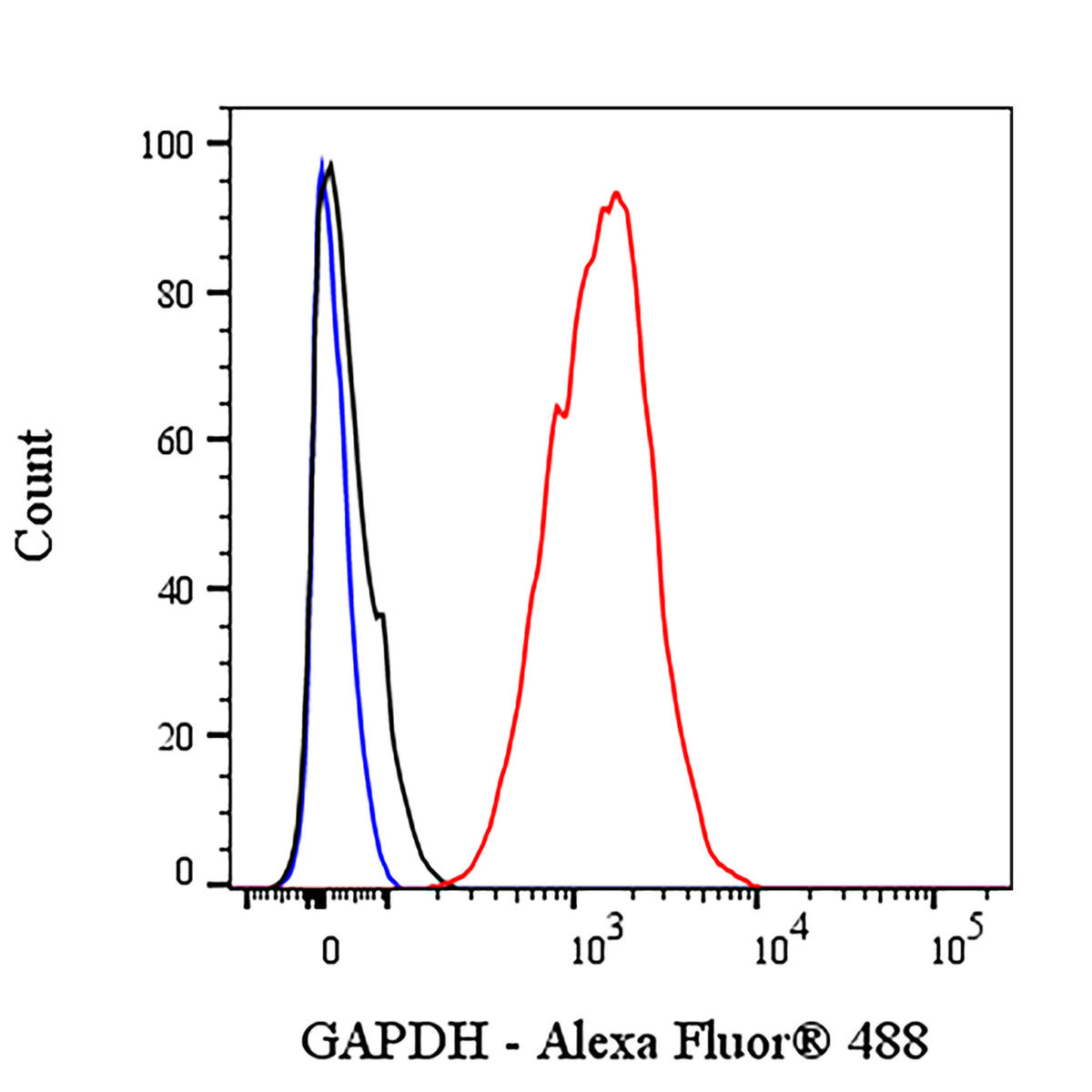
Flow cytometric analysis of 4% paraformaldehyde fixed 90% methanol permeabilized HeLa (Human cervix adenocarcinoma epithelial cell) labelling Alexa Fluor® 488 Mouse IgG2b Isotype Control (black line histogram) or SDT Alexa Fluor® 488 GAPDH Recombinant Mouse mAb (red line histogram) at 1:2000 dilution (0.1 μg), cells without incubation with primary antibody and secondary antibody (blue line histogram) was used as unlabeled control. Flow cytometry and data analysis were performed using BD FACSymphony™ A1 and FlowJo™ software.
GAPDH Recombinant Mouse mAb (Alexa Fluor® 488 Conjugate) (S-4721)
GAPDH Recombinant Mouse mAb (Alexa Fluor® 488 Conjugate) (S-4721)
Price:
Regular price
$100 USD
Regular price
Sale price
$100 USD
Unit price
per
For shipping services or bulk orders, you may request a quotation.
Secure checkout with

View full details
Product Details
Product Details
Product Specification
| Host | Mouse |
| Antigen | GAPDH |
| Synonyms | Glyceraldehyde-3-phosphate dehydrogenase; GAPD |
| Location | Cytoplasm, Cytoskeleton, Nucleus |
| Accession | P04406、P16858 |
| Clone Number | S-4721 |
| Antibody Type | Mouse mAb |
| Isotype | IgG2b |
| Application | ICC, ICFCM |
| Reactivity | Hu, Ms, Rb, Rt, Zf, Mk, Bv, Dg, Gt, Ck |
| Positive Sample | HeLa, NIH/3T3, C6 |
| Purification | Protein A |
| Concentration | 2 mg/ml |
| Conjugation | Alexa Fluor® 488 |
| Physical Appearance | Liquid |
| Storage Buffer | PBS, 1% BSA, 0.09% sodium azide |
| Stability & Storage | 12 months from date of receipt / reconstitution, 2 to 8 °C as supplied |
Dilution
| application | dilution | species |
| ICC | 1:500 | Hu, Ms, Rt |
| ICFCM | 1:2000 | Hu |
Background
Glyceraldehyde-3-phosphate dehydrogenase (GAPDH) is a ubiquitous and highly conserved multifunctional protein that plays a central role in cellular metabolism, primarily catalyzing the sixth step of glycolysis where it converts glyceraldehyde-3-phosphate into 1,3-bisphosphoglycerate while simultaneously reducing NAD+ to NADH. Beyond its canonical function in energy production, GAPDH exhibits remarkable "moonlighting" activities depending on its subcellular localization, participating in diverse processes such as DNA repair, transcriptional regulation, vesicular transport, and the initiation of apoptosis under stress conditions like oxidative damage or nitrosative stress. Due to its constitutive and relatively stable expression across various tissues and experimental conditions, GAPDH has historically been widely used as a loading control in techniques like Western blotting and RT-PCR, although recent studies caution against this practice without validation since its levels can fluctuate significantly in response to specific metabolic states or pathological conditions. Structurally, it typically functions as a homotetramer, and its involvement in several neurodegenerative diseases, including Huntington's and Alzheimer's, highlights its critical importance in maintaining cellular homeostasis and its potential as a therapeutic target.
Picture
Picture
FC
Immunocytochemistry
ICC shows positive staining in HeLa cells. Anti- GAPDH Recombinant Mouse mAb (Alexa Fluor® 488 Conjugate) antibody was used at 1/500 dilution (Green) and incubated overnight at 4°C. The cells were fixed with 100% ice-cold methanol and permeabilized with 0.1% PBS-Triton X-100. Nuclei were counterstained with DAPI (Blue).
ICC shows positive staining in NIH/3T3 cells. Anti- GAPDH Recombinant Mouse mAb (Alexa Fluor® 488 Conjugate) antibody was used at 1/500 dilution (Green) and incubated overnight at 4°C. The cells were fixed with 100% ice-cold methanol and permeabilized with 0.1% PBS-Triton X-100. Nuclei were counterstained with DAPI (Blue).
ICC shows positive staining in C6 cells. Anti- GAPDH Recombinant Mouse mAb (Alexa Fluor® 488 Conjugate) antibody was used at 1/500 dilution (Green) and incubated overnight at 4°C. The cells were fixed with 100% ice-cold methanol and permeabilized with 0.1% PBS-Triton X-100. Nuclei were counterstained with DAPI (Blue).