WB result of Galectin-9 Recombinant Rabbit mAb
Primary antibody: Galectin-9 Recombinant Rabbit mAb at 1/1000 dilution
Lane 1: PANC-1 whole cell lysate 20 µg
Lane 2: Saos-2 whole cell lysate 20 µg
Lane 3: U-937 whole cell lysate 20 µg
Lane 4: HL-60 whole cell lysate 20 µg
Lane 5: THP-1 whole cell lysate 20 µg
Negative control: PANC-1 whole cell lysate; Saos-2 whole cell lysate
Secondary antibody: Goat Anti-Rabbit IgG (H+L), HRP conjugated at 1/10000 dilution
Predicted MW: 36 kDa
Observed MW: 9-40 kDa
This blot was developed with high sensitivity substrate
Galectin-9 Recombinant Rabbit mAb (S-4579-67)
Galectin-9 Recombinant Rabbit mAb (S-4579-67)
Price:
Regular price
$100 USD
Regular price
Sale price
$100 USD
Unit price
per
For shipping services or bulk orders, you may request a quotation.
Secure checkout with

View full details
Product Details
Product Details
Product Specification
| Host | Rabbit |
| Antigen | Galectin-9 |
| Immunogen | Recombinant Protein |
| Location | Cytoplasm, Nucleus, Secreted |
| Accession | O00182 |
| Clone Number | S-4579-67 |
| Antibody Type | Recombinant mAb |
| Isotype | IgG |
| Application | WB, IHC-P |
| Reactivity | Hu |
| Positive Sample | U-937, HL-60, THP-1 |
| Purification | Protein A |
| Concentration | 0.5 mg/ml |
| Conjugation | Unconjugated |
| Physical Appearance | Liquid |
| Storage Buffer | PBS, 40% Glycerol, 0.05% BSA, 0.02% sodium azide |
| Stability & Storage | 12 months from date of receipt / reconstitution, -20 °C as supplied |
Dilution
| application | dilution | species |
| WB | 1:1000 | Hu |
| IHC-P | 1:500-1:2000 | Hu |
Background
Galectin-9 (Gal-9) is a tandem-repeat type member of the β-galactoside-binding lectin family, encoded by the LGALS9 gene on human chromosome 17q11.2, and characterized by two distinct carbohydrate recognition domains (N-CRD and C-CRD) connected by a linker peptide, with alternative splicing generating long, medium, and short isoforms. As a pleiotropic immunomodulatory lectin, Gal-9 binds to a range of cell surface glycoprotein receptors—most notably T-cell immunoglobulin and mucin domain-containing protein 3 (Tim-3), as well as CD44, 4-1BB/CD137, and Dectin-1—to regulate diverse immune cell activities. Its best-characterized function is the induction of apoptosis and functional exhaustion in Tim-3-expressing Th1 and CD8+ effector T cells, thereby serving as a critical negative regulator of immune responses; the Gal-9/Tim-3 axis has been implicated in immune evasion across multiple malignancies and is recognized as a key mechanism of resistance to anti-PD-1/PD-L1 immunotherapy. Beyond its immunosuppressive roles, Gal-9 also functions as an eosinophil chemoattractant, modulates Treg/Th17 balance, and plays context-dependent roles in autoimmune diseases, transplant tolerance, and tissue inflammation. Given its central position at the crossroads of immune checkpoint regulation, Gal-9 has emerged as a promising therapeutic target, with anti-Gal-9 antibodies (such as LYT-200) currently under clinical investigation for metastatic solid tumors.
Picture
Picture
Western Blot
Immunohistochemistry
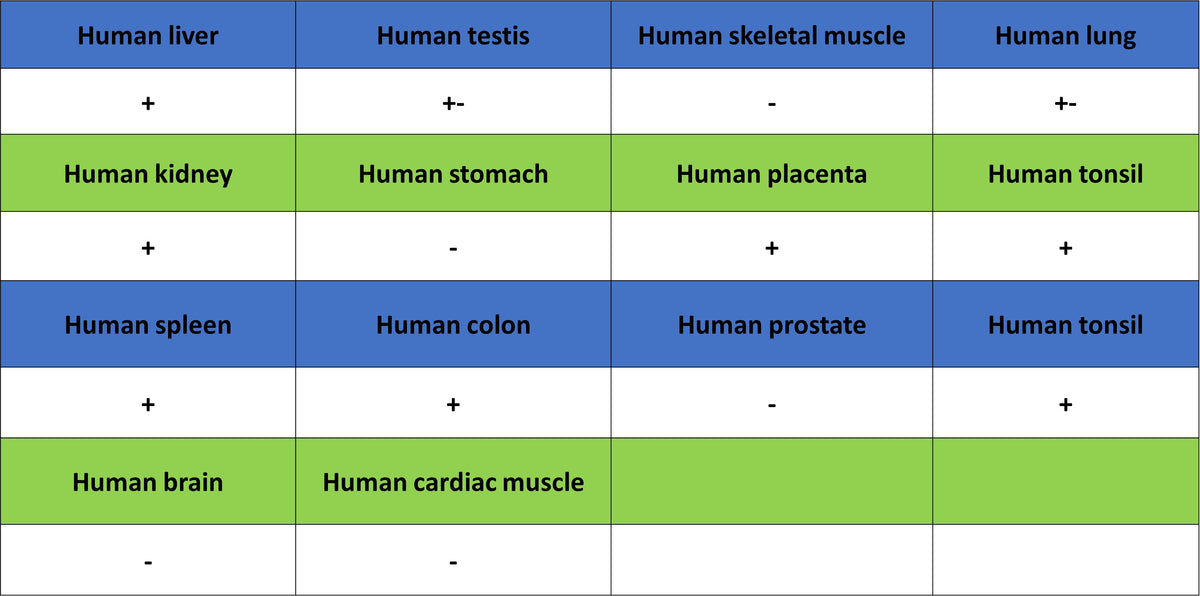
IHC shows positive staining in paraffin-embedded human colon. Anti-Galectin-9 antibody was used at 1/2000 dilution, followed by a HRP Polymer for Rabbit IgG (ready to use). Counterstained with hematoxylin. Heat mediated antigen retrieval with Tris/EDTA buffer pH9.0 was performed before commencing with IHC staining protocol.
IHC shows positive staining in paraffin-embedded human liver. Anti-Galectin-9 antibody was used at 1/2000 dilution, followed by a HRP Polymer for Rabbit IgG (ready to use). Counterstained with hematoxylin. Heat mediated antigen retrieval with Tris/EDTA buffer pH9.0 was performed before commencing with IHC staining protocol.
Negative control: IHC shows negative staining in paraffin-embedded human brain. Anti-Galectin-9 antibody was used at 1/2000 dilution, followed by a HRP Polymer for Rabbit IgG (ready to use). Counterstained with hematoxylin. Heat mediated antigen retrieval with Tris/EDTA buffer pH9.0 was performed before commencing with IHC staining protocol.
IHC shows positive staining in paraffin-embedded human colon cancer. Anti-Galectin-9 antibody was used at 1/500 dilution, followed by a HRP Polymer for Rabbit IgG (ready to use). Counterstained with hematoxylin. Heat mediated antigen retrieval with Tris/EDTA buffer pH9.0 was performed before commencing with IHC staining protocol.
IHC shows positive staining in paraffin-embedded human endometrial cancer. Anti-Galectin-9 antibody was used at 1/2000 dilution, followed by a HRP Polymer for Rabbit IgG (ready to use). Counterstained with hematoxylin. Heat mediated antigen retrieval with Tris/EDTA buffer pH9.0 was performed before commencing with IHC staining protocol.
IHC shows positive staining in paraffin-embedded human endometrial cancer. Anti-Galectin-9 antibody was used at 1/500 dilution, followed by a HRP Polymer for Rabbit IgG (ready to use). Counterstained with hematoxylin. Heat mediated antigen retrieval with Tris/EDTA buffer pH9.0 was performed before commencing with IHC staining protocol.
IHC shows positive staining in paraffin-embedded human lung cancer. Anti-Galectin-9 antibody was used at 1/500 dilution, followed by a HRP Polymer for Rabbit IgG (ready to use). Counterstained with hematoxylin. Heat mediated antigen retrieval with Tris/EDTA buffer pH9.0 was performed before commencing with IHC staining protocol.
IHC shows positive staining in paraffin-embedded human ovarian cancer. Anti-Galectin-9 antibody was used at 1/500 dilution, followed by a HRP Polymer for Rabbit IgG (ready to use). Counterstained with hematoxylin. Heat mediated antigen retrieval with Tris/EDTA buffer pH9.0 was performed before commencing with IHC staining protocol.