Standard curve
Example of G4S-CD3 bsAb t standard curve in Assay Diluent A1.
G4S OneStep Capture DIY ELISA Kit
G4S OneStep Capture DIY ELISA Kit
Price:
Regular price
$800 USD
Regular price
Sale price
$800 USD
Unit price
per
For shipping services or bulk orders, you may request a quotation.
Secure checkout with

View full details
Product Details
Product Details
Product Specification
| Antigen | G4S-CD3 bsAb |
| Immunogen | Recombinant Protein |
| Antibody Type | Recombinant mAb |
| Reactivity | Hu |
| Purification | Protein A |
| Stability & Storage | 12 months from date of receipt / reconstitution, 2 to 8'C as supplied. |
Kit
| Sample type | Cell culture supernatant,Serum |
| Assay type | Sandwich (quantitative) |
| Range | 0.94 ng/mL – 60 ng/mL |
| Recovery | Cell culture supernatant: 92% Serum:83% |
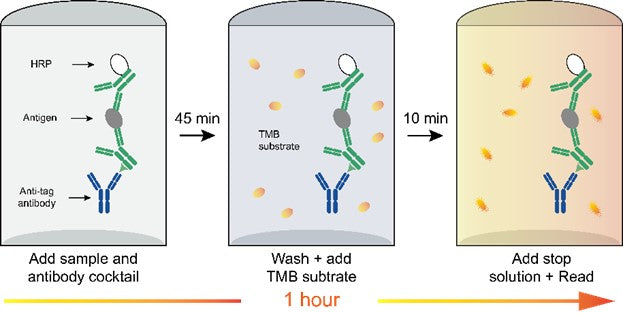
| Assay time | 60 minutes |
| Species reactivity | Hu |
Background
The G4S linker and CD3 complex represent fundamental elements in modern immunotherapy engineering. The G4S linker, a flexible (Gly-Gly-Gly-Gly-Ser)ₙ peptide spacer, serves as a crucial molecular tether that connects protein domains like the variable heavy and light chains in single-chain variable fragments (scFvs), ensuring proper folding and antigen-binding function. This structural role enables the precise targeting of tumor-associated antigens such as GPC3. Simultaneously, the CD3 epsilon (CD3ε) chain of the T-cell receptor complex acts as the primary activation switch for T lymphocytes. In bispecific T-cell engagers (TCEs), an anti-GPC3 scFv—optimized by the G4S linker—and an anti-CD3ε scFv work synergistically to bridge cancer cells with T cells, redirecting T-cell cytotoxicity to induce targeted tumor lysis. Thus, while the G4S linker provides the essential structural framework for antigen recognition, CD3 engagement delivers the critical activation signal, together enabling targeted immune responses against cancer.
Picture
Picture
ELISA
Protocol Diagram