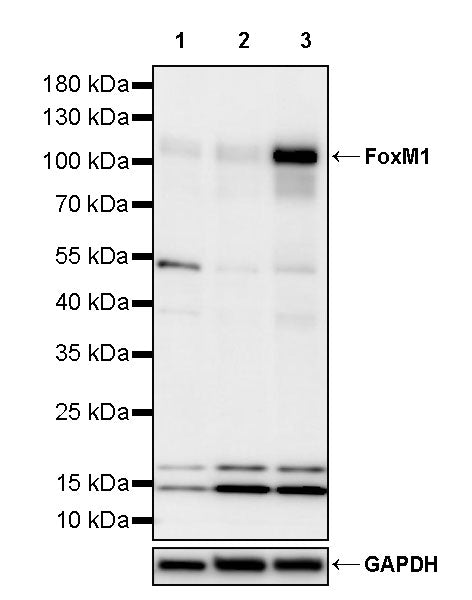
WB result of FoxM1 Recombinant Rabbit mAb
Primary antibody: FoxM1 Recombinant Rabbit mAb at 1/1000 dilution
Lane 1: HeLa whole cell lysate 20 µg
Lane 2: untreated HeLa whole cell lysate 20 µg
Lane 3: HeLa treated with 2 µM aphidicolin for 24 hours whole cell lysate 20 µg Secondary antibody: Goat Anti- rabbit IgG, (H+L), HRP conjugated at 1/10000 dilution
Predicted MW: 84 kDa
Observed MW: 110 kDa
FoxM1 Recombinant Rabbit mAb (S-3223-138)
FoxM1 Recombinant Rabbit mAb (S-3223-138)
Price:
Regular price
$100 USD
Regular price
Sale price
$100 USD
Unit price
per
For shipping services or bulk orders, you may request a quotation.
Secure checkout with

View full details
Product Details
Product Details
Product Specification
| Host | Rabbit |
| Antigen | FOXM1 |
| Synonyms | Forkhead box protein M1; Forkhead-related protein FKHL16; Hepatocyte nuclear factor 3 forkhead homolog 11 (HFH-11; HNF-3/fork-head homolog 11); M-phase phosphoprotein 2; MPM-2 reactive phosphoprotein 2; Transcription factor Trident; Winged-helix factor from INS-1 cells; FKHL16; HFH11; MPP2; WIN |
| Immunogen | Recombinant Protein |
| Location | Nucleus |
| Accession | Q08050 |
| Clone Number | S-3223-138 |
| Antibody Type | Recombinant mAb |
| Isotype | IgG |
| Application | WB |
| Reactivity | Hu |
| Positive Sample | HeLa treated with 2 µM aphidicolin for 24 hours |
| Purification | Protein A |
| Concentration | 0.5 mg/ml |
| Conjugation | Unconjugated |
| Physical Appearance | Liquid |
| Storage Buffer | PBS, 40% Glycerol, 0.05% BSA, 0.02% sodium azide |
| Stability & Storage | 12 months from date of receipt / reconstitution, -20 °C as supplied |
Dilution
| application | dilution | species |
| WB | 1:1000 | Hu |
Background
FOXM1 is a transcription factor of the Forkhead box family that orchestrates cell-cycle progression by directly activating genes required for G1/S and G2/M transitions, DNA replication, and mitosis; its expression is normally low in quiescent cells but rises sharply from late G1 through M phase, and it is frequently over-expressed in human cancers where it promotes proliferation, angiogenesis, metastasis, and chemo-radiotherapy resistance through pathways including PI3K/AKT, Wnt/β-catenin, and p53; post-translational modifications such as phosphorylation by CDK, PLK1 and AKT, together with ubiquitin-mediated degradation, tightly regulate FOXM1 activity, making it both a key biomarker for poor prognosis and an attractive therapeutic target in oncology.
Picture
Picture
Western Blot