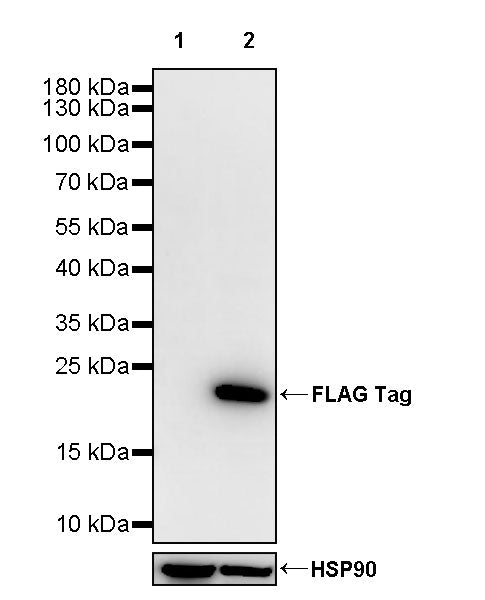
WB result of FLAG Tag Recombinant Mouse mAb
Primary antibody: FLAG Tag Recombinant Mouse mAb at 1/20000 dilution
Lane 1: 293F transfected with empty vector whole cell lysate 20 µg
Lane 2: 293F transfected with N-FLAG fusion protein whole cell lysate 20 µg
Secondary antibody: Goat Anti- mouse IgG, (H+L), HRP conjugated at 1/10000 dilution
Predicted MW: 15 kDa
Observed MW: 22 kDa
FLAG Tag Recombinant Mouse mAb (S-5005)
FLAG Tag Recombinant Mouse mAb (S-5005)
Price:
Regular price
$100 USD
Regular price
Sale price
$100 USD
Unit price
per
For shipping services or bulk orders, you may request a quotation.
Secure checkout with

View full details
Product Details
Product Details
Product Specification
| Host | Mouse |
| Antigen | FLAG tag |
| Synonyms | DYKDDDDK tag |
| Clone Number | S-5005 |
| Antibody Type | Mouse mAb |
| Isotype | IgG2b |
| Application | WB |
| Reactivity | Species Independent |
| Purification | Protein A |
| Concentration | 0.5 mg/ml |
| Conjugation | Unconjugated |
| Physical Appearance | Liquid |
| Storage Buffer | PBS, 40% Glycerol, 0.05% BSA, 0.02% sodium azide |
| Stability & Storage | 12 months from date of receipt / reconstitution, -20 °C as supplied |
Dilution
| application | dilution | species |
| WB | 1:5000-1:50000 | Species independent |
Background
FLAG-tag, or FLAG octapeptide, or FLAG epitope, is a peptide protein tag that can be added to a protein using recombinant DNA technology, having the sequence DYKDDDDK (where D=aspartic acid, Y=tyrosine, and K=lysine). It is one of the most specific tags and it is an artificial antigen to which specific, high affinity monoclonal antibodies have been developed and hence can be used for protein purification by affinity chromatography and also can be used for locating proteins within living cells. FLAG-tag has been used to separate recombinant, overexpressed protein from wild-type protein expressed by the host organism. FLAG-tag can also be used in the isolation of protein complexes with multiple subunits.
Picture
Picture
Western Blot