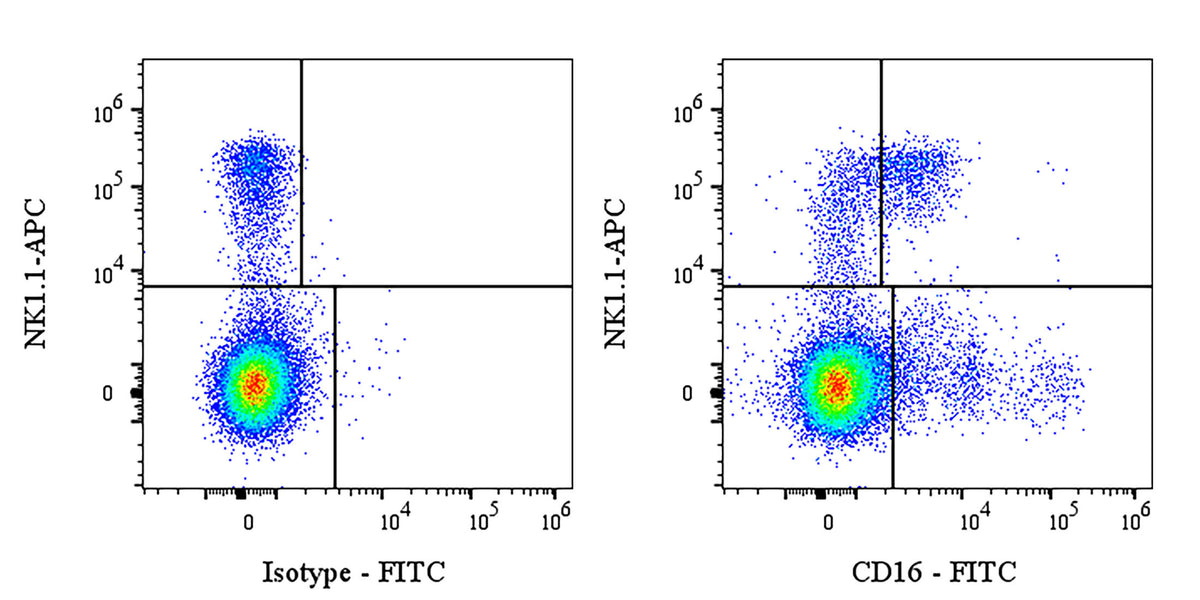
Flow cytometric analysis of Mouse CD16 expression on C57BL/6 mouse splenocytes. C57BL/6 mouse splenocytes were stained with APC Rat Anti-Mouse NK1.1 Antibody and either FITC Rat IgG2a, κ Isotype Control (left panel) or SDT FITC Rat Anti-Mouse CD16 Antibody (right panel) at 0.5 μl/test. Flow cytometry and data analysis were performed using Agilent NovoCyte Quanteon and FlowJo™ software.
FITC Rat Anti-Mouse CD16 Antibody (S-5324)
FITC Rat Anti-Mouse CD16 Antibody (S-5324)
Price:
Regular price
$50 USD
Regular price
Sale price
$50 USD
Unit price
per
For shipping services or bulk orders, you may request a quotation.
Secure checkout with

View full details
Product Details
Product Details
Product Specification
| Host | Rat |
| Antigen | CD16 |
| Synonyms | Low affinity immunoglobulin gamma Fc region receptor III; IgG Fc receptor III; Fc-gamma RIII (FcRIII); Fcgr3 |
| Location | Cell membrane |
| Accession | P08508 |
| Clone Number | S-5324 |
| Antibody Type | Rat mAb |
| Isotype | IgG2a,k |
| Application | FCM |
| Reactivity | Ms |
| Positive Sample | C57BL/6 mouse splenocytes |
| Purification | Protein G |
| Concentration | 0.5 mg/ml |
| Conjugation | FITC |
| Physical Appearance | Liquid |
| Storage Buffer | PBS, 1% BSA, 0.09% sodium azide |
| Stability & Storage | 12 months from date of receipt / reconstitution, 2 to 8 °C as supplied |
Dilution
| application | dilution | species |
| FCM | 0.25μg per million cells in 100μl volume | Ms |
Background
CD16, also known as FcγRIII (low-affinity IgG Fc receptor III), is a low-affinity receptor for immunoglobulin G expressed on the surface of natural killer (NK) cells, neutrophils, macrophages, and some T cells. It belongs to the immunoglobulin superfamily and is encoded by two distinct genes: FCGR3A (encoding the transmembrane CD16a) and FCGR3B (encoding the GPI-anchored CD16b), which differ significantly in their cellular distribution and signal transduction mechanisms. On NK cells, CD16a serves as a transmembrane receptor that couples with FcεRIγ or CD3ζ chain dimers via its intracellular immunoreceptor tyrosine-based activation motif (ITAM). Upon binding to IgG-opsonized target cells (such as tumor cells or virus-infected cells), it triggers antibody-dependent cell-mediated cytotoxicity (ADCC) in NK cells, releasing perforin and granzymes, thereby playing a central role in tumor immune surveillance and antiviral immunity. In contrast, CD16b expressed on neutrophils is a GPI-anchored form lacking transmembrane and intracellular domains, primarily mediating neutrophil phagocytosis, inflammatory mediator release, and immune complex clearance. Polymorphisms of the CD16 protein are closely associated with individual differences in IgG binding affinity, susceptibility to autoimmune diseases, and the efficacy of therapeutic monoclonal antibodies. For example, the FCGR3A V158F polymorphism influences the ADCC potency of NK cells against therapeutic antibodies such as rituximab, making CD16 an important biomarker for predicting immunotherapy response and guiding personalized medicine in oncology. Furthermore, CD16 serves as a key structural basis for antibody engineering (e.g., glycoengineering to enhance ADCC) and for CAR-NK cell therapy strategies.
Picture
Picture
FC