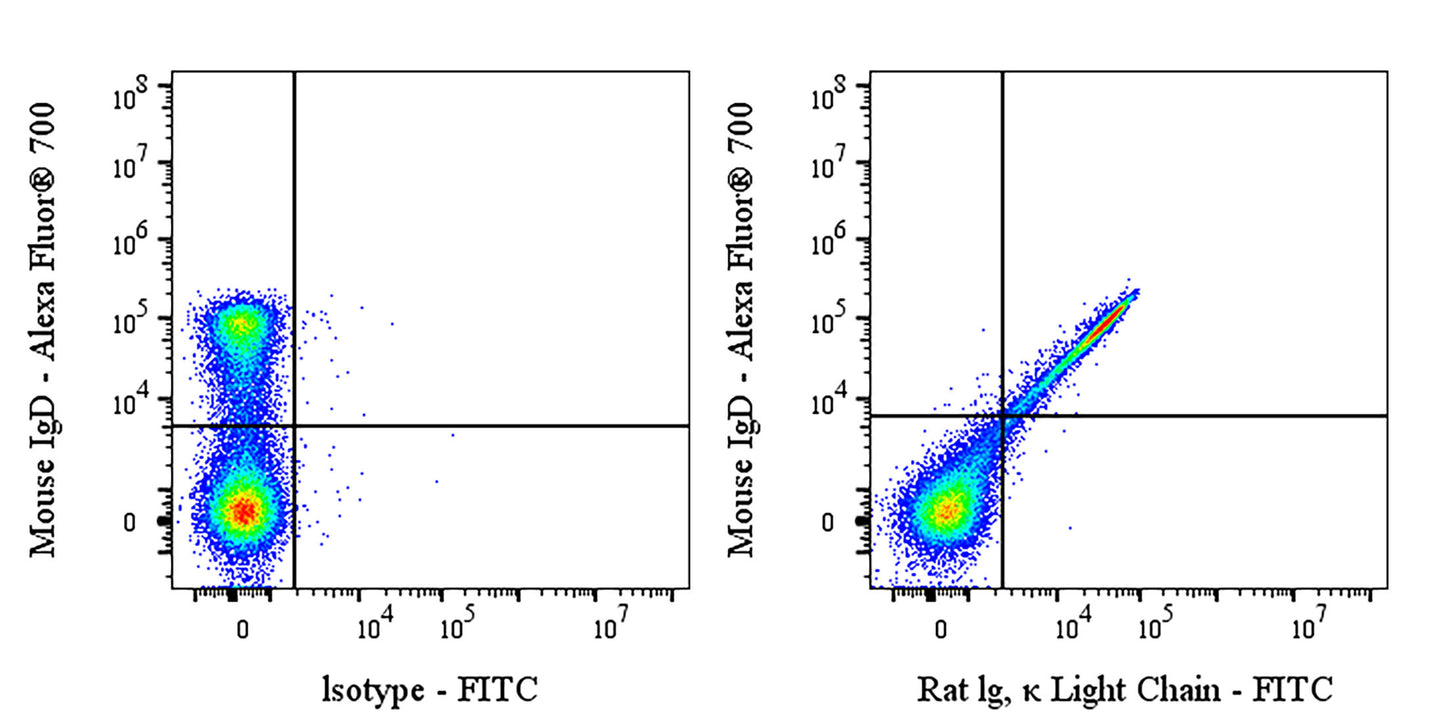
Flow cytometric analysis of rat Ig, κ light chain expression on C57BL/6 mouse splenocytes. C57BL/6 mouse splenocytes were stained with Alexa Fluor® 700 Rat Anti- Mouse IgD Antibody and either FITC Mouse IgG1 Isotype Control (left panel) or FITC Mouse Anti-Rat Ig, κ Light Chain Antibody (right panel) at 0.5 μl/test. Flow cytometry and data analysis were performed using Agilent NovoCyte Quanteon and FlowJo™ software.
FITC Mouse Anti-Rat Ig, κ Light Chain Antibody (S-4515)
FITC Mouse Anti-Rat Ig, κ Light Chain Antibody (S-4515)
Price:
Regular price
$60 USD
Regular price
Sale price
$60 USD
Unit price
per
For shipping services or bulk orders, you may request a quotation.
Secure checkout with

View full details
Product Details
Product Details
Product Specification
| Host | Mouse |
| Antigen | Rat Ig, κ Light Chain |
| Clone Number | S-4515 |
| Antibody Type | Mouse mAb |
| Isotype | IgG1 |
| Application | FCM |
| Reactivity | Rt |
| Positive Sample | C57BL/6 mouse splenocytes |
| Purification | Protein G |
| Concentration | 0.5 mg/ml |
| Conjugation | FITC |
| Physical Appearance | Liquid |
| Storage Buffer | PBS, 1% BSA, 0.3% Proclin 300 |
| Stability & Storage | 12 months from date of receipt / reconstitution, 2 to 8 °C as supplied |
Dilution
| application | dilution | species |
| FCM | 0.25μg per million cells in 100μl volume | Rt |
Background
Ig κ Light Chain is one of the two types of light chains (the other being the λ light chain) that constitute antibody (immunoglobulin) molecules. Composed of approximately 220 amino acids, it is linked to the heavy chain via disulfide bonds, together forming the basic structure of antibodies. In humans, the κ light chain is encoded by the IGK gene family located on chromosome 2, and its production involves the rearrangement of V (variable), J (joining), and C (constant) gene segments to generate high diversity for recognizing countless antigens. Under physiological conditions, the ratio of κ to λ light chains in serum is approximately 2:1, but this ratio may change under certain pathological conditions. For example, in multiple myeloma, abnormal plasma cells may overproduce free κ light chains (i.e., Bence Jones proteins), which can be excreted in the urine. Therefore, measuring κ light chains and their ratio to λ light chains in blood or urine holds important clinical value for diagnosing and monitoring B-cell-related disorders such as myeloma, amyloidosis, and lymphoproliferative diseases.
Picture
Picture
FC