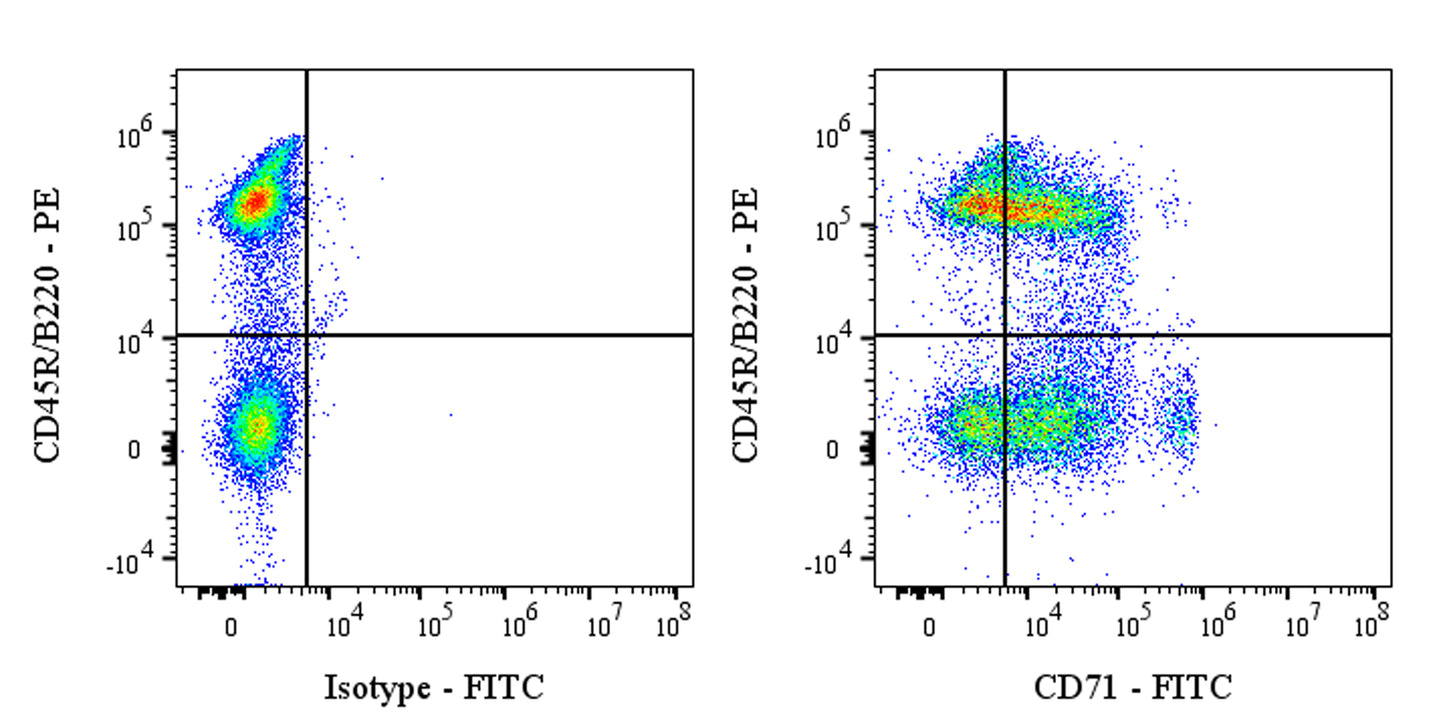
Flow cytometric analysis of rat CD71 expression on SD Rat bone marrow. SD Rat bone marrow were stained with PE Mouse Anti-Rat CD45R/B220 Antibody and either FITC Mouse IgG2a, k Isotype Control (left panel) or SDT FITC Mouse Anti-Rat CD71 Antibody (right panel) at 2 μl/test. Flow cytometry and data analysis were performed using Agilent NovoCyte Quanteon and FlowJo™ software.
FITC Mouse Anti-Rat CD71 Antibody (OX-26)
FITC Mouse Anti-Rat CD71 Antibody (OX-26)
Price:
Regular price
$85 USD
Regular price
Sale price
$85 USD
Unit price
per
For shipping services or bulk orders, you may request a quotation.
Secure checkout with

View full details
Product Details
Product Details
Product Specification
| Host | Mouse |
| Antigen | CD71 |
| Synonyms | Transferrin receptor protein 1; TR; TfR; TfR1; Trfr; Tfrc |
| Location | Cell membrane |
| Accession | Q99376 |
| Clone Number | OX-26 |
| Antibody Type | Mouse mAb |
| Isotype | IgG2a,k |
| Application | FCM |
| Reactivity | Rt |
| Positive Sample | SD Rat bone marrow |
| Purification | Protein A |
| Concentration | 0.5 mg/ml |
| Conjugation | FITC |
| Physical Appearance | Liquid |
| Storage Buffer | PBS, 1% BSA, 0.3% Proclin 300 |
| Stability & Storage | 12 months from date of receipt / reconstitution, 2 to 8 °C as supplied |
Dilution
| application | dilution | species |
| FCM | 1μg per million cells in 100μl volume | Rt |
Background
CD71, also known as the transferrin receptor 1 (TfR1), is a type II transmembrane glycoprotein that plays a pivotal role in cellular iron homeostasis by mediating the high-affinity uptake of iron-bound transferrin through receptor-mediated endocytosis. Structurally, it functions as a homodimer linked by disulfide bonds and is widely expressed on proliferating cells, particularly erythroid precursors, where its expression levels are tightly regulated to meet the substantial iron demands required for hemoglobin synthesis and DNA replication. Beyond its canonical function in iron transport, CD71 serves as a critical diagnostic marker in pathology, especially for identifying erythroid lineage cells and assessing proliferative activity in various malignancies, while emerging research also highlights its involvement in immune modulation, tumor progression, and as a potential therapeutic target for drug delivery systems due to its upregulation in many cancer types.
Picture
Picture
FC