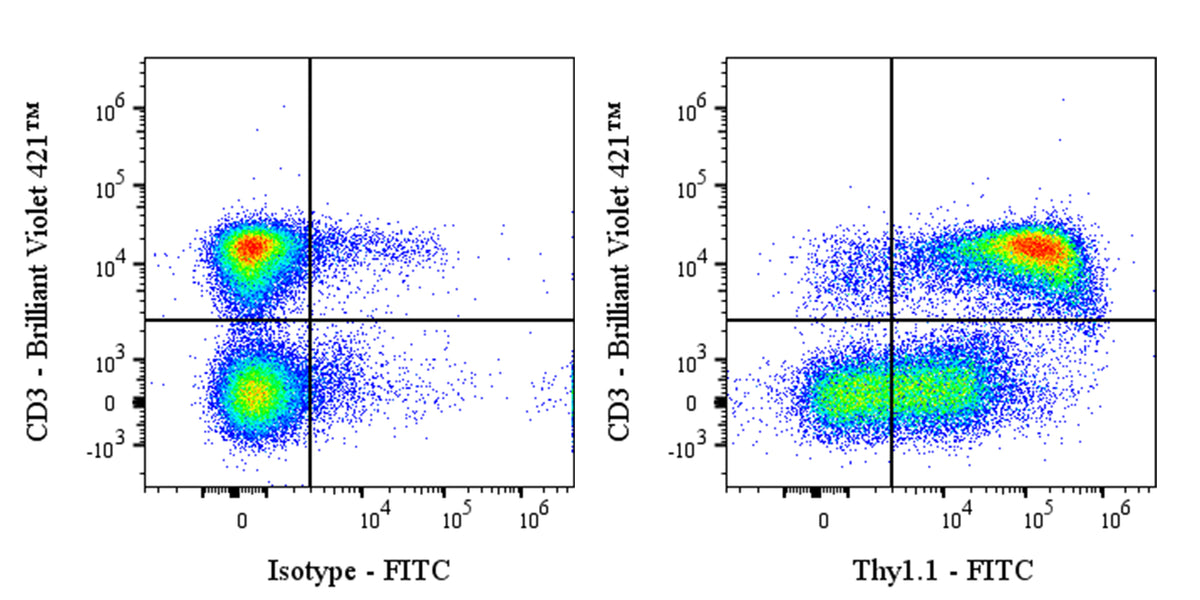
Flow cytometric analysis of Mouse Thy1.1 (CD90.1) expression on FVB mouse splenocytes. FVB mouse splenocytes were stained with Brilliant Violet 421™ Rat Anti-Mouse CD3 Antibody and either FITC Mouse IgG2a, κ Isotype Control (left panel) or SDT FITC Mouse Anti-Mouse Thy1.1 (CD90.1) Antibody (right panel) at 2 μl/test. Total viable cells, as determined by Fixable Viability Dye 662 (S0D0016), were used for analysis. Flow cytometry and data analysis were performed using Agilent NovoCyte Quanteon and FlowJo™ software.
FITC Mouse Anti-Mouse Thy1.1 (CD90.1) Antibody (S-3781)
FITC Mouse Anti-Mouse Thy1.1 (CD90.1) Antibody (S-3781)
Price:
Regular price
$25 USD
Regular price
Sale price
$25 USD
Unit price
per
For shipping services or bulk orders, you may request a quotation.
Secure checkout with

View full details
Product Details
Product Details
Product Specification
| Host | Mouse |
| Antigen | Thy1.1 (CD90.1) |
| Synonyms | Thy-1; Thy-1.1; CD90; CD90.1 |
| Location | Cell membrane |
| Accession | P01831 |
| Clone Number | S-3781 |
| Antibody Type | Mouse mAb |
| Isotype | IgG2a,k |
| Isotype Control | S0B5453 |
| Application | FCM |
| Reactivity | Ms |
| Positive Sample | FVB mouse splenocytes |
| Purification | Protein A |
| Concentration | 0.5 mg/ml |
| Conjugation | FITC |
| Physical Appearance | Liquid |
| Storage Buffer | PBS, 1% BSA, 0.09% sodium azide |
| Stability & Storage | 12 months from date of receipt / reconstitution, 2 to 8 °C as supplied |
Dilution
| application | dilution | species |
| FCM | 1μg per million cells in 100μl volume | Ms |
Background
Thy1.1 (also known as CD90.1) is a specific allelic variant of the Thy-1 antigen, belonging to the immunoglobulin superfamily. It is a glycoprotein attached to the cell surface via a glycosylphosphatidylinositol (GPI) anchor. It is primarily expressed on the surface of mouse thymocytes, neurons, fibroblasts, hematopoietic stem cells, and other cell types, serving as an important phenotypic marker for these cells. Thy1.1 differs from another common variant, Thy1.2 (CD90.2), by only a single amino acid (arginine at position 89 in Thy1.1). This minor difference makes them crucial tools for distinction in genetics and immunology research, especially widely used in mouse models (e.g., the C57BL/6 strain typically expresses Thy1.2, while strains like AKR and BALB/c express Thy1.1) for cell tracking, transplantation experiments, and studies of immune cell function. Its functions involve cell adhesion, signal transduction, and immune regulation, playing significant roles in neural development, T cell activation, and stem cell biology.
Picture
Picture
FC