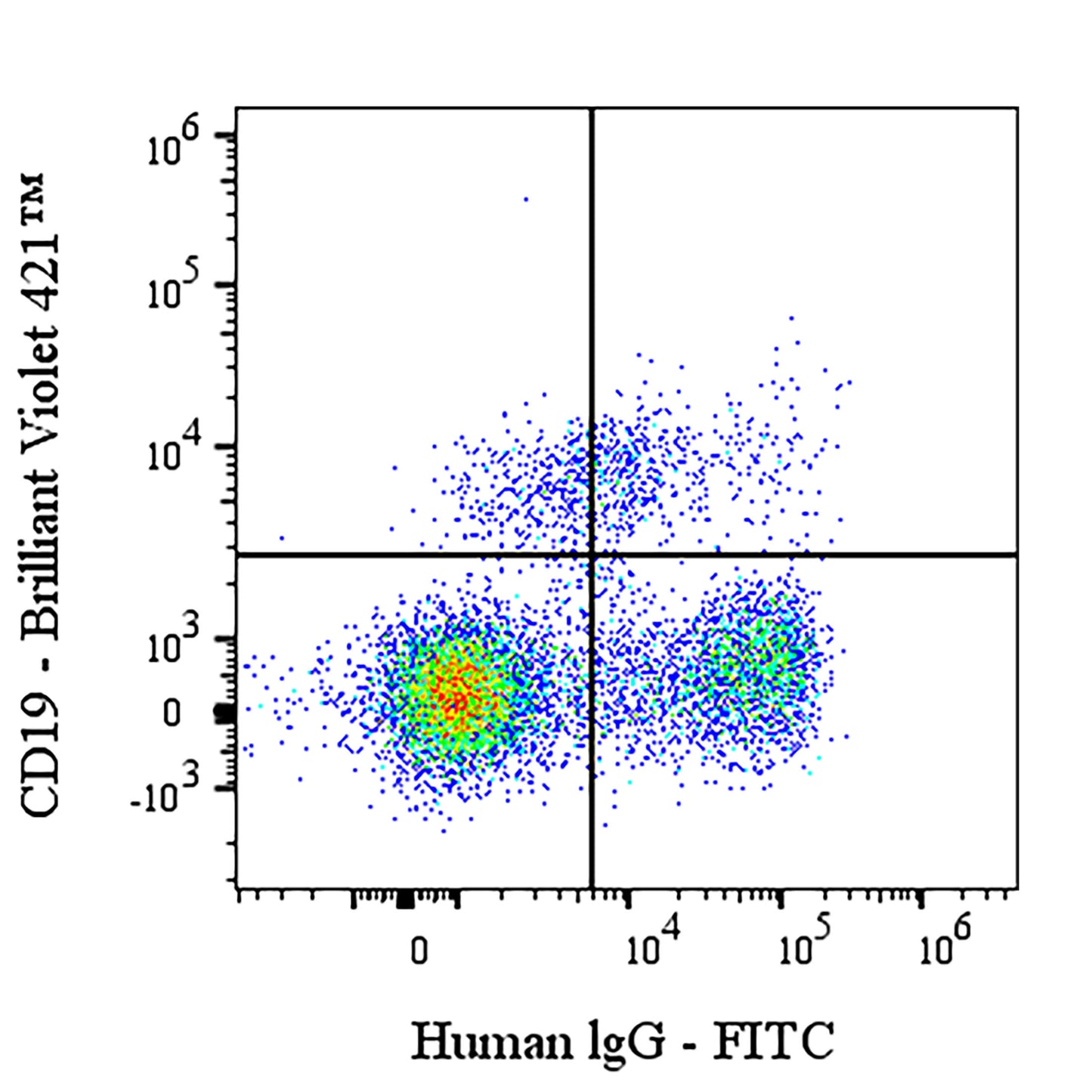
Flow cytometric analysis of Human IgG expression on human peripheral blood leukocytes. Human peripheral blood leukocytes were stained with Brilliant Violet 421™ Mouse Anti-Human CD19 Antibody and FITC Mouse Anti-Human IgG Antibody at 5 μl/test. Flow cytometry and data analysis were performed using Agilent NovoCyte Quanteon and FlowJo™ software.
FITC Mouse Anti-Human IgG Antibody (S-4825)
FITC Mouse Anti-Human IgG Antibody (S-4825)
Price:
Regular price
$70 USD
Regular price
Sale price
$70 USD
Unit price
per
For shipping services or bulk orders, you may request a quotation.
Secure checkout with

View full details
Product Details
Product Details
Product Specification
| Host | Mouse |
| Antigen | Human IgG |
| Clone Number | S-4825 |
| Antibody Type | Mouse mAb |
| Isotype | IgG1,k |
| Isotype Control | S0B1529 |
| Application | FCM |
| Reactivity | Hu |
| Positive Sample | Human peripheral blood leukocytes |
| Purification | Protein G |
| Concentration | 0.2 mg/ml |
| Conjugation | FITC |
| Physical Appearance | Liquid |
| Storage Buffer | PBS, 1% BSA, 0.09% sodium azide |
| Stability & Storage | 12 months from date of receipt / reconstitution, 2 to 8 °C as supplied |
Dilution
| application | dilution | species |
| FCM | 5μl per million cells in 100μl volume | Hu |
Background
Human immunoglobulin G (IgG) is the most abundant and important antibody type in serum, accounting for approximately 75-80% of all immunoglobulins. It is widely distributed in blood, lymph, and tissues, serving as a core effector molecule of the adaptive immune response. IgG is composed of four polypeptide chains—two identical heavy chains (γ chains) and two identical light chains (κ or λ chains)—connected by disulfide bonds to form a characteristic Y-shaped structure. It can be further divided into four subclasses: IgG1, IgG2, IgG3, and IgG4, each differing in hinge region flexibility, number of disulfide bonds, and effector functions. The primary functions of IgG include: recognizing and binding with high affinity to antigens from bacteria, viruses, or toxins via the variable region (Fab fragment) to form immune complexes; binding to Fc receptors on the surface of phagocytes and natural killer cells via the constant region (Fc fragment) to mediate opsonization and antibody-dependent cell-mediated cytotoxicity (ADCC). In addition, IgG is the only antibody subclass that can cross the placental barrier, providing passive immune protection to the fetus, and is involved in activating the classical complement pathway (particularly IgG1 and IgG3). In clinical and research settings, detection of specific IgG antibodies is commonly used to diagnose past infections or evaluate immune responses following vaccination, while recombinant human IgG monoclonal antibodies have been widely developed for the treatment of autoimmune diseases, malignancies, and infectious diseases.
Picture
Picture
FC