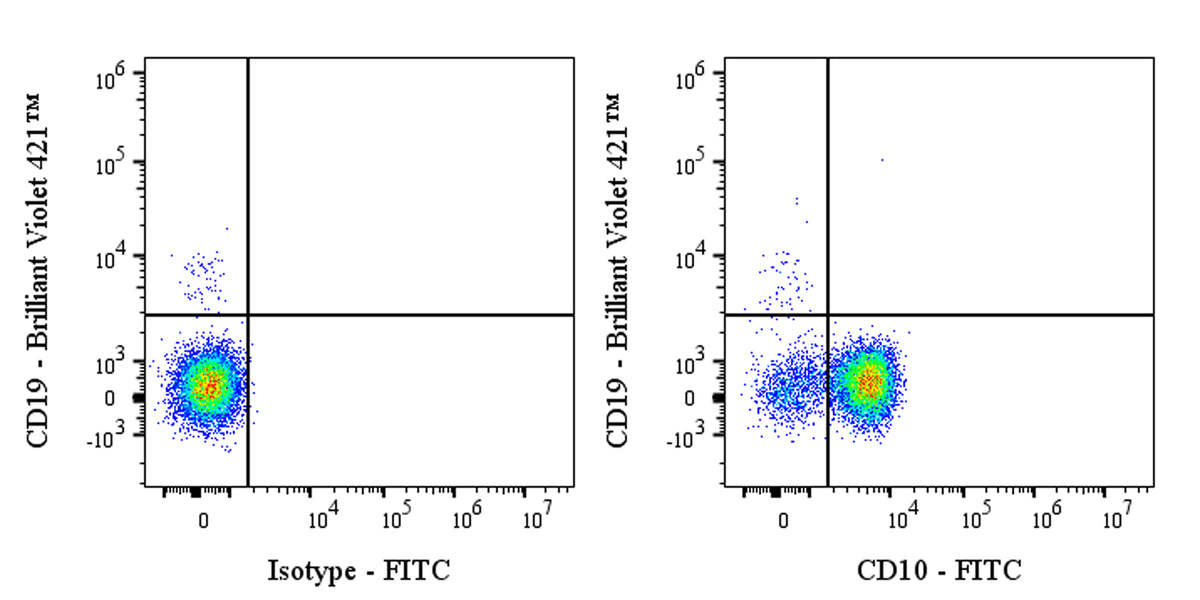
Flow cytometric analysis of Human CD10 expression on Human Peripheral Blood cells. Human Peripheral Blood cells were stained with Brilliant Violet 421™ Mouse Anti-Human CD19 antibody and either FITC Mouse IgG1, κ Isotype Control (left panel) or SDT FITC Mouse Anti-Human CD10 antibody (right panel) at 5μl/test. Flow cytometry and data analysis were performed using Agilent NovoCyte Quanteon and FlowJo™ software.
FITC Mouse Anti-Human CD10 Antibody (S-713-5)
FITC Mouse Anti-Human CD10 Antibody (S-713-5)
Price:
Regular price
$135 USD
Regular price
Sale price
$135 USD
Unit price
per
For shipping services or bulk orders, you may request a quotation.
Secure checkout with

View full details
Product Details
Product Details
Product Specification
| Host | Mouse |
| Antigen | CD10 |
| Synonyms | Neprilysin; Atriopeptidase; Common acute lymphocytic leukemia antigen (CALLA); Enkephalinase; Neutral endopeptidase 24.11 (NEP; Neutral endopeptidase); Skin fibroblast elastase (SFE); EPN; MME |
| Immunogen | Recombinant Protein |
| Location | Cell membrane |
| Accession | P08473 |
| Clone Number | S-713-5 |
| Antibody Type | Mouse mAb |
| Isotype | IgG1,k |
| Application | FCM |
| Reactivity | Hu |
| Positive Sample | Human Peripheral Blood cells |
| Purification | Protein G |
| Concentration | 0.2 mg/ml |
| Conjugation | FITC |
| Physical Appearance | Liquid |
| Storage Buffer | PBS, 1% BSA, 0.3% Proclin 300 |
| Stability & Storage | 12 months from date of receipt / reconstitution, 2 to 8 °C as supplied |
Dilution
| application | dilution | species |
| FCM | 5μl per million cells in 100μl volume | Hu |
Background
CD10, also known as neutral endopeptidase, neprilysin, or common acute lymphoblastic leukemia antigen (CALLA), is a zinc-dependent metalloprotease found on the cell surface. It is a single-pass type II transmembrane glycoprotein with a molecular weight of around 100 kDa, belonging to the peptidase M13 family. CD10 plays a crucial role in various physiological and pathological processes, including cardiovascular regulation, immune function, fetal development, pain response, oncogenesis, and aging. It acts by cleaving and inactivating a wide range of biologically active neuropeptides, such as substance P, bradykinin, and oxytocin, thereby modulating neurotransmitter levels, blood pressure, and inflammatory responses. CD10 is also recognized as a biomarker for hematopoietic and tissue stem cells and has prognostic significance in the progression of leukemia and various solid tumors. In addition, it has been found to have therapeutic potential in diseases like Alzheimer’s disease, heart failure, obesity, and type-2 diabetes.
Picture
Picture
FC