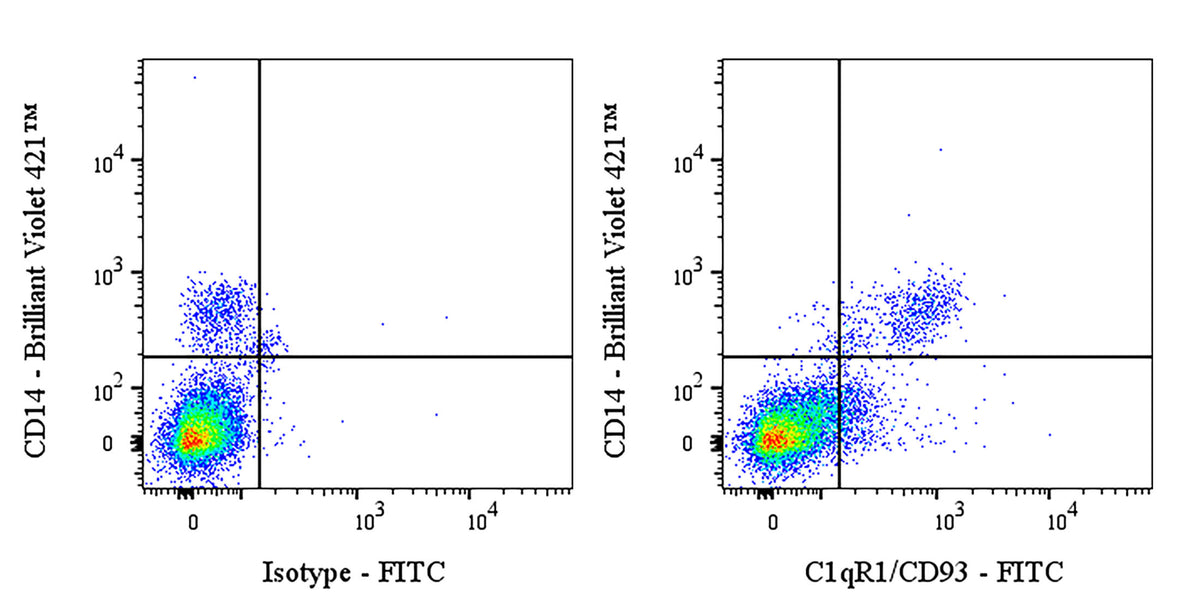
Flow cytometric analysis of Human C1qR1/CD93 expression on human peripheral blood Leukocytes. Human peripheral blood Leukocytes were stained with Brilliant Violet 421™ Mouse Anti-Human CD14 Antibody and either FITC Mouse IgG1, κ Isotype Control (left panel) or FITC Mouse Anti-Human C1qR1/CD93 Antibody (right panel) at 5 μl/test. Flow cytometry and data analysis were performed using BD FACSymphony™ A1 and FlowJo™ software.
FITC Mouse Anti-Human C1qR1/CD93 Antibody (VIMD)
FITC Mouse Anti-Human C1qR1/CD93 Antibody (VIMD)
Price:
Regular price
$230 USD
Regular price
Sale price
$230 USD
Unit price
per
For shipping services or bulk orders, you may request a quotation.
Secure checkout with

View full details
Product Details
Product Details
Product Specification
| Host | Mouse |
| Antigen | C1qR1/CD93 |
| Synonyms | Complement component C1q receptor; C1q/MBL/SPA receptor (C1qR; C1qR(p); C1qRp); CDw93; Complement component 1 q subcomponent receptor 1; Matrix-remodeling-associated protein 4; C1QR1; MXRA4 |
| Location | Cell membrane |
| Accession | Q9NPY3 |
| Clone Number | VIMD |
| Antibody Type | Mouse mAb |
| Isotype | IgG1,k |
| Isotype Control | S0B1529 |
| Application | FCM |
| Reactivity | Hu |
| Positive Sample | Human peripheral blood leukocytes |
| Purification | Protein G |
| Concentration | 0.2 mg/ml |
| Conjugation | FITC |
| Physical Appearance | Liquid |
| Storage Buffer | PBS, 1% BSA, 0.09% sodium azide |
| Stability & Storage | 12 months from date of receipt / reconstitution, 2 to 8 °C as supplied |
Dilution
| application | dilution | species |
| FCM | 5μl per million cells in 100μl volume | Hu |
Background
C1qR1, also known as CD93, is a type I transmembrane glycoprotein initially identified as a receptor for complement C1q; however, its function as a genuine C1q receptor remains controversial, as its binding to C1q is considered to occur only under non-physiological conditions. Structurally, the protein contains an N-terminal C-type lectin domain and five epidermal growth factor (EGF)-like domains, and is expressed on various cell types, including monocytes, neutrophils, and endothelial cells. Nevertheless, current studies have demonstrated that C1qR1/CD93 participates in multiple physiological processes, including cell-cell adhesion, regulation of phagocytosis of opsonized particles by myeloid cells, and clearance of apoptotic cells, as well as playing an important role in plasma cell differentiation and the maintenance of long-lived plasma cells in the bone marrow.
Picture
Picture
FC