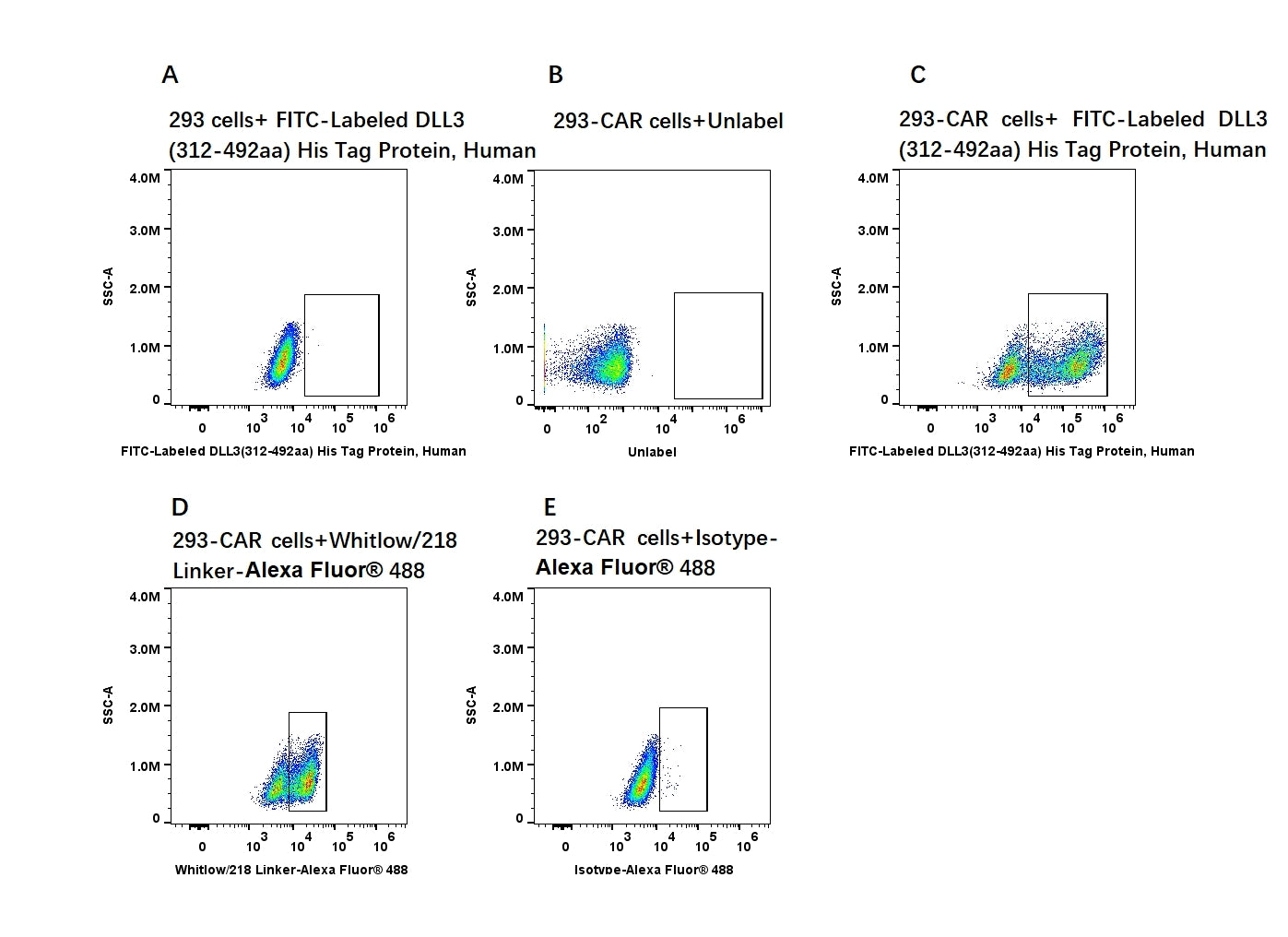
2e5 of transient transfected anti- DLL3 ScFv CAR-293 cells were stained with 0.5ug FITC-Labeled DLL3(312-492) His Tag Protein, Human, (Cat. No. UA016080) and unlable respectively (Fig. C and B), and non-transfected 293 cells were used as a control (Fig. A). FITC signal was used to evaluate the binding activity.
2e5 of transient transfected anti- DLL3 ScFv CAR-293 cells were stained with isotype and Whitlow/218 Linker-Alexa Fluor® 488 (Fig. D and E). Alexa Fluor® 488 signal was used to evaluate the binding activity.
FITC-Labeled DLL3(312-492) His Tag Protein, Human
FITC-Labeled DLL3(312-492) His Tag Protein, Human
Price:
Regular price
$390 USD
Regular price
Sale price
$390 USD
Unit price
per
For shipping services or bulk orders, you may request a quotation.
Secure checkout with

View full details
Product Details
Product Details
Product Specification
| Species | Human |
| Synonyms | DLL3,Delta3,delta-like 3 (Drosophila),delta-like protein 3,Pudgy,SCDO1,SCDO1delta3 |
| Accession | Q9NYJ7 |
| Amino Acid Sequence | Ser312-Arg490 with His Tag at C-Terminus |
| Expression System | HEK293 |
| Molecular Weight | 20-24kDa |
| Conjugation | FITC |
| Tag | His Tag |
| Physical Appearance | Liquid |
| Storage Buffer | PBS pH7.4 |
| Stability & Storage | · 12 months from date of receipt stored at -20 to -80℃. |
| Reference | 1、Ladi E. et al. (2005) The divergent DSL ligand DLL3 does not activate Notch signaling but cell autonomously attenuates signaling induced by other DSL ligands. J Cell Biol. 170: 983-992. |
Background
Delta-like protein 3 (DLL3) is a transmembrane protein that belongs to the Delta/Serrate/Lag-2 (DSL) family of Notch ligands. Mature human DLL3 consists of a 466 amino acid (aa) extracellular domain (ECD) with one DSL domain and six EGF-like repeats, a 21 aa transmembrane segment, and a 105 aa cytoplasmic domain. Within the ECD, human DLL3 shares 86% aa sequence identity with mouse and rat DLL3. DLL3 is known as a divergent DSL ligand since it does not function in similar manner as the rest of DSL ligands. It does not activate Notch signaling through trans-activation, but autonomously attenuates signaling induced by other DSL ligands. A loss-of-function mutation of DLL3 is linked to axial skeletal defects in the spondylocostal dysplasia, which is linked to abnormal Notch signaling. DL-3 promotes proliferation and inhibits apoptosis of cancer cells. The proliferative effect mediated by DLL3 is thought to be due to increased Akt phosphorylation in cancer cells. The Notch pathway is a highly conserved cell signaling pathway that is implicated in malignant transformation, cell proliferation, cycle arrest, and apoptosis, epithelial to mesenchymal transition, and suppression of neuroendocrine differentiation. The Notch signaling pathway is initiated by the binding of one of five ligands (Jagged 1 [Jag 1], Jag 2, DLL1, DLL3, DLL4) with one of four receptors (Notch 1-4). The DLL family of proteins interact with EGF repeats on Notch receptors on cell membranes, triggering Notch signaling. In canonical Notch signaling, ligand binding results in the intracellular cleavage of the receptor by metalloproteases, and the Notch intracellular domain then translocates into the nucleus and modulates transcription of Notch-responsive genes. Notch signaling can be oncogenic or tumor suppressive depending on the cellular context.DLL1 has a tumor-suppressive role in lung cancer and is poorly expressed in the bone marrow of patients with lung cancer. In contrast, DLL1 has an oncogenic role in breast cancer, and its overexpression is associated with a poorer prognosis.DLL4 has an oncogenic role in a range of cancers.DLL3 is a noncanonical inhibitory ligand of the Notch receptor that is involved in NEC/NET tumorigenesis.DLL3 is thought to inhibit Notch signaling in cis; it does not bind or activate Notch receptors when presented in trans. In normal tissues, DLL3 is generally expressed at low levels (if at all) and confined to the cytoplasm. It regulates Notch signaling by preventing the localization of Notch receptors to the cell surface and redirecting them to the endosomes for degradation.
Guidelines
Please strictly follow the recommended dosage for experiments. If the population clustering is not distinct, the recommended dosage may be appropriately increased by 2–5 folds.
Picture
Picture
FC