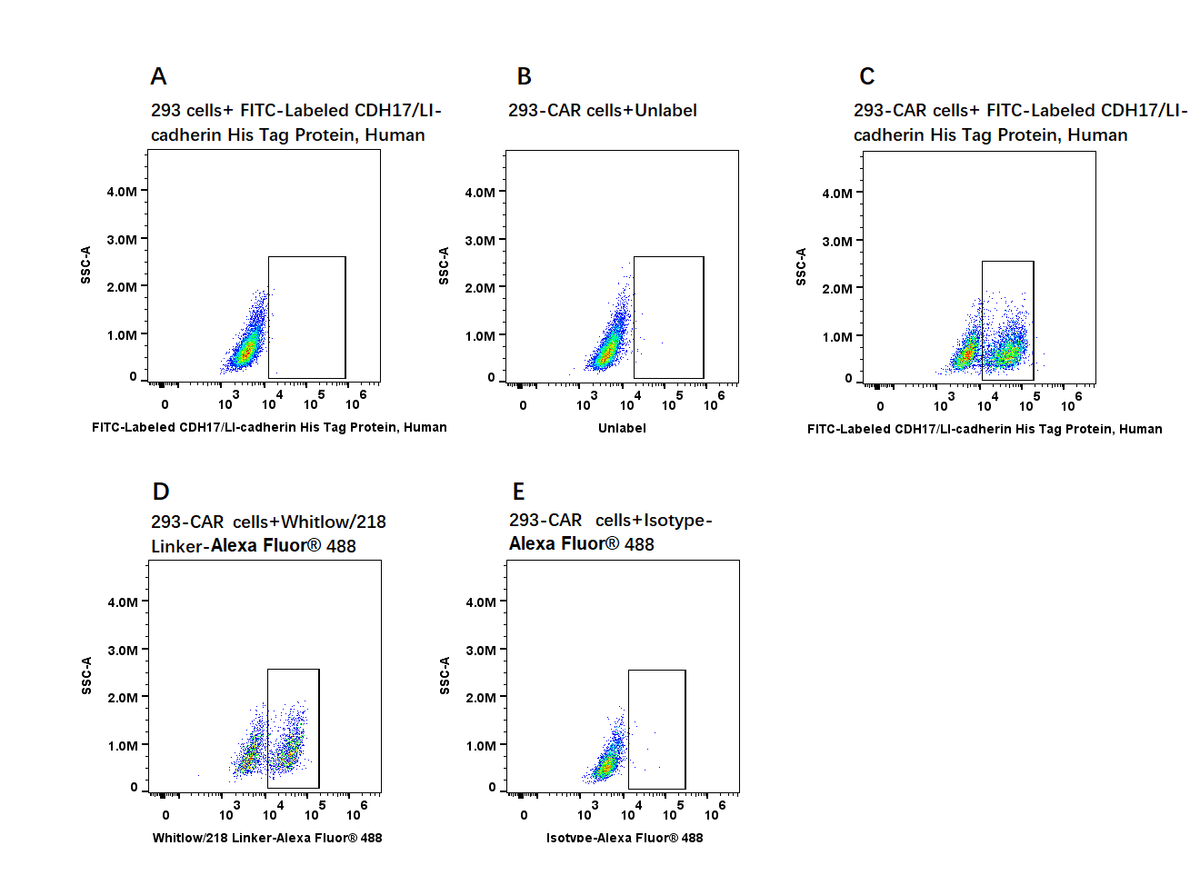
2e5 of transient transfected anti- CDH17 ScFv CAR-293 cells were stained with 0.1ug FITC-Labeled CDH17/LI-cadherin His Tag Protein, Human, (Cat. No. UA016013) and unlable respectively (Fig. C and B), and non-transfected 293 cells were used as a control (Fig. A). FITC signal was used to evaluate the binding activity.
2e5 of transient transfected anti- CDH17 ScFv CAR-293 cells were stained with isotype and Whitlow/218 Linker-Alexa Fluor® 488 (Fig. D and E). Alexa Fluor® 488 signal was used to evaluate the binding activity.
FITC-Labeled CDH17/LI-cadherin His Tag Protein, Human
FITC-Labeled CDH17/LI-cadherin His Tag Protein, Human
Price:
Regular price
$310 USD
Regular price
Sale price
$310 USD
Unit price
per
For shipping services or bulk orders, you may request a quotation.
Secure checkout with

View full details
Product Details
Product Details
Product Specification
| Species | Human |
| Synonyms | Liver-intestine cadherin,HPT-1,CDH16,Intestinal peptide-associated transporter HPT-1,LI-cadherin,HPT-1 Cadherin,Cadherin 17,LI Cadherin (Liver-Intestine),HPT1,Human Intestinal Peptide-Associated Transporter HPT-1,LI Cadherin,Cadherin,Cadherin 17,Human Peptide Transporter 1,Cadherin-16 |
| Accession | Q12864 |
| Amino Acid Sequence | Gln23-Met787 with His Tag at C-Terminus |
| Expression System | HEK293 |
| Molecular Weight | 95-110kDa (Reducing) |
| Conjugation | FITC |
| Tag | His Tag |
| Physical Appearance | Liquid |
| Storage Buffer | PBS, pH7.4 |
| Stability & Storage | · 12 months from date of receipt stored at -20 to -80℃. |
| Reference | 1. Liu LX, et al. (2009) Targeting cadherin-17 inactivates Wnt signaling and inhibits tumor growth in liver carcinoma. Hepatology. 50(5): 1453-63. |
Background
Cadherin-17 or LI-cadherin is a member of the cadherin superfamily, genes encoding calcium-dependent, membrane-associated glycoproteins. Cadherin-17/LI-cadherin is a cadherin-like protein consisting of an extracellular region, 7 cadherin domains, and a transmembrane region but lacking the conserved cytoplasmic domain. Cadherins preferentially interact with themselves in a homophilic manner in connecting cells; cadherins may thus contribute to the sorting of heterogeneous cell types. LI-cadherin may have a role in the morphological organization of liver and intestine. Cadherin-17/LI-cadherin preferentially interact with themselves in a homophilic manner in connecting cells. It's also involved in intestinal peptide transport.
Guidelines
Following recommended dosage for experiments strictly. If the population clustering is not distinct, the recommended dosage could be appropriately increased by 2–5 folds.
Picture
Picture
FC