FITC-Labeled CD38 Fc Chimera Protein, Human
FITC-Labeled CD38 Fc Chimera Protein, Human

Product Details
Product Details
Product Specification
| Species | Human |
| Antigen | CD38 |
| Accession | P28907-1 |
| Amino Acid Sequence |
Val43-Ile300, withC-terminal HumanIgG Fc VPRWRQQWSGPGTTKRFPETVLARCVKYTEIHPEMRHVDCQSVWDAFKGAFISKHPCNITEEDYQPLMKLGTQTVPCNKILLWSRIKDLAHQFTQVQRDMFTLEDTLLGYLADDLTWCGEFNTSKINYQSCPDWRKDCSNNPVSVFWKTVSRRFAEAACDVVHVMLNGSRSKIFDKNSTFGSVEVHNLQPEKVQTLEAWVIHGGREDSRDLCQDPTIKELESIISKRNIQFSCKNIYRPDKFLQCVKNPEDSSCTSEIIEGRMDPKSSDKTHTCPPCPAPELLGGPSVFLFPPKPKDTLMISRTPEVTCVVVDVSHEDPEVKFNWYVDGVEVHNAKTKPREEQYNSTYRVVSVLTVLHQDWLNGKEYKCKVSNKALPAPIEKTISKAKGQPREPQVYTLPPSRDELTKNQVSLTCLVKGFYPSDIAVEWESNGQPENNYKTTPPVLDSDGSFFLYSKLTVDKSRWQQGNVFSCSVMHEALHNHYTQKSLSLSPGK |
| Expression System | HEK293 |
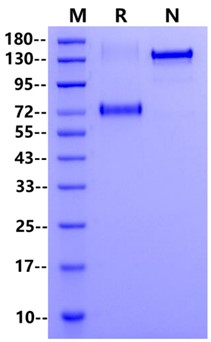
| Molecular Weight | 72-74kDa (Reducing) |
| Purity | >95% by SDS-PAGE |
| Endotoxin | <0.1EU/μg |
| Conjugation | FITC |
| Tag | Human Fc Tag |
| Physical Appearance | Lyophilized powder |
| Storage Buffer | PBS, pH7.4 |
| Reconstitution | Reconstitute at 0.1-1 mg/ml according to the size in ultrapure water after rapid centrifugation. |
| Stability & Storage |
· 12 months from date of receipt, lyophilized powder stored at -20 to -80℃. · 3 months, -20 to -80℃ under sterile conditions after reconstitution. · 1 week, 2 to 8℃ under sterile conditions after reconstitution. · Please avoid repeated freeze-thaw cycles. |
Background
Clusterof differentiation 38 (CD38) is a multifunctional extracellular enzyme on thecell surface with NADase and cyclase activities. As a NADase, CD38 producesadenosine through the adenosine energy pathway to cause immunosuppression. As acell surface receptor, CD38 is necessary for immune cell activation andproliferation. Previous studies suggested that CD38 plays an important role inthe regulation of macrophage function. Therefore, as a new marker of macrophages, the effect of CD38 onmacrophage proliferation, polarization and function, its possible mechanism;CD38 is not only expressed in human immune cells, such as lymphocytes andplasma cells, but also is abnormally expressed in a variety of tumor cells,which is closely related to the occurrence and development of tumors. The role of CD38 in immune cells ranges frommodulating cell differentiation to effector functions during inflammation,where CD38 may regulate cell recruitment, cytokine release, and NADavailability. In line with a role in inflammation, CD38 appears to also play acritical role in inflammatory processes during autoimmunity, although whetherCD38 has pathogenic or regulatory effects varies depending on the disease,immune cell, or animal model analyzed.
Picture
Picture
Bioactivity
SDS-PAGE