

FITC-Labeled CD19 His Tag Protein, Human
FITC-Labeled CD19 His Tag Protein, Human

Product Details
Product Details
Product Specification
| Species | Human |
| Synonyms | CD19, B4, CVID3, MGC12802 |
| Accession | P15391 |
| Amino Acid Sequence | Pro20-Lys291 |
| Expression System | HEK293 |
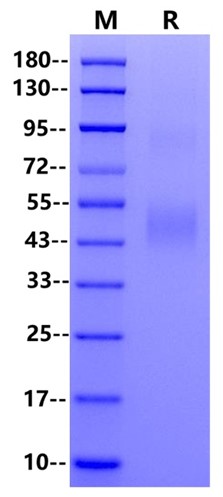
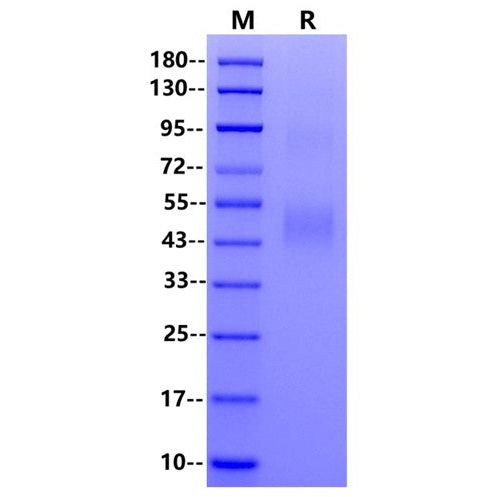
| Molecular Weight | 44-55kDa |
| Purity | >95% by SDS-PAGE |
| Endotoxin | <0.1EU/μg |
| Conjugation | FITC |
| Tag | His Tag |
| Physical Appearance | Liquid |
| Storage Buffer | PBS, pH7.4 |
| Reconstitution | Reconstitute at 0.1-1 mg/ml according to the size in ultrapure water after rapid centrifugation. |
| Stability & Storage |
· 12 months from date of receipt, lyophilized powder stored at -20 to -80℃. · 3 months, -20 to -80℃ under sterile conditions after reconstitution. · 1 week, 2 to 8℃ under sterile conditions after reconstitution. · Please avoid repeated freeze-thaw cycles. |
| Reference |
1、Tedder T F. et al. (1997) The CD19–CD21 Complex Regulates Signal Transduction Thresholds Governing Humoral Immunity and Autoimmunity. Immunity. 6(2): 107-118. 2、Deaglio S. et al. (2007) CD38/CD19: a lipid raft–dependent signaling complex in human B cells. Blood. 109(12): 5390-5398. 3、Engels N. et al. (2016) Signal Transduction by the B Cell Antigen Receptor. Encyclopedia of Immunobiology. 3: 44-50. 4、Oliveira S N D. et al. (2013) A CD19/Fc fusion protein for detection of anti-CD19 chimeric antigen receptors. J Transl Med. 11(1): 23. |
Background
CD19 is a type-I transmembrane glycoprotein of 95 kDa that belongs to the immunoglobulin superfamily and is widely expressed on B cells throughout most stages of B-cell differentiation, though its expression is down-regulated during their terminal differentiation to plasma cells. CD19 maps to chromosome 16p11.2, where it encodes a 540 amino acid protein with two extracellular C-type IgSF domains as well as a large, approximately 240 residue, cytoplasmic tail that exhibits extensive conservation between mice and humans. CD19 is a signal amplifying coreceptor whose expression is restricted to B cells and follicular dendritic cells. CD19 exists in a multimolecular complex with CD21 (complement receptor type 2, CR2), the tetraspanin CD81 and CD225 on the B cell surface. Via its interaction with CD21, CD19 serves as a signal transducing device for complement-conjugated antigen in B cells. Coligation of the BCR and the CD19/CD21 complex lowers the threshold for B cell activation by approximately two orders of magnitude. CD19 is a potential target for monoclonal antibody therapy, and preliminary data have demonstrated its effectiveness in B-cell depletion, making this an attractive therapy for autoimmune disorders and treatment of malignant B-cell lymphomas. CD19 serves as an attractive target for immunotherapy for many reasons: (1) It is expressed on most B-cell malignancies; (2) it is expressed in the B-cell lineage at an early stage, even before the expression of CD20; (3) it internalizes efficiently in lymphoma tumor models252; and (4) it is possibly involved in the development of B-cell cancers.
Picture
Picture
Bioactivity
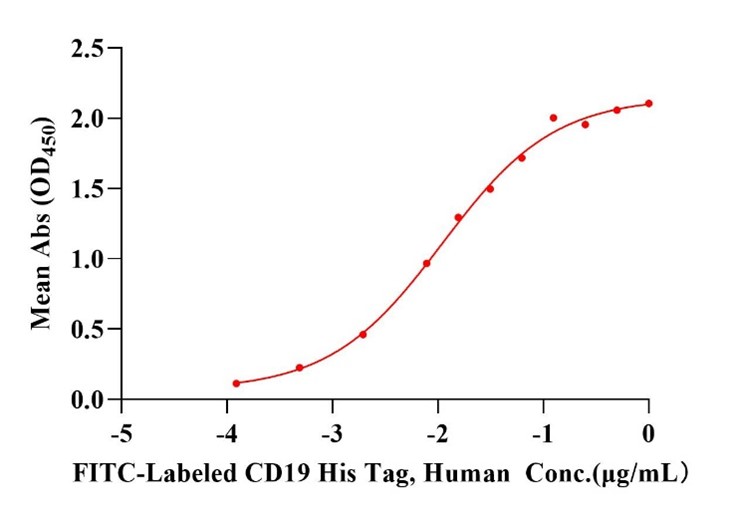
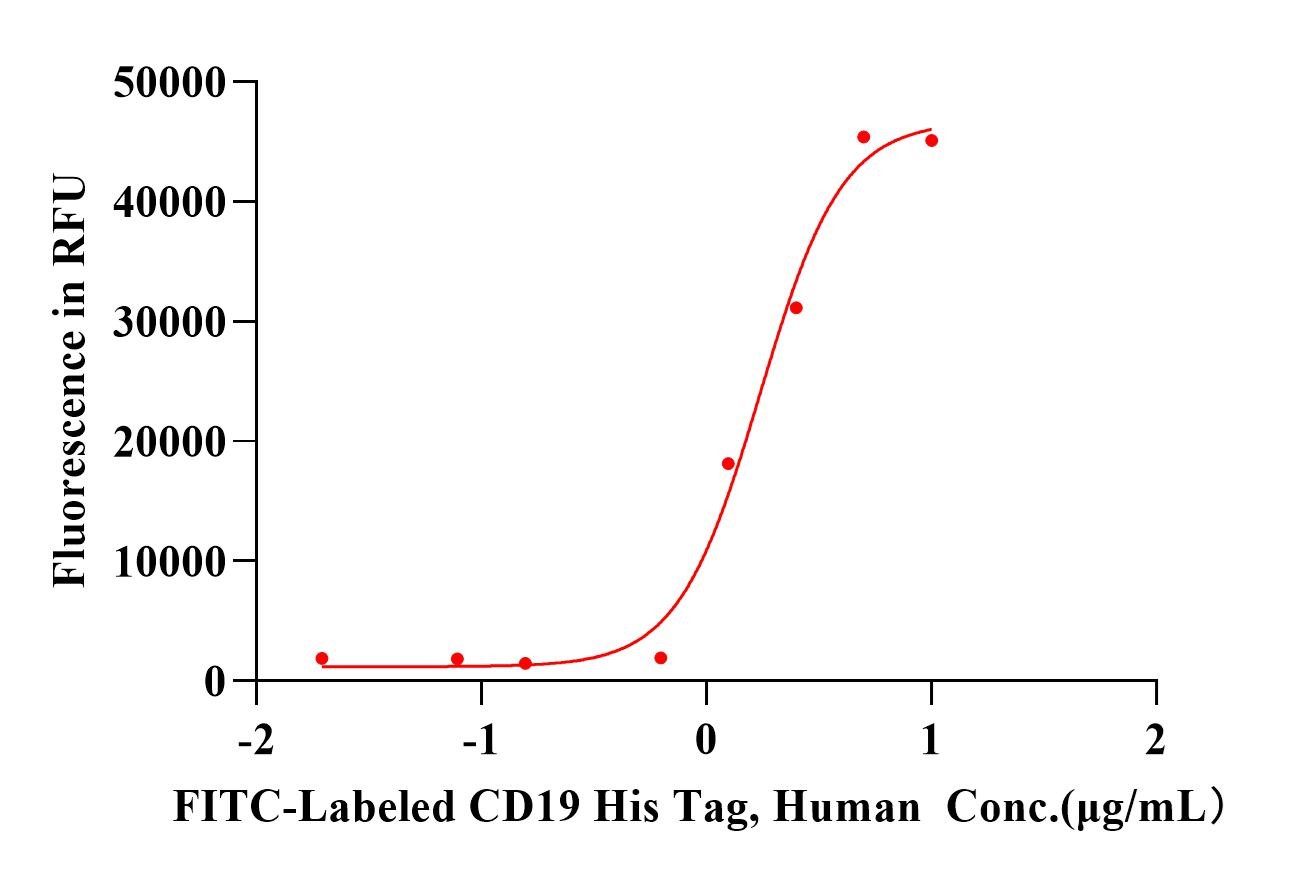
SDS-PAGE