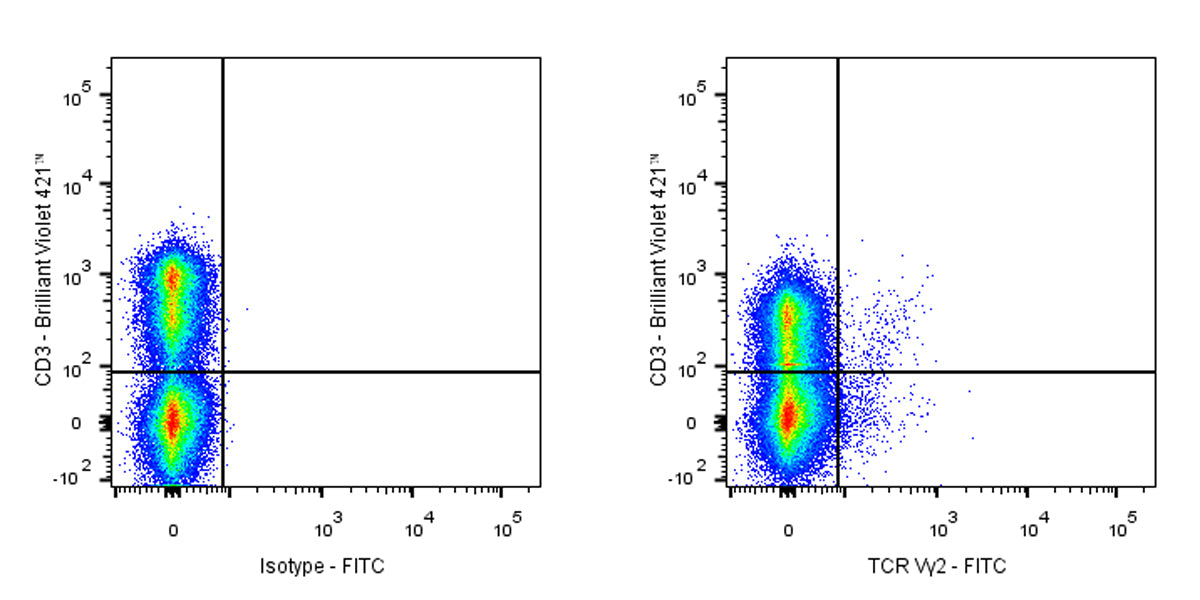
Flow cytometric analysis of Mouse TCR Vγ2 expression on BALB/c mouse splenocytes. BALB/c mouse splenocytes were stained with Brilliant Violet 421™ Rat Anti-Mouse CD3 antibody and either FITC Armenian hamster IgG Isotype Control (Left panel) or SDT FITC Armenian hamster Anti-Mouse TCR Vγ2 Antibody (Right panel) at 5 μl/test. Flow cytometry and data analysis were performed using BD FACSymphony™ A1 and FlowJo™ software.
FITC Armenian hamster Anti-Mouse TCR Vγ2 Antibody (UC3-10A6)
FITC Armenian hamster Anti-Mouse TCR Vγ2 Antibody (UC3-10A6)
Price:
Regular price
$65 USD
Regular price
Sale price
$65 USD
Unit price
per
For shipping services or bulk orders, you may request a quotation.
Secure checkout with

View full details
Product Details
Product Details
Product Specification
| Host | Armenian hamster |
| Antigen | TCR Vγ2 |
| Location | Cell membrane |
| Accession | A2J008 |
| Clone Number | UC3-10A6 |
| Antibody Type | Recombinant mAb |
| Isotype | IgG |
| Application | FCM |
| Reactivity | Ms |
| Positive Sample | BALB/c mouse splenocytes |
| Purification | Protein G |
| Concentration | 0.2 mg/ml |
| Conjugation | FITC |
| Physical Appearance | Liquid |
| Storage Buffer | PBS, 1% BSA, 0.3% Proclin 300 |
| Stability & Storage | 12 months from date of receipt / reconstitution, 2 to 8 °C as supplied |
Dilution
| application | dilution | species |
| FCM | 5μl per million cells in 100μl volume | Ms |
Background
TCR Vγ2 protein is a variable-region subunit of the T-cell receptor (TCR) γ-chain that pairs with Vδ2 to form the predominant γδ TCR in human peripheral blood; this 280-residue Ig-like domain anchors to the γ-chain constant region, contacts antigen directly via surface-exposed CDR loops, and—when co-expressed with CD3 complexes—enables γδ T cells to sense phosphoantigens from microbes or stressed tumors without MHC restriction, triggering potent cytotoxicity and cytokine release that are being exploited for Vγ2/Vδ2-targeted immunotherapies against infection and cancer.
Picture
Picture
FC