WB result of Filamin A Rabbit Polyclonal Antibody
Primary antibody: Filamin A Rabbit Polyclonal Antibody at 1/1000 dilution
Lane 1: NIH/3T3 whole cell lysate 20 μg
Secondary antibody: Goat Anti-Rabbit IgG (H+L), HRP conjugated at 1/10000 dilution
Predicted MW: 280 kDa
Observed MW: 290 kDa
Filamin A Rabbit Polyclonal Antibody
Filamin A Rabbit Polyclonal Antibody
Price:
Regular price
$100 USD
Regular price
Sale price
$100 USD
Unit price
per
For shipping services or bulk orders, you may request a quotation.
Secure checkout with

View full details
Product Details
Product Details
Product Specification
| Host | Rabbit |
| Antigen | Filamin A |
| Immunogen | Synthetic Peptide |
| Location | Cytoplasm, Cytoskeleton |
| Accession | Q8BTM8 |
| Antibody Type | Polyclonal antibody |
| Isotype | IgG |
| Application | WB, ICC |
| Reactivity | Ms, Rt |
| Positive Sample | NIH/3T3, C6, rat skeletal muscle |
| Purification | Immunogen Affinity |
| Concentration | 0.5 mg/ml |
| Conjugation | Unconjugated |
| Physical Appearance | Liquid |
| Storage Buffer | PBS, 40% Glycerol, 0.05% BSA, 0.02% sodium azide |
| Stability & Storage | 12 months from date of receipt / reconstitution, -20 °C as supplied |
Dilution
| application | dilution | species |
| WB | 1:1000 | Ms, Rt |
| ICC | 1:500 | Ms, Rt |
Background
Filamin A (FLNA), also known as actin-binding protein 280 (ABP-280), is a widely expressed 280-kDa non-muscle actin filament cross-linking protein encoded by the X-linked FLNA gene at Xq28. Structurally, it forms a V-shaped homodimer whose subunits each comprise an N-terminal actin-binding domain followed by 24 immunoglobulin-like repeats and two calpain-sensitive hinge regions, enabling it to cross-link F-actin into orthogonal networks and anchor membrane proteins to the cytoskeleton. Beyond its structural role, Filamin A serves as a highly dynamic scaffold interacting with over 90 binding partners—including integrins, transmembrane receptors, signaling intermediates, and transcription factors—thereby integrating diverse cellular functions such as cell migration, adhesion, mechanotransduction, and signal transduction. Pathogenic FLNA variants cause a broad spectrum of X-linked developmental disorders known as filaminopathies, with loss-of-function mutations classically leading to periventricular nodular heterotopia (PVNH) in females and embryonic lethality in males, while gain-of-function or altered-function mutations result in skeletal malformations including otopalatodigital syndrome and frontometaphyseal dysplasia; additionally, FLNA variants have been increasingly associated with cardiac valvular disease, aortic aneurysm, and macrothrombocytopenia .
Picture
Picture
Western Blot
WB result of Filamin A Rabbit Polyclonal Antibody
Primary antibody: Filamin A Rabbit Polyclonal Antibody at 1/1000 dilution
Lane 1: C6 whole cell lysate 20 μg
Lane 2: rat skeletal muscle lysate 20 μg
Secondary antibody: Goat Anti-Rabbit IgG (H+L), HRP conjugated at 1/10000 dilution
Predicted MW: 280 kDa
Observed MW: 280 kDa
Immunocytochemistry
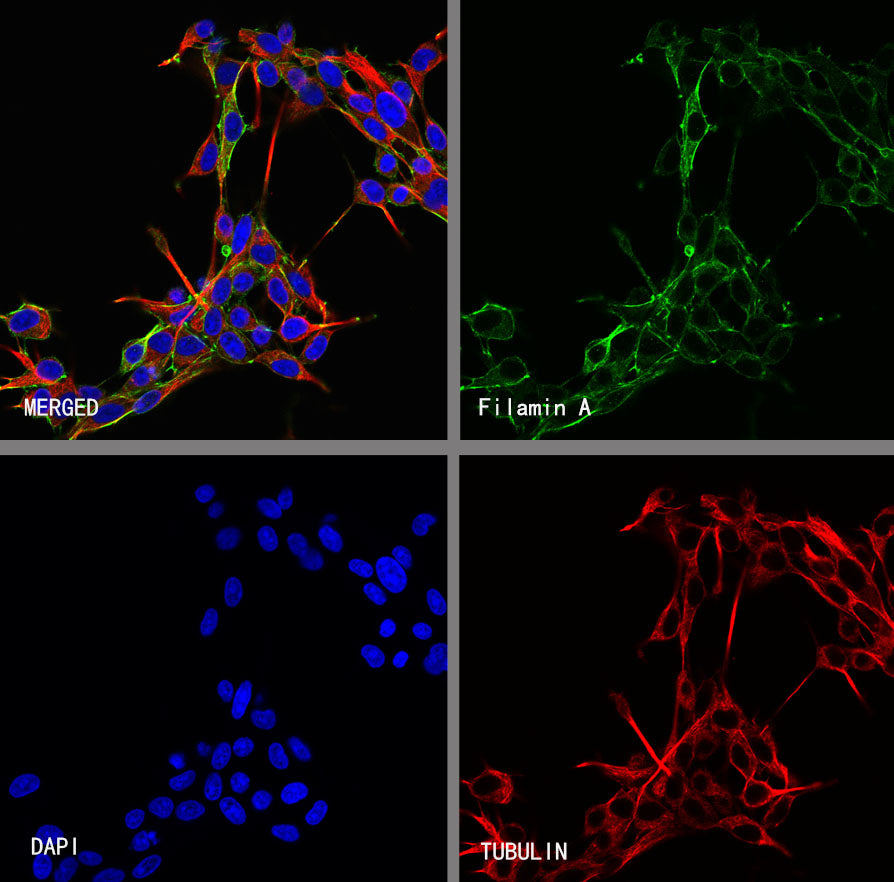
ICC shows positive staining in NIH/3T3 cells. Anti-Filamin A antibody was used at 1/500 dilution (Green) and incubated overnight at 4°C. Goat polyclonal Antibody to Rabbit IgG - H&L (Alexa Fluor® 488) was used as secondary antibody at 1/1000 dilution. The cells were fixed with 100% ice-cold methanol and permeabilized with 0.1% PBS-Triton X-100. Nuclei were counterstained with DAPI (Blue). Counterstain with tubulin (Red).
ICC shows positive staining in C6 cells. Anti-Filamin A antibody was used at 1/500 dilution (Green) and incubated overnight at 4°C. Goat polyclonal Antibody to Rabbit IgG - H&L (Alexa Fluor® 488) was used as secondary antibody at 1/1000 dilution. The cells were fixed with 100% ice-cold methanol and permeabilized with 0.1% PBS-Triton X-100. Nuclei were counterstained with DAPI (Blue). Counterstain with tubulin (Red).