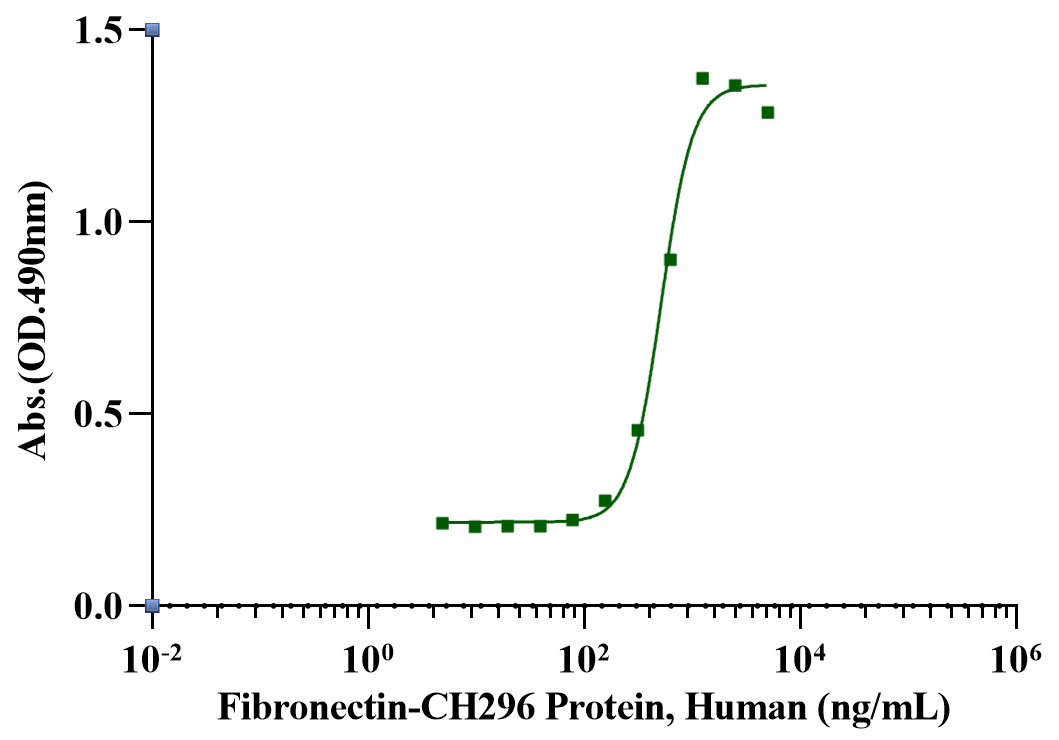
Measured by its ability to support cell attachment and spreading when used as a substratum for cell culture. The EC50 for this effect is less than 1 μg/mL.
Fibronectin-CH296 Protein, Human
Fibronectin-CH296 Protein, Human
Price:
Regular price
$20 USD
Regular price
Sale price
$20 USD
Unit price
per
For shipping services or bulk orders, you may request a quotation.
Secure checkout with

View full details
Product Details
Product Details
Product Specification
| Species | Human |
| Synonyms | Fibronectin Curated, FN, Cold-insoluble globulin (CIG) |
| Accession | P02751-15 |
| Amino Acid Sequence | Pro1361-Ser1637&Ala1812-Thr2107 |
| Expression System | E.coli |
| Molecular Weight | 58-68 kDa (Reducing) |
| Purity | >95% by SDS-PAGE & HPLC. |
| Endotoxin | <0.1EU/μg |
| Conjugation | Unconjugated |
| Tag | No Tag |
| Physical Appearance | Liquid |
| Storage Buffer | 12.5 mM sodium citrate, 1.25% sucrose, pH 6.2 |
| Stability & Storage | Stable for 12 months upon stored at -80℃ from the date of receipt. And avoid repeated freeze-thaws cycles. |
| Reference | Nature. 1990 Jun 14;345(6276):642-6. |
Background
Fibronectin-CH296 is a recombinant human fibronectin fragment developed in 1995. The protein comprises 574 amino acids with a molecular weight of 58–63 kDa, produced in E. coli expression systems. CH296 contains three critical functional domains derived from the parent fibronectin molecule:
1. Central Cell-Binding Domain (type III repeats 8-10): Contains the Arg-Gly-Asp (RGD) sequence that binds integrin VLA-5 (α5β1) on target cells.
2. Heparin-Binding Domain II (type III repeats 12-14): Mediates binding to viral particles via heparan sulfate moieties on retroviral/lentiviral envelopes.
3. CS-1 Site (alternatively-spliced IIICS region): Binds integrin VLA-4 (α4β1) expressed on hematopoietic cells, T cells, and monocytes. This domain organization enables co-localization of viral particles and target cells on the CH296-coated surface, dramatically enhancing transduction efficiency by increasing effective viral concentration at the cell membrane.
Picture
Picture
Bioactivity
SDS-PAGE
2μg (R: reducing condition, N: non-reducing condition).
RP-HPLC
>95% as determined by RP-HPLC.