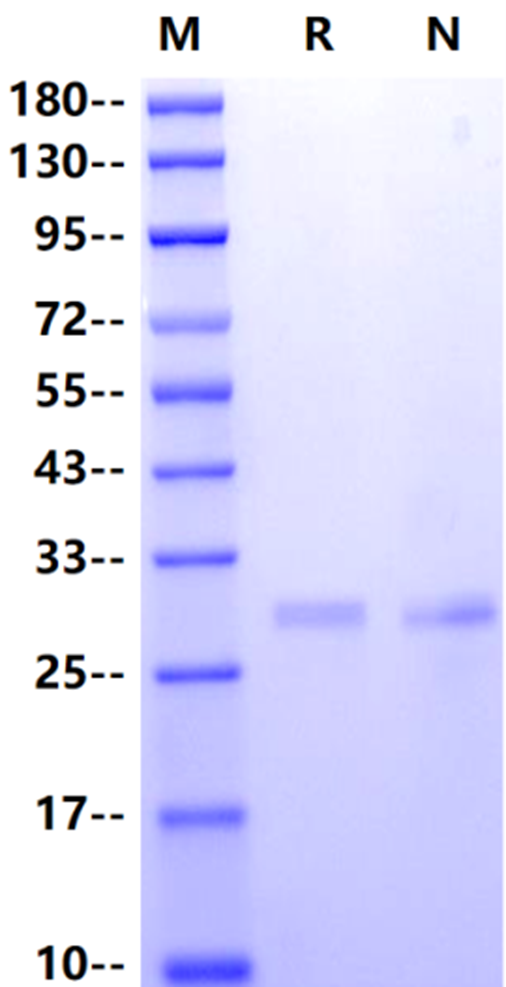
1 μg (R: reducing conditions, N: non-reducing conditions).
FGF-9 Protein, Human
FGF-9 Protein, Human
Price:
Regular price
$135 USD
Regular price
Sale price
$135 USD
Unit price
per
For shipping services or bulk orders, you may request a quotation.
Secure checkout with

View full details
Product Details
Product Details
Product Specification
| Species | Human |
| Accession | P31371-1 |
| Amino Acid Sequence | Leu4-Ser208, with N-terminal 6*His |
| Expression System | HEK293 |
| Molecular Weight | 27-30kDa |
| Purity | >95% by SDS-PAGE |
| Endotoxin | <0.1EU/μg |
| Conjugation | Unconjugated |
| Tag | His Tag |
| Physical Appearance | Lyophilized powder |
| Storage Buffer | PBS, pH7.4 |
| Reconstitution | Reconstitute at 0.1-1 mg/ml according to the size in ultrapure water after rapid centrifugation. |
| Stability & Storage | · 12 months from date of receipt, lyophilized powder stored at -20 to -80℃. · 3 months, -20 to -80℃ under sterile conditions after reconstitution. · 1 week, 2 to 8℃ under sterile conditions after reconstitution. · Please avoid repeated freeze-thaw cycles. |
| Reference |
1. Schmahl J. et al. (2004) Fgf9 induces proliferation and nuclear localization of FGFR2 in Sertoli precursors during male sex determination. Development. 131(15): 3627-36. 2. Garcès A. et al. (2000) FGF9: a motoneuron survival factor expressed by medial thoracic and sacral motoneurons. J Neurosci Res. 60(1): 1-9. |
Background
FGF9 (fibroblast growth factor 9, FGF9) is one of the fibroblast growth factor (FGF) family members. It is widely distributed in various tissues of human body and involved in bone development, angiogenesis, embryonic development, damage repair, cell apoptosis, nerve regeneration, tumor growth and other physiological and pathological processes, and can effectively promote mitosis and cell growth. Current evidence suggests that FGF9 may play a prominent role not only in bone development and growth of cartilage into bone formation and generation, but also has a significant impact on aspects of ovarian cancer, nerve regeneration, gonadal differentiation, there remains much to be discovered and investigated on the functions and mechanisms of FGF18.
Picture
Picture
SDS-PAGE
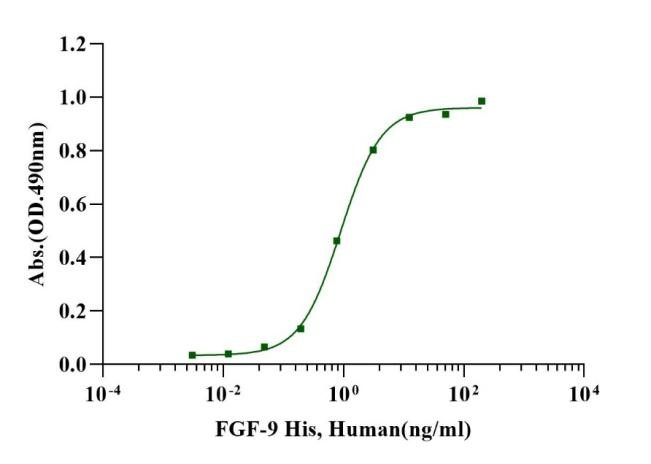
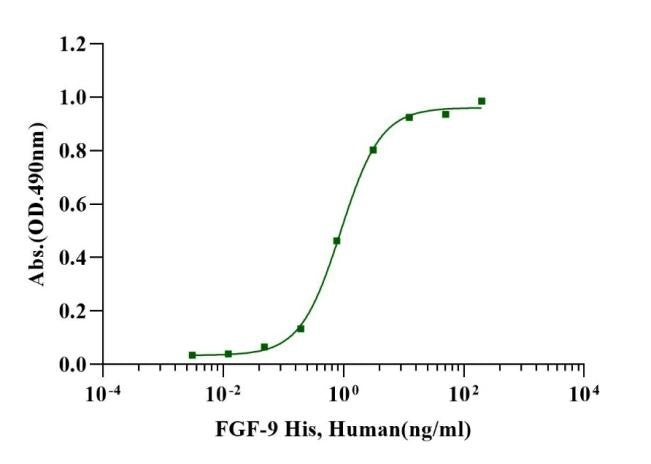
Measured in a cell proliferation assay using Balb/c 3T3 mouse fibroblast cells. The EC50 for this effect is less than 1ng/ml.