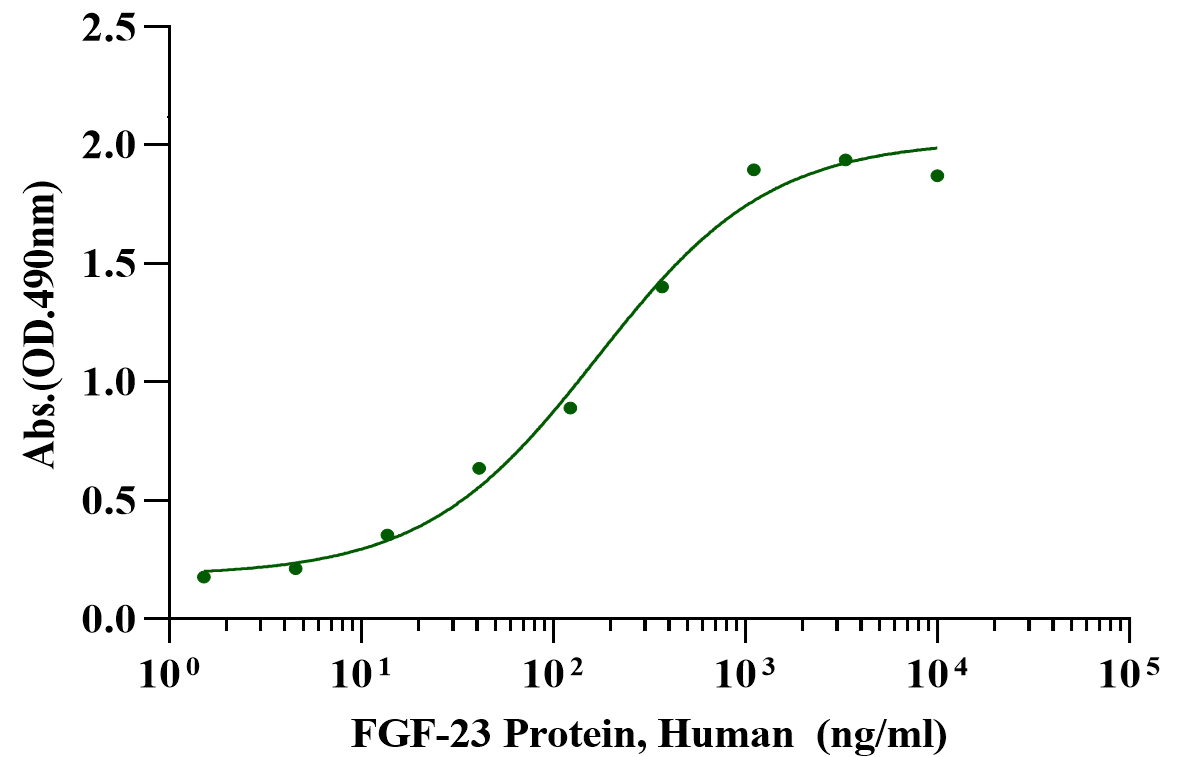
Determined by its ability to stimulate the proliferation of murine NIH-3T3 cells. The expected EC50 for this effect is 0.12-0.25 μg/ml, in the presence of murine Klotho and heparin.
FGF-23 Protein, Human
FGF-23 Protein, Human
Price:
Regular price
$135 USD
Regular price
Sale price
$135 USD
Unit price
per
For shipping services or bulk orders, you may request a quotation.
Secure checkout with

View full details
Product Details
Product Details
Product Specification
| Species | Human |
| Synonyms | Fibroblast growth factor 23, FGF-23, Phosphatonin, Tumor-derived hypophosphatemia-inducing factor |
| Accession | Q9GZV9 |
| Amino Acid Sequence | Tyr25-Val251(R179Q) |
| Expression System | HEK293 |
| Molecular Weight | 26-34 kDa (Reducing) |
| Purity | >95% by SDS-PAGE & HPLC. |
| Endotoxin | <0.1EU/μg |
| Conjugation | Unconjugated |
| Tag | No Tag |
| Physical Appearance | Lyophilized Powder |
| Storage Buffer | 10mM NaAc, 0.1M L-Arg, pH6.0 |
| Reconstitution | Reconstitute at 0.1-1 mg/ml according to the size in ultrapure water after rapid centrifugation. |
| Stability & Storage | ·12 months from date of receipt, lyophilized powder stored at -20 to -80℃. |
| Reference | Nat Rev Nephrol. 2023;19:185‑193. |
Background
FGF23 is predominantly secreted by osteocytes, with its secretion and cleavage tightly regulated by serum phosphate, 1,25-dihydroxyvitamin D (1,25D), and parathyroid hormone (PTH). It binds to FGF receptors in concert with the obligate co‑receptor α‑Klotho to promote phosphaturia and suppress renal 1,25D synthesis, thereby controlling systemic phosphorus balance. Disorders of FGF23 signaling lead to either hypophosphatemia (e.g., X-linked hypophosphatemia, XLH) or hyperphosphatemia (e.g., familial tumoral calcinosis).
Picture
Picture
Bioactivity
SDS-PAGE
2μg (R: reducing condition, N: non-reducing condition).
RP-HPLC
>95% as determined by RP-HPLC.