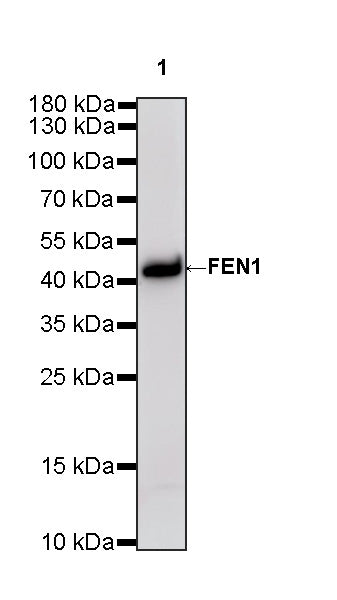
WB result of FEN1 Rabbit Polyclonal Antibody
Primary antibody: FEN1 Rabbit Polyclonal Antibody at 1/1000 dilution
Lane 1: HeLa whole cell lysate 20 µg
Lane 2: Jurkat whole cell lysate 20 µg
Lane 3: Daudi whole cell lysate 20 µg
Secondary antibody: Goat Anti-Rabbit IgG (H+L), HRP conjugated at 1/10000 dilution
Predicted MW: 43 kDa
Observed MW: 43 kDa
FEN1 Rabbit Polyclonal Antibody
FEN1 Rabbit Polyclonal Antibody
Price:
Regular price
$100 USD
Regular price
Sale price
$100 USD
Unit price
per
For shipping services or bulk orders, you may request a quotation.
Secure checkout with

View full details
Product Details
Product Details
Product Specification
| Host | Rabbit |
| Antigen | FEN1 |
| Synonyms | Flap endonuclease 1; DNase IV; Flap structure-specific endonuclease 1; Maturation factor 1 (MF1; hFEN-1); RAD2 |
| Immunogen | Synthetic Peptide |
| Location | Mitochondrion |
| Accession | P39748 |
| Antibody Type | Polyclonal antibody |
| Isotype | IgG |
| Application | WB |
| Reactivity | Hu, Ms, Rt |
| Positive Sample | HeLa, Jurkat , Daudi, NIH/3T3, mouse spleen, C6, rat spleen, COS7 |
| Predicted Reactivity | Bv |
| Purification | Immunogen Affinity |
| Concentration | 0.5 mg/ml |
| Conjugation | Unconjugated |
| Physical Appearance | Liquid |
| Storage Buffer | PBS, 40% Glycerol, 0.05% BSA, 0.02% sodium azide |
| Stability & Storage | 12 months from date of receipt / reconstitution, -20 °C as supplied |
Dilution
| application | dilution | species |
| WB | 1:1000 | Hu, Ms, Rt, Mk |
Background
FEN1 is a structure-specific, multifunctional, and highly conserved nuclease that plays an indispensable role in DNA replication and repair. It primarily recognizes and cleaves nucleic acid intermediates with 5′ overhanging single-stranded "flap" structures on DNA duplexes; its unique dual-flap recognition mechanism enables precise excision of these intermediates, thereby providing the key step of RNA primer removal for Okazaki fragment maturation and playing a central role in the long-patch base excision repair pathway. In addition to its endonuclease activity, FEN1 also possesses 5′→3′ exonuclease activity, assisting in the removal of damaged DNA fragments in various DNA damage repair pathways. Furthermore, FEN1 participates in telomere maintenance, ensuring stable replication of telomeric sequences through its structure-specific cleavage. The activity of FEN1 is closely associated with cell proliferation, and its expression levels are significantly upregulated in various cancers to support the efficient proliferation and genomic stability of cancer cells, making it a potential anti-cancer target; however, its dysfunction or mutations lead to genomic instability and accumulation of mutations, which are linked to cancer susceptibility, premature aging, and neurodegenerative diseases.
Picture
Picture
Western Blot
WB result of FEN1 Rabbit Polyclonal Antibody
Primary antibody: FEN1 Rabbit Polyclonal Antibody at 1/1000 dilution
Lane 1: NIH/3T3 whole cell lysate 20 µg
Lane 2: mouse spleen lysate 20 µg
Secondary antibody: Goat Anti-Rabbit IgG (H+L), HRP conjugated at 1/10000 dilution
Predicted MW: 43 kDa
Observed MW: 43 kDa
WB result of FEN1 Rabbit Polyclonal Antibody
Primary antibody: FEN1 Rabbit Polyclonal Antibody at 1/1000 dilution
Lane 1: C6 whole cell lysate 20 µg
Lane 2: rat spleen lysate 20 µg
Secondary antibody: Goat Anti-Rabbit IgG (H+L), HRP conjugated at 1/10000 dilution
Predicted MW: 43 kDa
Observed MW: 43 kDa
WB result of FEN1 Rabbit Polyclonal Antibody
Primary antibody: FEN1 Rabbit Polyclonal Antibody at 1/1000 dilution
Lane 1: COS7 whole cell lysate 20 µg
Secondary antibody: Goat Anti-Rabbit IgG (H+L), HRP conjugated at 1/10000 dilution
Predicted MW: 43 kDa
Observed MW: 43 kDa