WB result of FAH Recombinant Rabbit mAb
Primary antibody: FAH Recombinant Rabbit mAb at 1/1000 dilution
Primary antibody incubation conditions: overnight at 4°C
Lane 1: Raji whole cell lysate 20 μg
Lane 2: HeLa whole cell lysate 20 μg
Lane 3: Hep G2 whole cell lysate 20 μg
Negative control: Raji whole cell lysate
Secondary antibody: Goat Anti-Rabbit IgG (H+L), HRP conjugated at 1/10000 dilution
Predicted MW: 46 kDa
Observed MW: 39 kDa
This blot was developed with high sensitivity substrate
FAH Recombinant Rabbit mAb (S-5082-7)
FAH Recombinant Rabbit mAb (S-5082-7)
Price:
Regular price
$100 USD
Regular price
Sale price
$100 USD
Unit price
per
For shipping services or bulk orders, you may request a quotation.
Secure checkout with

View full details
Product Details
Product Details
Product Specification
| Host | Rabbit |
| Antigen | FAH |
| Immunogen | Synthetic Peptide |
| Location | Cytoplasm |
| Accession | P16930 |
| Clone Number | S-5082-7 |
| Antibody Type | Recombinant mAb |
| Isotype | IgG |
| Application | WB |
| Reactivity | Hu |
| Positive Sample | HeLa, Hep G2, RPMI 8226, HL-60 |
| Purification | Protein A |
| Concentration | 0.5 mg/ml |
| Conjugation | Unconjugated |
| Physical Appearance | Liquid |
| Storage Buffer | PBS, 40% Glycerol, 0.05% BSA, 0.02% sodium azide |
| Stability & Storage | 12 months from date of receipt / reconstitution, -20 °C as supplied |
Dilution
| application | dilution | species |
| WB | 1:1000 | Hu |
Background
FAH (fumarylacetoacetate hydrolase) is a metabolic enzyme encoded by the FAH gene on human chromosome 15, mainly expressed in the liver, and is a key enzyme in the catabolic pathway of phenylalanine and tyrosine, catalyzing the hydrolytic cleavage of the carbon–carbon bond of fumarylacetoacetate to yield fumarate and acetoacetate. The enzyme exists as a homodimer, and its active site contains Ca²⁺; its catalytic mechanism involves the metal ion, a Glu/His catalytic dyad, and a charged oxyanion hole. Deficiency of the FAH gene leads to the toxic accumulation of fumarylacetoacetate and its metabolic derivative succinylacetone, causing the human autosomal recessive disease tyrosinemia type I, which is associated with hepatic and renal abnormalities and neurological impairment; patients experience continuous hepatocyte injury and carry an extremely high risk of hepatocellular carcinoma. Notably, recent studies have also found that FAH is upregulated in glioblastoma and promotes tumor progression by activating the PI3K/AKT/mTOR signaling pathway, suggesting that, in addition to its metabolic function, it may have potential pro-oncogenic effects.
Picture
Picture
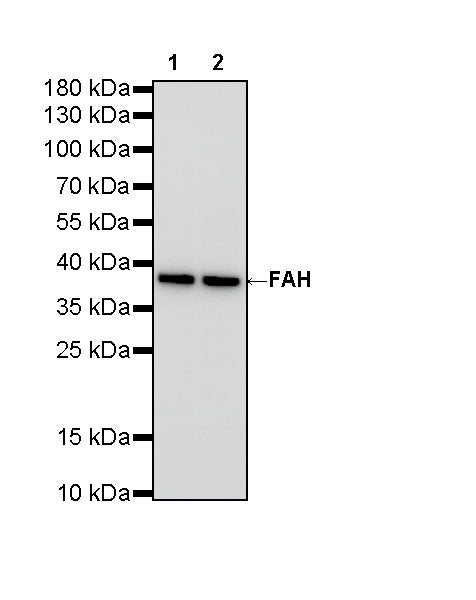
Western Blot
WB result of FAH Recombinant Rabbit mAb
Primary antibody: FAH Recombinant Rabbit mAb at 1/1000 dilution
Primary antibody incubation conditions: overnight at 4°C
Lane 1: RPMI 8226 whole cell lysate 20 μg
Lane 2: HL-60 whole cell lysate 20 μg
Secondary antibody: Goat Anti-Rabbit IgG (H+L), HRP conjugated at 1/10000 dilution
Predicted MW: 46 kDa
Observed MW: 39 kDa