WB result of Factor XII (FXII) Recombinant Rabbit mAb
Primary antibody: Factor XII (FXII) Recombinant Rabbit mAb at 1/1000 dilution
Lane 1: Human plasma lysate 20 µg
Secondary antibody: Goat Anti-Rabbit IgG (H+L), HRP conjugated at 1/10000 dilution
Predicted MW: 67 kDa
Observed MW: 80 kDa
This blot was developed with high sensitivity substrate
Factor XII (FXII) Recombinant Rabbit mAb (S-4487-31)
Factor XII (FXII) Recombinant Rabbit mAb (S-4487-31)
Price:
Regular price
$100 USD
Regular price
Sale price
$100 USD
Unit price
per
For shipping services or bulk orders, you may request a quotation.
Secure checkout with

View full details
Product Details
Product Details
Product Specification
| Host | Rabbit |
| Antigen | Factor XII (FXII) |
| Synonyms | Coagulation factor XII; Beta-factor XIIa part 2; F12 |
| Immunogen | Synthetic Peptide |
| Location | Secreted |
| Accession | P00748 |
| Clone Number | S-4487-31 |
| Antibody Type | Recombinant mAb |
| Isotype | IgG |
| Application | WB, IHC-P |
| Reactivity | Hu |
| Positive Sample | Human plasma |
| Purification | Protein A |
| Concentration | 2 mg/ml |
| Conjugation | Unconjugated |
| Physical Appearance | Liquid |
| Storage Buffer | PBS, 40% Glycerol, 0.05% BSA, 0.02% sodium azide |
| Stability & Storage | 12 months from date of receipt / reconstitution, -20 °C as supplied |
Dilution
| application | dilution | species |
| WB | 1:1000 | Hu |
| IHC-P | 1:400 | Hu |
Background
Factor XII (coagulation factor XII, also known as Hageman factor) is a serine protease zymogen synthesized by the liver and primarily present in plasma in its inactive form. It serves as the initiator of the intrinsic coagulation pathway. When blood is exposed to negatively charged foreign surfaces (such as collagen, glass, kaolin, or bacterial lipopolysaccharides), Factor XII is activated to its enzymatically active form, Factor XIIa, which subsequently activates downstream Factor XI and FXIa, ultimately initiating the coagulation cascade. In addition to its classical procoagulant function, Factor XII also activates the kallikrein-kinin system through its activated products, generating bradykinin, thereby participating in vascular permeability regulation, blood pressure control, and inflammatory responses, while also playing an auxiliary role in the fibrinolytic system to promote clot dissolution. Notably, Factor XII is not essential for physiological hemostasis; its deficiency is not associated with bleeding tendencies, but rather with a reduced risk of thrombotic diseases such as deep vein thrombosis, pulmonary embolism, and myocardial infarction. This renders it an ideal target for the development of novel anticoagulant drugs. Currently, antisense oligonucleotides and small-molecule inhibitors targeting Factor XII have demonstrated effective antithrombotic effects with a low bleeding risk in animal models, showing promising prospects for clinical translation. Furthermore, Factor XIIa can also activate the complement system and neutrophils, playing a role in the amplification of inflammation in allergic reactions and autoimmune diseases.
Picture
Picture
Western Blot
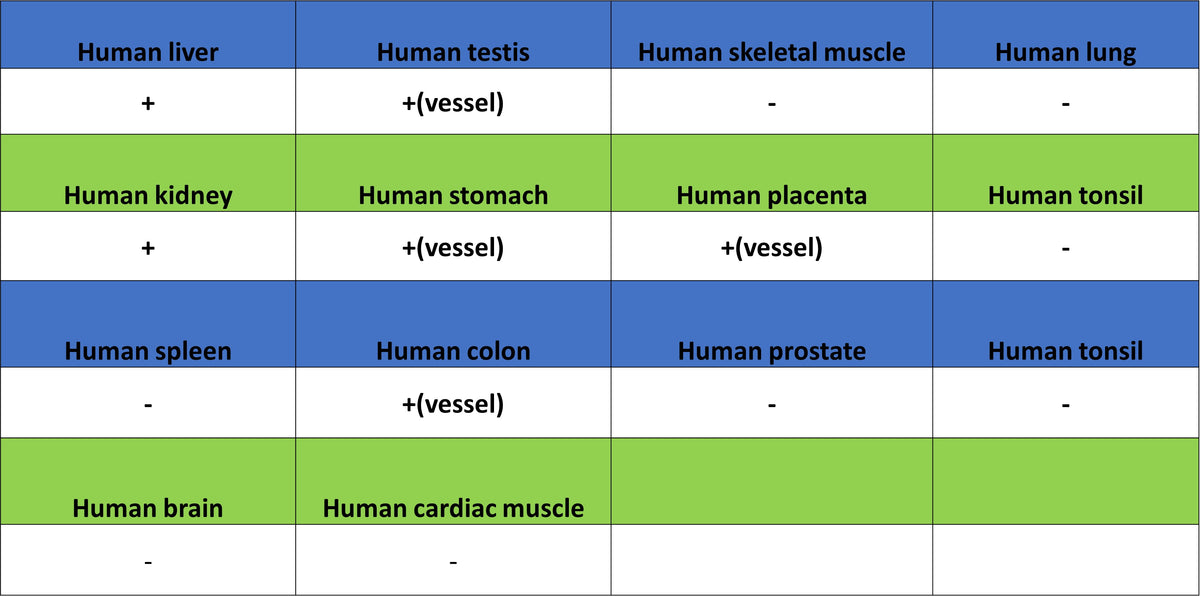
Immunohistochemistry
IHC shows positive staining in paraffin-embedded human liver. Anti-Factor XII (FXII) antibody was used at 1/400 dilution, followed by a HRP Polymer for Rabbit IgG (ready to use). Counterstained with hematoxylin. Heat mediated antigen retrieval with Tris/EDTA buffer pH9.0 was performed before commencing with IHC staining protocol.
IHC shows positive staining in paraffin-embedded human breast cancer. Anti-Factor XII (FXII) antibody was used at 1/400 dilution, followed by a HRP Polymer for Rabbit IgG (ready to use). Counterstained with hematoxylin. Heat mediated antigen retrieval with Tris/EDTA buffer pH9.0 was performed before commencing with IHC staining protocol.
IHC shows positive staining in paraffin-embedded human ovarian cancer. Anti-Factor XII (FXII) antibody was used at 1/400 dilution, followed by a HRP Polymer for Rabbit IgG (ready to use). Counterstained with hematoxylin. Heat mediated antigen retrieval with Tris/EDTA buffer pH9.0 was performed before commencing with IHC staining protocol.
Negative control: IHC shows negative staining in paraffin-embedded human cardiac muscle. Anti- Factor XII (FXII) antibody was used at 1/400 dilution, followed by a HRP Polymer for Rabbit IgG (ready to use). Counterstained with hematoxylin. Heat mediated antigen retrieval with Tris/EDTA buffer pH9.0 was performed before commencing with IHC staining protocol.