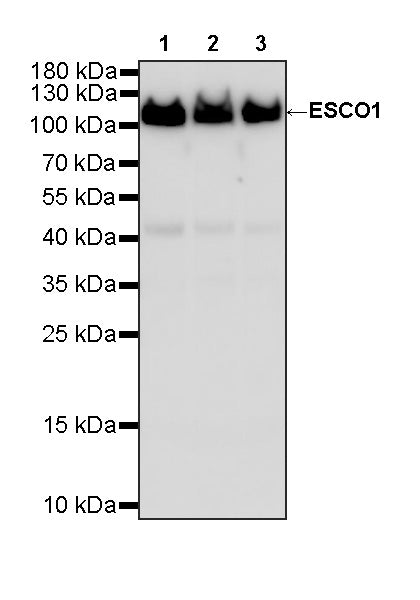
WB result of ESCO1 Rabbit Polyclonal Antibody
Primary antibody: ESCO1 Rabbit Polyclonal Antibody at 1/1000 dilution
Lane 1: A375 whole cell lysate 20 µg
Lane 2: MCF7 whole cell lysate 20 µg
Lane 3: PANC-1 whole cell lysate 20 µg
Secondary antibody: Goat Anti-Rabbit IgG (H+L), HRP conjugated at 1/10000 dilution
Predicted MW: 95 kDa
Observed MW: 110 kDa
ESCO1 Rabbit Polyclonal Antibody
ESCO1 Rabbit Polyclonal Antibody
Price:
Regular price
$100 USD
Regular price
Sale price
$100 USD
Unit price
per
For shipping services or bulk orders, you may request a quotation.
Secure checkout with

View full details
Product Details
Product Details
Product Specification
| Host | Rabbit |
| Antigen | ESCO1 |
| Synonyms | N-acetyltransferase ESCO1; CTF7 homolog 1; Establishment factor-like protein 1 (EFO1; EFO1p; hEFO1); Establishment of cohesion 1 homolog 1 (ECO1 homolog 1; ESO1 homolog 1); EFO1; KIAA1911 |
| Immunogen | Synthetic Peptide |
| Location | Nucleus |
| Accession | Q5FWF5 |
| Antibody Type | Polyclonal antibody |
| Isotype | IgG |
| Application | WB |
| Reactivity | Hu |
| Purification | Immunogen Affinity |
| Concentration | 2 mg/ml |
| Conjugation | Unconjugated |
| Physical Appearance | Liquid |
| Storage Buffer | PBS, 40% Glycerol, 0.05% BSA, 0.02% sodium azide |
| Stability & Storage | 12 months from date of receipt / reconstitution, -20 °C as supplied |
Dilution
| application | dilution | species |
| WB | 1:1000-1:5000 | Hu |
Background
ESCO1 (Establishment of Sister Chromatid Cohesion N-Acetyltransferase 1) is an acetyltransferase that plays a key role in the establishment of sister chromatid cohesion, with its core function being to ensure proper chromosome segregation by acetylating the SMC3 subunit of the cohesin complex. The protein consists of approximately 840 amino acids, and its structure includes a diverse N-terminal domain (responsible for chromosome binding and targeting), a conserved C2H2-type zinc finger domain, and a C-terminal acetyltransferase catalytic domain, the latter being homologous in sequence and structure to the Gcn5-related N-acetyltransferase family. Mechanistically, ESCO1 employs a distinctive "substrate-assisted catalysis" mode: its active site lacks a general catalytic base, and instead utilizes an aspartate residue (such as D114) on the substrate SMC3 adjacent to the acetylation target sites (K105/K106) to assist proton transfer, thereby accomplishing acetylation of the target lysine. Beyond its role in normal cell cycle regulation, abnormal expression of ESCO1 is closely associated with the development and progression of various tumors; it is highly expressed in cancers such as renal cell carcinoma, prostate cancer, and bladder cancer, and is significantly correlated with poor patient prognosis. Knockdown of ESCO1 can inhibit tumor cell proliferation and migration, making it a potential tumor prognostic marker and therapeutic target.
Picture
Picture
Western Blot