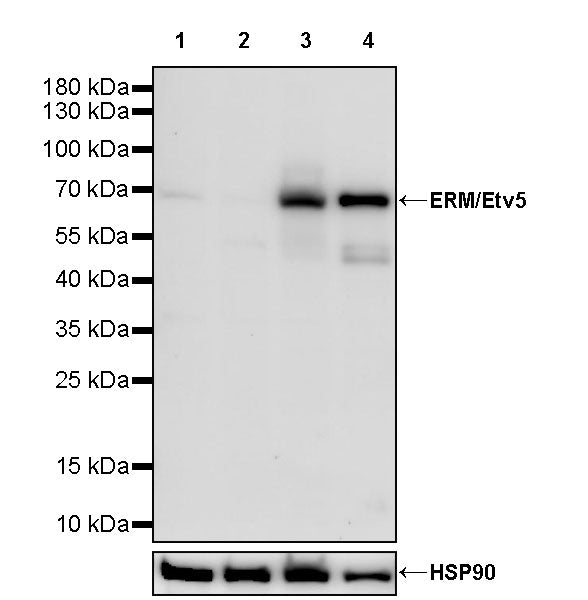
WB result of ERM/Etv5 Recombinant Rabbit mAb
Primary antibody: ERM/Etv5 Recombinant Rabbit mAb at 1/1000 dilution
Lane 1: T-47D whole cell lysate 20 µg
Lane 2: SK-BR-3 whole cell lysate 20 µg
Lane 3: SW480 whole cell lysate 20 µg
Lane 4: SK-MEL-28 whole cell lysate 20 µg
Negative control: T-47D whole cell lysate; SK-BR-3 whole cell lysate
Secondary antibody: Goat Anti- rabbit IgG, (H+L), HRP conjugated at 1/10000 dilution
Predicted MW: 58 kDa
Observed MW: 68 kDa
ERM / Etv5 Recombinant Rabbit mAb (S-3996-27)
ERM / Etv5 Recombinant Rabbit mAb (S-3996-27)
Price:
Regular price
$100 USD
Regular price
Sale price
$100 USD
Unit price
per
For shipping services or bulk orders, you may request a quotation.
Secure checkout with

View full details
Product Details
Product Details
Product Specification
| Host | Rabbit |
| Antigen | ERM / Etv5 |
| Synonyms | ETS translocation variant 5; ERM; ETV5 |
| Immunogen | Recombinant Protein |
| Location | Nucleus |
| Accession | P41161 |
| Clone Number | S-3996-27 |
| Antibody Type | Recombinant mAb |
| Isotype | IgG |
| Application | WB |
| Reactivity | Hu |
| Positive Sample | SW480, SK-MEL-28 |
| Purification | Protein A |
| Concentration | 0.5 mg/ml |
| Conjugation | Unconjugated |
| Physical Appearance | Liquid |
| Storage Buffer | PBS, 40% Glycerol, 0.05% BSA, 0.02% sodium azide |
| Stability & Storage | 12 months from date of receipt / reconstitution, -20 °C as supplied |
Dilution
| application | dilution | species |
| WB | 1:1000 | Hu |
Background
ETV5 (ETS variant transcription factor 5) is a key member of the PEA3 subfamily of the ETS transcription factor family, encoded by the ETV5 gene on human chromosome 3, and is widely expressed in various tissues, particularly abundant in the reproductive and nervous systems. This protein is characterized by its N-terminal Pointed domain and a highly conserved C-terminal ETS domain, where the ETS domain specifically recognizes and binds to the 5'-GGAA/T-3' core motif in DNA sequences, thereby regulating the transcription of downstream target genes. In terms of physiological functions, ETV5 plays an indispensable role in male reproductive development by regulating the balance between self-renewal and differentiation of spermatogonial stem cells, thereby maintaining normal spermatogenesis; Etv5 knockout mice exhibit Sertoli cell-only syndrome and infertility. Additionally, ETV5 participates in neuronal differentiation, synaptic plasticity, and female reproductive tract development. Under pathological conditions, dysregulation of ETV5 function is closely associated with various diseases. In multiple malignancies, ETV5 can act as either an oncogene or a tumor suppressor. In acute myeloid leukemia, high expression of ETV5 promotes leukemia stem cell self-renewal and chemotherapy resistance; whereas in glioma, ETV5 interacts with ATRX to maintain the heterochromatic state of telomeres, inhibiting alternative lengthening of telomeres, thereby exerting a tumor-suppressive effect. Interestingly, ETV5 also responds to mechanical stress signals, transcriptionally regulating target genes such as osteopontin, affecting vascular smooth muscle cell proliferation and migration, and participating in vascular remodeling and the development of atherosclerosis. Furthermore, ETV5 has been found to be closely associated with the pathogenesis of polycystic ovary syndrome, where its altered expression affects follicular development and steroid hormone synthesis. In summary, ETV5, as a multifunctional transcription factor, plays complex regulatory roles in reproduction, neural development, tumorigenesis, and cardiovascular disease.
Picture
Picture
Western Blot