ERCC2 Recombinant Rabbit mAb (S-4403-3)
ERCC2 Recombinant Rabbit mAb (S-4403-3)
Price:
Regular price
$100 USD
Regular price
Sale price
$100 USD
Unit price
per
For shipping services or bulk orders, you may request a quotation.
Secure checkout with

View full details
Product Details
Product Details
Product Specification
| Host | Rabbit |
| Antigen | ERCC2 |
| Synonyms | General transcription and DNA repair factor IIH helicase subunit XPD; Basic transcription factor 2 80 kDa subunit (BTF2 p80); CXPD; DNA 5'-3' helicase XPD; DNA excision repair protein ERCC-2; DNA repair protein complementing XP-D cells; XPD; XPDC |
| Immunogen | Synthetic Peptide |
| Location | Cytoplasm, Cytoskeleton, Nucleus |
| Accession | P18074 |
| Clone Number | S-4403-3 |
| Antibody Type | Recombinant mAb |
| Isotype | IgG |
| Application | WB |
| Reactivity | Hu, Mk |
| Positive Sample | K-562, HeLa, A431, MCF7, U-87 MG, COS7 |
| Predicted Reactivity | Bv |
| Purification | Protein A |
| Concentration | 0.5 mg/ml |
| Conjugation | Unconjugated |
| Physical Appearance | Liquid |
| Storage Buffer | PBS, 40% Glycerol, 0.05% BSA, 0.02% sodium azide |
| Stability & Storage | 12 months from date of receipt / reconstitution, -20 °C as supplied |
Dilution
| application | dilution | species |
| WB | 1:1000-1:5000 | Hu, Mk |
Background
ERCC2 (Excision Repair Cross-Complementing Rodent Repair Deficiency, Complementation Group 2), also known as XPD (Xeroderma Pigmentosum group D), is a multifunctional ATP-dependent 5'→3' DNA helicase that serves as the core catalytic subunit of the transcription factor IIH (TFIIH) complex, playing an irreplaceable dual role in DNA repair and transcriptional regulation. In the nucleotide excision repair (NER) pathway, ERCC2 utilizes its helicase activity to locally unwind the double helix at DNA damage sites, providing spatial access for the excision and repair of damaged fragments. Simultaneously, as an essential component of TFIIH, it participates in RNA polymerase II-mediated transcription initiation, assisting in unwinding the DNA double strand at gene promoter regions to initiate transcription. Consequently, mutations or functional deficiencies in ERCC2 simultaneously affect both DNA repair and transcription—two fundamental life processes—leading to multiple severe diseases, most notably Xeroderma Pigmentosum, in which patients exhibit extreme UV sensitivity and dramatically increased risk of skin cancer due to impaired DNA repair capacity. Additionally, its mutations are also associated with other rare disorders such as Cockayne Syndrome and Trichothiodystrophy. Given its central role in maintaining genomic stability and regulating gene expression, ERCC2 gene polymorphisms have been extensively studied as potential biomarkers for prognosis assessment in various cancers (such as lung cancer and melanoma) as well as for predicting sensitivity to platinum-based chemotherapy drugs.
Picture
Picture
Western Blot
WB result of ERCC2 Recombinant Rabbit mAb
Primary antibody: ERCC2 Recombinant Rabbit mAb at 1/1000 dilution
Lane 1: K-562 whole cell lysate 20 µg
Lane 2: HeLa whole cell lysate 20 µg
Lane 3: A431 whole cell lysate 20 µg
Lane 4: MCF7 whole cell lysate 20 µg
Lane 5: U-87 MG whole cell lysate 20 µg
Secondary antibody: Goat Anti-Rabbit IgG, (H+L), HRP conjugated at 1/10000 dilution
Predicted MW: 86 kDa
Observed MW: 80 kDa
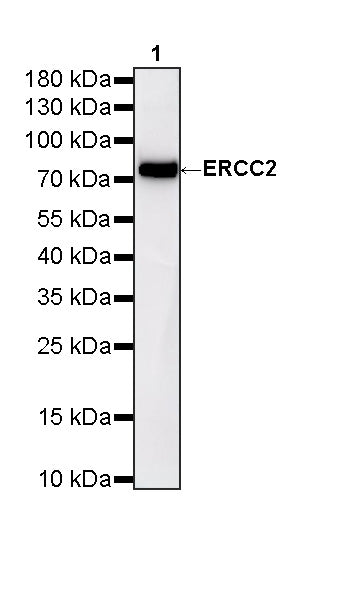
WB result of ERCC2 Recombinant Rabbit mAb
Primary antibody: ERCC2 Recombinant Rabbit mAb at 1/1000 dilution
Lane 1: COS7 whole cell lysate 20 µg
Secondary antibody: Goat Anti-Rabbit IgG, (H+L), HRP conjugated at 1/10000 dilution
Predicted MW: 86 kDa
Observed MW: 80 kDa