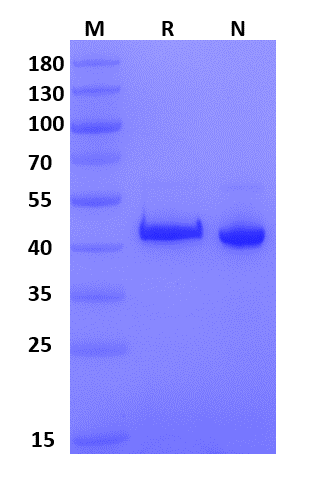
2μg (R: reducing condition, N: non-reducing condition).
ER alpha(LBD) His&Sumo Tag Protein, Human
ER alpha(LBD) His&Sumo Tag Protein, Human
Price:
Regular price
$665 USD
Regular price
Sale price
$665 USD
Unit price
per
For shipping services or bulk orders, you may request a quotation.
Secure checkout with

View full details
Product Details
Product Details
Product Specification
| Species | Human |
| Synonyms | ESR1,ER-alpha,Estradiol receptor,NR3A1 |
| Accession | P03372 |
| Amino Acid Sequence | Leu310–Arg548 with His&Sumo Tag at the N-Terminus |
| Expression System | E. coli |
| Molecular Weight | 40-55kDa (Reducing) |
| Endotoxin | <1EU/μg |
| Tag | His Tag, SUMO |
| Physical Appearance | Liquid |
| Storage Buffer | 50mM Tris, 500mM KCl, pH8.0, 5mM DTT, 20%Glycerol |
| Stability & Storage | Stable for 12 months upon stored at -80℃ from the date ofreceipt. And avoid repeated freeze-thaws cycles. |
Background
The ligand-binding domain (LBD) of the estrogen receptor (ER) is located at the C-terminus of the protein and consists of approximately 250 amino acids, forming a three-layer helical bundle containing 12 α-helices, among which helix 12 (H12) serves as a conformational switch. Its function is to bind ligands such as estradiol; upon agonist binding, H12 caps the ligand-binding pocket and exposes the AF-2 coactivator-binding site, thereby initiating transcription. Clinically, the LBD is a core target of endocrine therapy, but mutations such as Y537S and D538G can stabilize the active conformation, leading to constitutive receptor activation and resistance to SERDs such as fulvestrant. PROTACs developed based on the LBD structure, such as Vepdegestrant, employ an event-driven degradation mechanism to effectively eliminate mutant ER, offering a new strategy for refractory breast cancer.
Protocol
Picture
Picture
SDS-PAGE
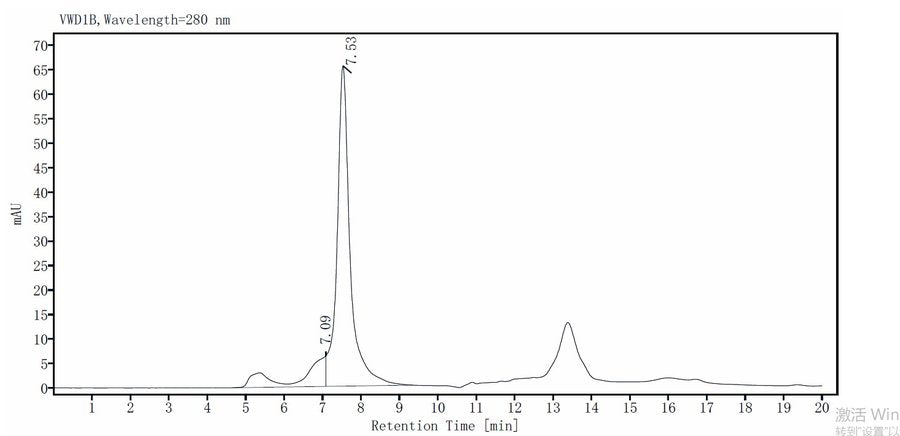
SEC-HPLC
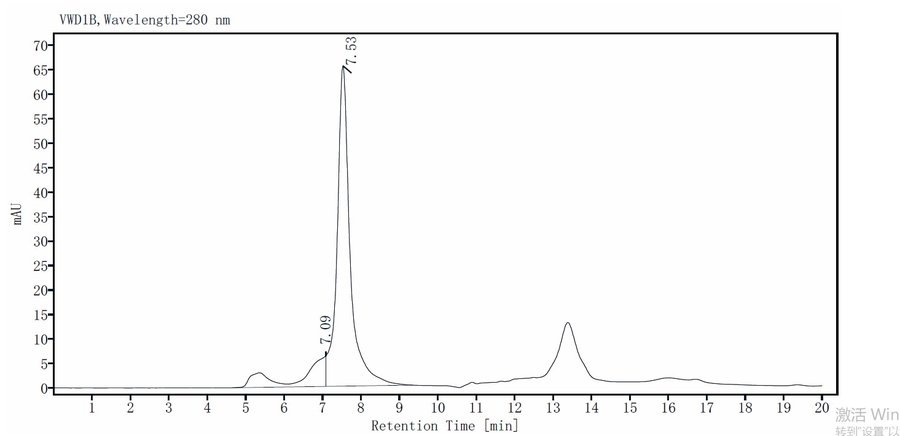
The purity of ER alpha(LBD) His&Sumo Tag Protein, Human is more than 80% as determined by SEC-HPLC.