1μg (R: reducing condition, N:non-reducing condition).
ER alpha Protein, Human
ER alpha Protein, Human
Price:
Regular price
$200 USD
Regular price
Sale price
$200 USD
Unit price
per
For shipping services or bulk orders, you may request a quotation.
Secure checkout with

View full details
Product Details
Product Details
Product Specification
| Species | Human |
| Synonyms | ESR1, ESR,NR3A1, Estradiol receptor, Nuclear receptor subfamily 3 group A member 1 |
| Accession | P03372 |
| Amino Acid Sequence | Met1-Gln116 |
| Expression System | E.coli |
| Molecular Weight | 10-15kDa (Reducing) |
| Purity | >90% by SDS-PAGE & > 80% by HPLC |
| Conjugation | Unconjugated |
| Tag | No Tag |
| Physical Appearance | Liquid |
| Storage Buffer | 50mM Tris, 200mM NaCl, 20% Glycerol, PH7.5 |
| Stability & Storage | Stable for 12 months upon stored at -80℃ from the date of receipt. And avoid repeated freeze-thaws cycles. |
| Reference | 1.Lessey BA, Palomino WA, Apparao KB, Young SL, Lininger RA. Estrogen receptor-alpha (ER-alpha) and defects in uterine receptivity in women. Reprod Biol Endocrinol. 2006;4 Suppl 1(Suppl 1):S9. |
Background
Estrogen receptor-alpha (ERα), also known as ESR1 or NR3A1, is a ligand-dependent nuclear transcription factor belonging to the nuclear receptor superfamily. Its protein structure comprises an N-terminal transcriptional activation domain (AF-1), a central DNA-binding domain (DBD), and a C-terminal ligand-binding domain (LBD containing AF-2). Upon estrogen binding to the LBD, the receptor undergoes conformational changes that promote dimerization and binding to estrogen response elements (EREs) in target gene promoters, thereby regulating gene transcription. ERα mediates estrogen's physiological effects on target tissues including breast, uterus, and bone, promoting cell proliferation, differentiation, and metabolic regulation. Clinically, ERα serves as the most critical molecular biomarker and therapeutic target in breast cancer, with approximately 70% of breast cancer patients being ERα-positive. Endocrine therapies such as tamoxifen and aromatase inhibitors significantly improve patient outcomes by blocking ERα signaling. Furthermore, ERα expression levels correlate with malignancy and treatment response in gynecological cancers including endometrial and ovarian cancers, while aberrant expression or mutations (e.g., Y537S, D538G) are associated with endocrine therapy resistance. Consequently, ERα testing has become the cornerstone for molecular subtyping of breast cancer and personalized treatment decision-making.
Picture
Picture
SDS-PAGE
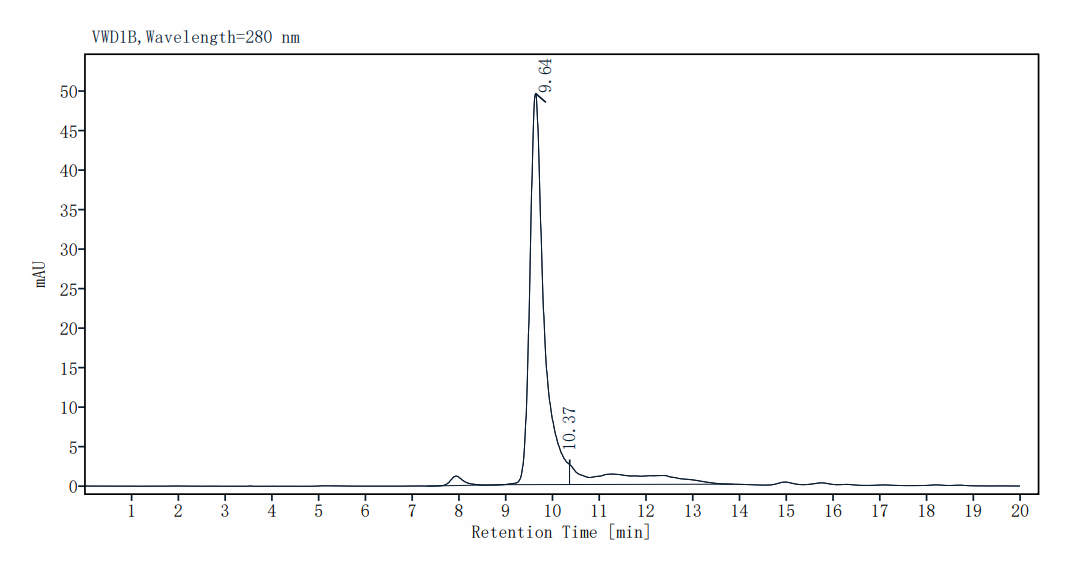
SEC-HPLC
The purity of ER alpha Protein, Human is more than 80% determined by SEC-HPLC.
ELISA
Immobilized ER alpha Protein, Human (Cat. No. UA085061) at 1.0μg/mL (100μL/well) can bind ER alpha Recombinant Rabbit mAb (SDT-2950-36) (Cat. No. S0B2444) with EC50 of 0.14-0.31 ng/mL.