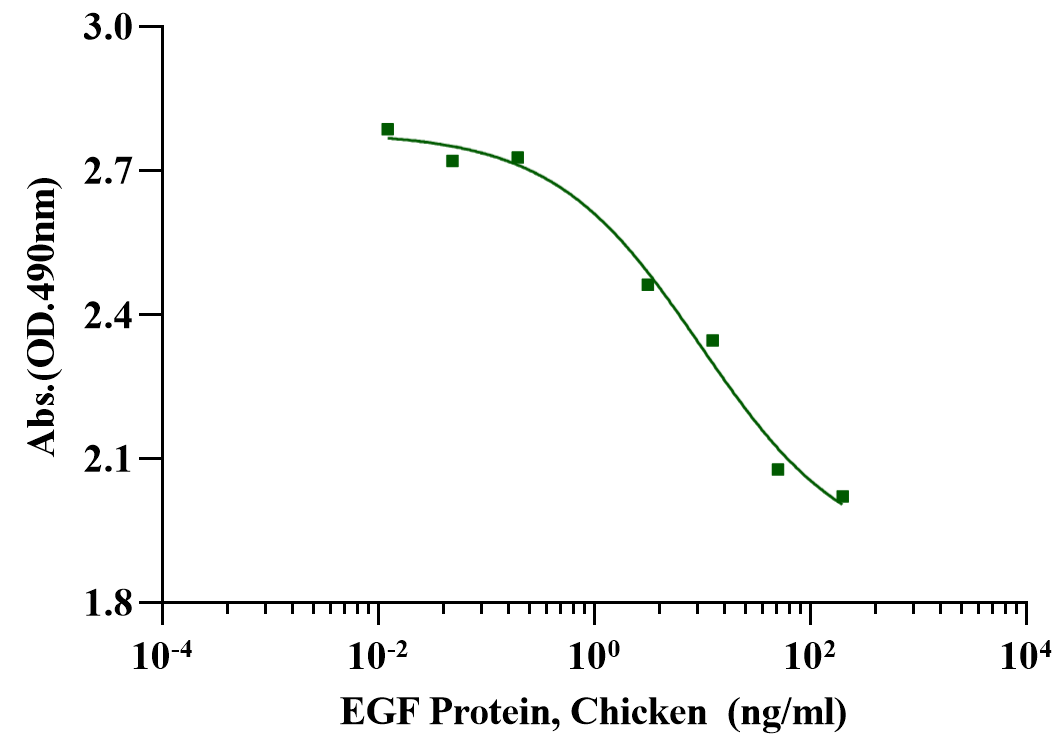
Measured by its ability to inhibit proliferation of A431. The IC50 for this effect is less than 10 ng/ml.
EGF Protein, Chicken
EGF Protein, Chicken
Price:
Regular price
$45 USD
Regular price
Sale price
$45 USD
Unit price
per
For shipping services or bulk orders, you may request a quotation.
Secure checkout with

View full details
Product Details
Product Details
Product Specification
| Species | Chicken |
| Synonyms | epidermal growth factor, EGF |
| Accession | A0A8V0XLN7 |
| Amino Acid Sequence | Gly1026-Arg1082 |
| Expression System | E.coli |
| Molecular Weight | 13-15 kDa (Reducing) |
| Purity | >95% by SDS-PAGE. |
| Endotoxin | <0.1EU/μg |
| Conjugation | Unconjugated |
| Tag | No Tag |
| Physical Appearance | Lyophilized Powder |
| Storage Buffer | PBS, pH7.4 |
| Reconstitution | Reconstitute at 0.1-1 mg/ml according to the size in ultrapure water after rapid centrifugation. |
| Stability & Storage | ·12 months from date of receipt, lyophilized powder stored at -20 to -80℃. |
| Reference | Proc Natl Acad Sci USA. 1975;72(4):1317-1321. |
Background
Epidermal growth factor (EGF) is a 53-amino acid single-chain polypeptide (~6.2 kDa) with three intramolecular disulfide bonds that belongs to the EGF family of growth factors. It was first isolated by Stanley Cohen from mouse submaxillary glands in 1962, who observed that crude extracts caused precocious eyelid opening and tooth eruption in newborn mice; this work earned Cohen and Rita Levi-Montalcini the 1986 Nobel Prize in Physiology or Medicine. EGF exerts its biological effects by binding to the EGF receptor (EGFR/ErbB1/HER1), a receptor tyrosine kinase that triggers downstream signaling cascades (MAPK, PI3K/Akt) governing cell proliferation, differentiation, migration, and survival. Chicken EGF (gEGF) shares conserved structural features with mammalian homologs and has been successfully expressed in recombinant systems.
Picture
Picture
Bioactivity
SDS-PAGE
2μg (R: reducing condition, N: non-reducing condition).