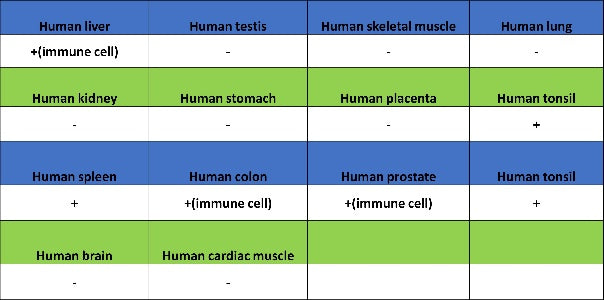
IHC shows positive staining in paraffin-embedded human spleen. Anti-EBV Induced Gene 2/EBI2 antibody was used at 1/50 dilution, followed by a HRP Polymer for Rabbit IgG (ready to use). Counterstained with hematoxylin. Heat mediated antigen retrieval with Tris/EDTA buffer pH9.0 was performed before commencing with IHC staining protocol.
EBV Induced Gene 2/EBI2 Recombinant Rabbit mAb (S-5946)
EBV Induced Gene 2/EBI2 Recombinant Rabbit mAb (S-5946)
Price:
Regular price
$100 USD
Regular price
Sale price
$100 USD
Unit price
per
For shipping services or bulk orders, you may request a quotation.
Secure checkout with

View full details
Product Details
Product Details
Product Specification
| Host | Rabbit |
| Antigen | EBV Induced Gene 2/EBI2 |
| Synonyms | G-protein coupled receptor 183; Epstein-Barr virus-induced G-protein coupled receptor 2 (EBI2; EBV-induced G-protein coupled receptor 2; hEBI2); EBI2; GPR183 |
| Location | Cell membrane |
| Accession | P32249 |
| Clone Number | S-5946 |
| Antibody Type | Recombinant mAb |
| Isotype | IgG |
| Application | IHC-P |
| Reactivity | Hu |
| Purification | Protein A |
| Concentration | 0.5 mg/ml |
| Conjugation | Unconjugated |
| Physical Appearance | Liquid |
| Storage Buffer | PBS, 40% Glycerol, 0.05% BSA, 0.02% sodium azide |
| Stability & Storage | 12 months from date of receipt / reconstitution, -20 °C as supplied |
Dilution
| application | dilution | species |
| IHC-P | 1:50-1:100 | Hu |
Background
EBV-induced gene 2 (EBI2), also known as GPR183, is a G protein-coupled receptor initially identified as being significantly upregulated in EBV-infected Burkitt's lymphoma cell lines, and is predominantly highly expressed on immune cells such as B cells. Functionally, the most central role of EBI2 is as a chemotactic receptor, guiding B cells to precisely migrate to extrafollicular regions and bridging channels within secondary lymphoid organs such as the spleen, in response to concentration gradients of its endogenous ligands—oxysterols such as 7α,25-dihydroxycholesterol (7α,25-OHC). This process acts synergistically with signaling from the chemokine receptors CXCR5 and CCR7 to collectively orchestrate the spatial positioning of T-cell-dependent antibody responses. Beyond this classical function in B cell localization, EBI2 also plays important roles in broader immunoregulation: under inflammatory conditions, stromal cells such as those in high endothelial venules within lymph nodes upregulate the expression of ligand-synthesizing enzymes like cholesterol 25-hydroxylase (CH25H), making EBI2 signaling a critical pathway for recruiting naïve lymphocytes into inflamed lymph nodes. Simultaneously, the EBI2 signaling axis is also involved in the regulation of myelination and remyelination, where its loss of function or antagonism impairs this process, positioning it as a potential therapeutic target for autoimmune diseases of the central nervous system such as multiple sclerosis. This multifaceted nature of EBI2 renders it a pivotal hub molecule connecting infection, immune responses, and autoimmune diseases, and it is regarded as a highly promising drug target.
Picture
Picture
Immunohistochemistry
IHC shows positive staining in paraffin-embedded human tonsil. Anti-EBV Induced Gene 2/EBI2 antibody was used at 1/50 dilution, followed by a HRP Polymer for Rabbit IgG (ready to use). Counterstained with hematoxylin. Heat mediated antigen retrieval with Tris/EDTA buffer pH9.0 was performed before commencing with IHC staining protocol.
IHC shows positive staining in paraffin-embedded human endometrial cancer. Anti-EBV Induced Gene 2/EBI2 antibody was used at 1/50 dilution, followed by a HRP Polymer for Rabbit IgG (ready to use). Counterstained with hematoxylin. Heat mediated antigen retrieval with Tris/EDTA buffer pH9.0 was performed before commencing with IHC staining protocol.
Negative control: IHC shows negative staining in paraffin-embedded human brain. Anti-EBV Induced Gene 2/EBI2 antibody was used at 1/100 dilution, followed by a HRP Polymer for Rabbit IgG (ready to use). Counterstained with hematoxylin. Heat mediated antigen retrieval with Tris/EDTA buffer pH9.0 was performed before commencing with IHC staining protocol.
Negative control: IHC shows negative staining in paraffin-embedded human skeletal muscle. Anti-EBV Induced Gene 2/EBI2 antibody was used at 1/100 dilution, followed by a HRP Polymer for Rabbit IgG (ready to use). Counterstained with hematoxylin. Heat mediated antigen retrieval with Tris/EDTA buffer pH9.0 was performed before commencing with IHC staining protocol.