WB result of DMT1 Recombinant Rabbit mAb
Primary antibody: DMT1 Recombinant Rabbit mAb at 1/10000 dilution
Lane 1: HeLa whole cell lysate 20 µg
Lane 2: HepG2 whole cell lysate 20 µg
Lane 3: HEK-293 whole cell lysate 20 µg
Lane 4: Caco-2 whole cell lysate 20 µg
Secondary antibody: Goat Anti-Rabbit IgG, (H+L), HRP conjugated at 1/10000 dilution
Predicted MW: 62 kDa
Observed MW: 70 kDa
DMT1 Recombinant Rabbit mAb
DMT1 Recombinant Rabbit mAb
Price:
Regular price
$100 USD
Regular price
Sale price
$100 USD
Unit price
per
For shipping services or bulk orders, you may request a quotation.
Secure checkout with

View full details
Product Details
Product Details
Product Specification
| Host | Rabbit |
| Antigen | DMT1 |
| Synonyms | SLC11A2, 1I13, DCT1, DMT-1, Natural resistance-associated macrophage protein 2 |
| Location | Mitochondrion outer membrane |
| Accession | P49281 |
| Antibody Type | Recombinant mAb |
| Isotype | IgG |
| Application | WB |
| Reactivity | Hu, Ms |
| Positive Sample | HeLa, HepG2, HEK-293, Caco-2, Neuro-2a |
| Purification | Protein A |
| Concentration | 1 mg/ml |
| Conjugation | Unconjugated |
| Physical Appearance | Liquid |
| Storage Buffer | PBS, 40% Glycerol, 0.05% BSA, 0.02% sodium azide |
| Stability & Storage | 12 months from date of receipt / reconstitution, -20 °C as supplied |
Dilution
| application | dilution | species |
| WB | 1:1000-1:10000 | Hu, Ms |
Background
Divalent metal transporter 1 (DMT1, also known as DCT1 or SLC11A2) is a highly hydrophobic transmembrane protein belonging to the SLC11 family, composed primarily of 12 transmembrane helices (TM) with both the N- and C-termini located on the cytoplasmic side, and featuring a conserved intracellular loop (containing a histidine residue critical for substrate transport) between the 4th and 5th transmembrane helices. The protein exists in multiple splice variants that differ in whether they include an N-terminal or C-terminal iron-responsive element (IRE) for post-transcriptional regulation in response to intracellular iron levels. Physiologically, DMT1 is the principal transporter in mammalian iron metabolism, responsible for the apical uptake of divalent iron (Fe²⁺) from the intestinal lumen across enterocytes into the body, and also mediates the transport of Fe²⁺ released from the transferrin–transferrin receptor complex following endocytosis across the endosomal or lysosomal membrane into the cytoplasm. Additionally, it transports other divalent metal ions such as manganese (Mn²⁺), zinc (Zn²⁺), and cobalt (Co²⁺), with its proton-coupled transport mechanism relying on cotransport driven by the pH gradient between the intra- and extracellular compartments. Pathologically, mutations in the DMT1 gene cause a rare autosomal recessive disorder—congenital iron-deficiency anemia (also known as DMT1 deficiency)—characterized by childhood-onset microcytic hypochromic anemia, elevated serum ferritin, hepatic iron overload, and developmental delay. Dysregulated expression or functional abnormalities of DMT1 are also closely associated with the pathogenesis of neurodegenerative diseases (particularly Parkinson's disease), hemochromatosis, and anemia of inflammation, while its aberrant expression in the central nervous system may lead to iron accumulation in specific brain regions and oxidative stress damage.
Picture
Picture
Western Blot
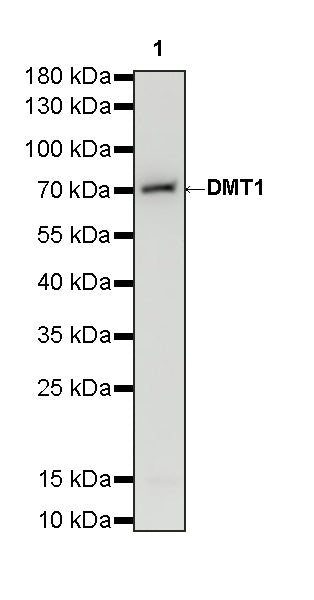
WB result of DMT1 Recombinant Rabbit mAb
Primary antibody: DMT1 Recombinant Rabbit mAb at 1/10000 dilution
Lane 1: Neuro-2a whole cell lysate 20 µg
Secondary antibody: Goat Anti-Rabbit IgG, (H+L), HRP conjugated at 1/10000 dilution
Predicted MW: 62 kDa
Observed MW: 70 kDa