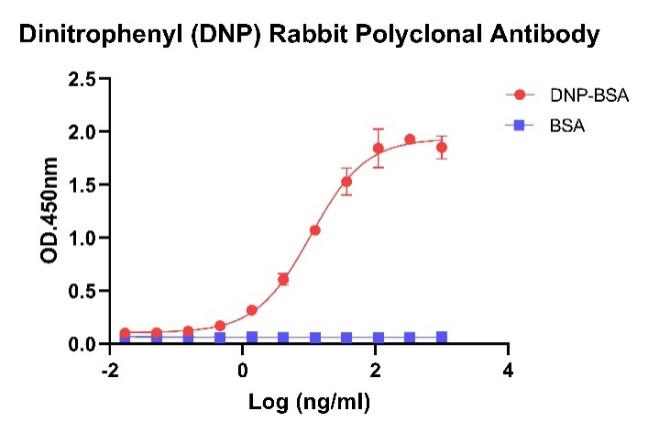
ELISA binding of Dinitrophenyl (DNP) Rabbit pAb with DNP-BSA conjugate. While the antibody does not recognize the BSA control.
Coating antigen: DNP-BSA/BSA with 0.5 µg/ml.
Dinitrophenyl (DNP) Rabbit pAb dilutions start from 1 µg/ml.
EC50=10.63ng/ml.
Dinitrophenyl (DNP) Rabbit Polyclonal Antibody
Dinitrophenyl (DNP) Rabbit Polyclonal Antibody
Price:
Regular price
$70 USD
Regular price
Sale price
$70 USD
Unit price
per
For shipping services or bulk orders, you may request a quotation.
Secure checkout with

View full details
Product Details
Product Details
Product Specification
| Host | Rabbit |
| Antigen | Dinitrophenyl |
| Antibody Type | Polyclonal antibody |
| Isotype | IgG |
| Application | ELISA |
| Purification | Immunogen Affinity |
| Concentration | 6 mg/ml |
| Conjugation | Unconjugated |
| Physical Appearance | Liquid |
| Storage Buffer | PBS pH7.4, 0.03% Proclin 300 |
| Stability & Storage | 12 months from date of receipt, 2 to 8 °C as supplied |
Background
Dinitrophenyl (DNP) is an important functional group in organic chemistry, consisting of a phenyl ring substituted with two nitro groups (-NO₂). The most common isomer is 2,4-dinitrophenyl, which is widely used due to its high reactivity and unique properties. In biochemistry and immunology, DNP is frequently employed as a hapten for antibody production or to study immune responses. In organic synthesis, it serves as a protecting group or a labeling moiety because the strong electron-withdrawing effect of the nitro groups makes the attached phenyl ring highly susceptible to nucleophilic substitution reactions. Additionally, DNP-containing compounds are often yellow and exhibit fluorescent properties, facilitating detection and analysis. It is important to note that DNP compounds, such as 2,4-dinitrophenol, were once used as weight-loss drugs or industrial dyes but are now strictly regulated due to their ability to disrupt cellular energy metabolism and pose a significant risk of causing hyperthermia.
Picture
Picture
ELISA