WB result of DGCR8 Recombinant Rabbit mAb
Primary antibody: DGCR8 Recombinant Rabbit mAb at 1/1000 dilution
Lane 1: HeLa whole cell lysate 20 µg
Lane 2: Jurkat whole cell lysate 20 µg
Lane 3: HCT 116 whole cell lysate 20 µg
Lane 4: HEK-293 whole cell lysate 20 µg
Lane 5: A549 whole cell lysate 20 µg
Lane 6: PC-3 whole cell lysate 20 µg
Secondary antibody: Goat Anti- rabbit IgG, (H+L), HRP conjugated at 1/10000 dilution
Predicted MW: 86 kDa
Observed MW: 100 kDa
DGCR8 Recombinant Rabbit mAb (S-4082-6)
DGCR8 Recombinant Rabbit mAb (S-4082-6)
Price:
Regular price
$100 USD
Regular price
Sale price
$100 USD
Unit price
per
For shipping services or bulk orders, you may request a quotation.
Secure checkout with

View full details
Product Details
Product Details
Product Specification
| Host | Rabbit |
| Antigen | DGCR8 |
| Synonyms | Microprocessor complex subunit DGCR8; C22orf12; DGCRK6 |
| Immunogen | Synthetic Peptide |
| Location | Nucleus |
| Accession | Q8WYQ5 |
| Clone Number | S-4082-6 |
| Antibody Type | Recombinant mAb |
| Isotype | IgG |
| Application | WB, IHC-P |
| Reactivity | Hu, Ms, Rt |
| Positive Sample | HeLa, Jurkat, HCT-116, HEK-293, A549, PC-3, Neuro-2a, NIH/3T3, mouse brain, PC-12, rat brain, rat testis |
| Purification | Protein A |
| Concentration | 0.5 mg/ml |
| Conjugation | Unconjugated |
| Physical Appearance | Liquid |
| Storage Buffer | PBS, 40% Glycerol, 0.05% BSA, 0.03% Proclin 300 |
| Stability & Storage | 12 months from date of receipt / reconstitution, -20 °C as supplied |
Dilution
| application | dilution | species |
| WB | 1:1000 | Hu, Ms, Rt |
| IHC-P | 1:2000 | Hu, Ms, Rt |
Background
DGCR8 (DiGeorge Syndrome Critical Region 8), also known as Pasha in invertebrates, is an essential double-stranded RNA-binding protein that functions as a core component of the Microprocessor complex alongside the RNase III enzyme Drosha, playing a pivotal role in the canonical biogenesis of microRNAs (miRNAs) within the nucleus. By recognizing and binding to the apical loop and single-stranded RNA segments of primary miRNA transcripts (pri-miRNAs), DGCR8 serves as a molecular ruler that positions Drosha to precisely cleave the pri-miRNA base, thereby generating precursor miRNAs (pre-miRNAs) that are subsequently exported to the cytoplasm for further processing into mature miRNAs involved in post-transcriptional gene regulation. Beyond its central function in miRNA processing, DGCR8 contributes to the maintenance of genomic stability, DNA damage response, and cellular differentiation, and its haploinsufficiency due to deletions in chromosome 22q11.2 is directly linked to DiGeorge syndrome (22q11.2 deletion syndrome), a multisystem developmental disorder characterized by congenital heart defects, immune deficiencies, and neuropsychiatric abnormalities, underscoring the critical importance of precise DGCR8-mediated regulatory networks in human development and disease.
Picture
Picture
Western Blot
WB result of DGCR8 Recombinant Rabbit mAb
Primary antibody: DGCR8 Recombinant Rabbit mAb at 1/1000 dilution
Lane 1: Neuro-2a whole cell lysate 20 µg
Lane 2: NIH/3T3 whole cell lysate 20 µg
Lane 3: mouse brain lysate 20 µg
Secondary antibody: Goat Anti- rabbit IgG, (H+L), HRP conjugated at 1/10000 dilution
Predicted MW: 86 kDa
Observed MW: 100 kDa
WB result of DGCR8 Recombinant Rabbit mAb
Primary antibody: DGCR8 Recombinant Rabbit mAb at 1/1000 dilution
Lane 1: PC-12 whole cell lysate 20 µg
Lane 2: rat brain lysate 20 µg
Lane 3: rat testis lysate 20 µg
Secondary antibody: Goat Anti- rabbit IgG, (H+L), HRP conjugated at 1/10000 dilution
Predicted MW: 86 kDa
Observed MW: 100 kDa
Immunohistochemistry
IHC shows positive staining in paraffin-embedded human colon. Anti-DGCR8 antibody was used at 1/2000 dilution, followed by a HRP Polymer for Rabbit IgG (ready to use). Counterstained with hematoxylin. Heat mediated antigen retrieval with Tris/EDTA buffer pH9.0 was performed before commencing with IHC staining protocol.
IHC shows positive staining in paraffin-embedded human breast cancer. Anti-DGCR8 antibody was used at 1/2000 dilution, followed by a HRP Polymer for Rabbit IgG (ready to use). Counterstained with hematoxylin. Heat mediated antigen retrieval with Tris/EDTA buffer pH9.0 was performed before commencing with IHC staining protocol.
IHC shows positive staining in paraffin-embedded human lung cancer. Anti-DGCR8 antibody was used at 1/2000 dilution, followed by a HRP Polymer for Rabbit IgG (ready to use). Counterstained with hematoxylin. Heat mediated antigen retrieval with Tris/EDTA buffer pH9.0 was performed before commencing with IHC staining protocol.
IHC shows positive staining in paraffin-embedded human stomach cancer. Anti-DGCR8 antibody was used at 1/2000 dilution, followed by a HRP Polymer for Rabbit IgG (ready to use). Counterstained with hematoxylin. Heat mediated antigen retrieval with Tris/EDTA buffer pH9.0 was performed before commencing with IHC staining protocol.
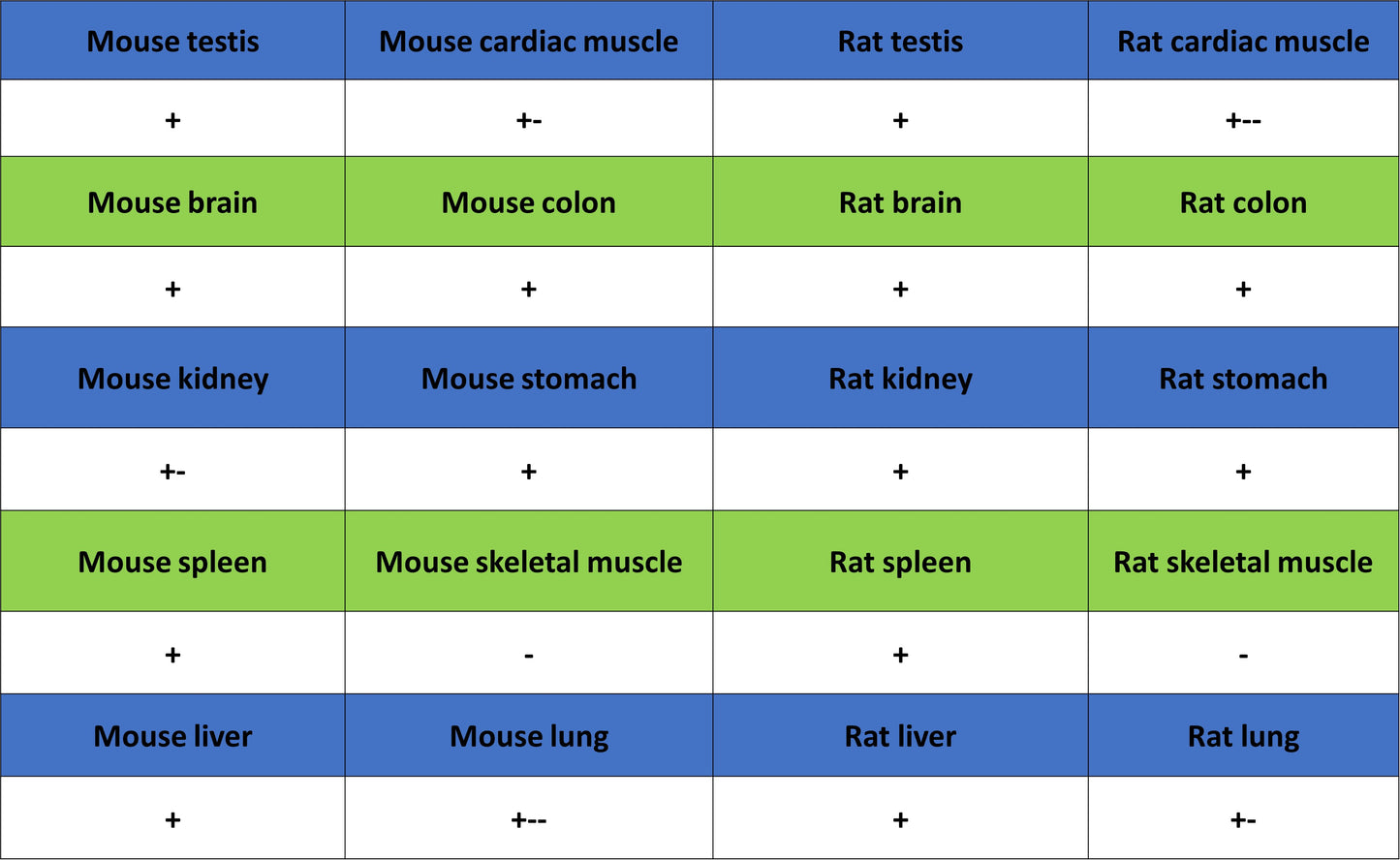
IHC shows positive staining in paraffin-embedded mouse colon. Anti-DGCR8 antibody was used at 1/2000 dilution, followed by a HRP Polymer for Rabbit IgG (ready to use). Counterstained with hematoxylin. Heat mediated antigen retrieval with Tris/EDTA buffer pH9.0 was performed before commencing with IHC staining protocol.
IHC shows positive staining in paraffin-embedded rat colon. Anti-DGCR8 antibody was used at 1/2000 dilution, followed by a HRP Polymer for Rabbit IgG (ready to use). Counterstained with hematoxylin. Heat mediated antigen retrieval with Tris/EDTA buffer pH9.0 was performed before commencing with IHC staining protocol.