WB result of DGAT2 Recombinant Rabbit mAb
Primary antibody: DGAT2 Recombinant Rabbit mAb at 1/1000 dilution
Lane 1: mouse spleen lysate 20 µg
Lane 2: mouse lung lysate 20 µg
Lane 3: mouse liver lysate 20 µg
Lane 4: mouse adipose lysate 20 µg
Lane 5: mouse skin lysate 20 µg
Negative control: mouse spleen lysate; mouse lung lysate
Secondary antibody: Goat Anti- rabbit IgG, (H+L), HRP conjugated at 1/10000 dilution
Predicted MW: 43 kDa
Observed MW: 38 kDa
DGAT2 Recombinant Rabbit mAb (S-3871-31)
DGAT2 Recombinant Rabbit mAb (S-3871-31)
Price:
Regular price
$100 USD
Regular price
Sale price
$100 USD
Unit price
per
For shipping services or bulk orders, you may request a quotation.
Secure checkout with

View full details
Product Details
Product Details
Product Specification
| Host | Rabbit |
| Antigen | DGAT2 |
| Synonyms | Diacylglycerol O-acyltransferase 2; Acyl-CoA retinol O-fatty-acyltransferase (ARAT; Retinol O-fatty-acyltransferase); Diglyceride acyltransferase 2; Dgat2 |
| Immunogen | Synthetic Peptide |
| Location | Cytoplasm, Endoplasmic reticulum |
| Accession | Q9DCV3 |
| Clone Number | S-3871-31 |
| Antibody Type | Recombinant mAb |
| Isotype | IgG |
| Application | WB |
| Reactivity | Ms, Rt |
| Positive Sample | mouse liver, mouse adipose, mouse skin, rat adipose |
| Purification | Protein A |
| Concentration | 0.5 mg/ml |
| Conjugation | Unconjugated |
| Physical Appearance | Liquid |
| Storage Buffer | PBS, 40% Glycerol, 0.05% BSA, 0.03% Proclin 300 |
| Stability & Storage | 12 months from date of receipt / reconstitution, -20 °C as supplied |
Dilution
| application | dilution | species |
| WB | 1:1000 | Ms, Rt |
Background
Diacylglycerol O-acyltransferase 2 (DGAT2) is a critical membrane-bound enzyme primarily localized to the endoplasmic reticulum that catalyzes the final and committed step in triglyceride biosynthesis by acylating diacylglycerol with fatty acyl-CoA to form triacylglycerol. Distinct from its homolog DGAT1, DGAT2 belongs to a separate gene family and plays a predominant role in hepatic and adipose tissue lipid metabolism, where it is essential for the assembly of lipid droplets and the production of very-low-density lipoproteins (VLDL). Due to its central function in regulating cellular lipid storage and energy homeostasis, DGAT2 has emerged as a significant therapeutic target for metabolic disorders such as obesity, type 2 diabetes, and non-alcoholic fatty liver disease, with studies indicating that its inhibition can effectively reduce hepatic steatosis and improve insulin sensitivity, although careful modulation is required to avoid potential adverse effects on skin barrier function and overall lipid balance.
Picture
Picture
Western Blot
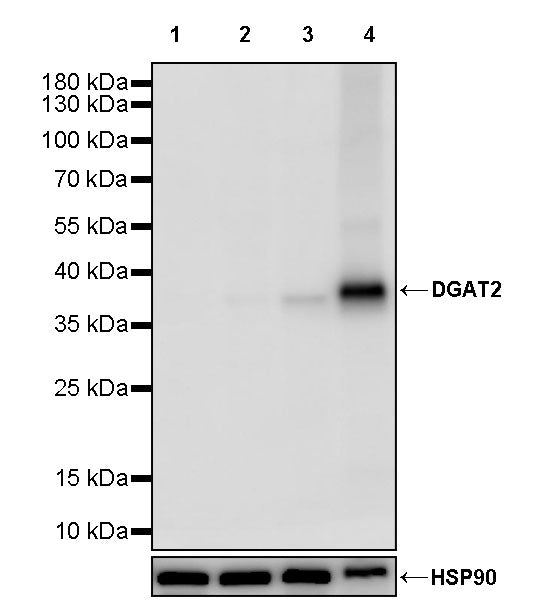
WB result of DGAT2 Recombinant Rabbit mAb
Primary antibody: DGAT2 Recombinant Rabbit mAb at 1/1000 dilution
Lane 1: rat spleen lysate 20 µg
Lane 2: rat lung lysate 20 µg
Lane 3: rat liver lysate 20 µg
Lane 4: rat adipose lysate 20 µg
Negative control: rat spleen lysate; rat lung lysate
Secondary antibody: Goat Anti- rabbit IgG, (H+L), HRP conjugated at 1/10000 dilution
Predicted MW: 43 kDa
Observed MW: 38 kDa