WB result of DCTN1 Rabbit Polyclonal Antibody
Primary antibody: DCTN1 Rabbit Polyclonal Antibody at 1/1000 dilution
Lane 1: HeLa whole cell lysate 20 µg
Lane 2: MCF7 whole cell lysate 20 µg
Lane 3: HEK-293 whole cell lysate 20 µg
Secondary antibody: Goat Anti-Rabbit IgG (H+L), HRP conjugated at 1/10000 dilution
Predicted MW: 142 kDa
Observed MW: 150 kDa
DCTN1 Rabbit Polyclonal Antibody
DCTN1 Rabbit Polyclonal Antibody
Price:
Regular price
$100 USD
Regular price
Sale price
$100 USD
Unit price
per
For shipping services or bulk orders, you may request a quotation.
Secure checkout with

View full details
Product Details
Product Details
Product Specification
| Host | Rabbit |
| Antigen | DCTN1 |
| Synonyms | Dynactin subunit 1; 150 kDa dynein-associated polypeptide; DAP-150 (DP-150); p135; p150-glued |
| Immunogen | Synthetic Peptide |
| Location | Cytoplasm, Nucleus |
| Accession | Q14203 |
| Antibody Type | Polyclonal antibody |
| Isotype | IgG |
| Application | WB |
| Reactivity | Hu, Ms, Rt, Mk |
| Positive Sample | HeLa, MCF7, HEK-293, Neuro-2a, mouse brain, PC-12, rat brain |
| Purification | Immunogen Affinity |
| Concentration | 2 mg/ml |
| Conjugation | Unconjugated |
| Physical Appearance | Liquid |
| Storage Buffer | PBS, 40% Glycerol, 0.05% BSA, 0.02% sodium azide |
| Stability & Storage | 12 months from date of receipt / reconstitution, -20 °C as supplied |
Dilution
| application | dilution | species |
| WB | 1:1000-1:2000 | Hu, Ms, Rt, Mk |
Background
DCTN1, encoded by the DCTN1 gene, is a multifunctional scaffolding protein known as dynactin subunit 1, and it is the largest subunit (p150Glued) of the dynactin complex. As a critical adaptor protein connecting cytoplasmic dynein to microtubules, DCTN1 plays an irreplaceable role in microtubule-dependent retrograde transport within cells. Its N-terminus contains a highly conserved CAP-Gly domain that directly binds to microtubules, while other regions are responsible for interacting with dynein and cargo molecules, thereby mediating the transport of cellular cargos such as endosomes, lysosomes, Golgi-derived vesicles, and signaling molecules toward the nucleus along microtubules. In addition, DCTN1 participates in spindle assembly and chromosome movement during mitosis, and promotes axonal growth and branching during neuronal development. Due to its central role in retrograde axonal transport in neurons, DCTN1 gene mutations have been identified as the cause of various neurodegenerative diseases, including Perry syndrome (characterized by parkinsonism, depression, weight loss, and respiratory abnormalities), distal hereditary motor neuronopathy, and have also been associated with conditions such as amyotrophic lateral sclerosis (ALS) and frontotemporal dementia. The pathogenic mechanisms typically involve abnormal aggregation of mutant proteins in the cytoplasm, impaired microtubule-binding capacity, and disruption of TDP-43 protein normal localization, ultimately leading to neuronal dysfunction and death.
Picture
Picture
Western Blot
WB result of DCTN1 Rabbit Polyclonal Antibody
Primary antibody: DCTN1 Rabbit Polyclonal Antibody at 1/1000 dilution
Lane 1: Neuro-2a whole cell lysate 20 µg
Secondary antibody: Goat Anti-Rabbit IgG (H+L), HRP conjugated at 1/10000 dilution
Predicted MW: 142 kDa
Observed MW: 150 kDa
WB result of DCTN1 Rabbit Polyclonal Antibody
Primary antibody: DCTN1 Rabbit Polyclonal Antibody at 1/1000 dilution
Lane 1: mouse liver lysate 20 µg
Lane 2: mouse brain lysate 20 µg
Negative control: mouse liver lysate
Secondary antibody: Goat Anti-Rabbit IgG (H+L), HRP conjugated at 1/10000 dilution
Predicted MW: 142 kDa
Observed MW: 130, 150 kDa
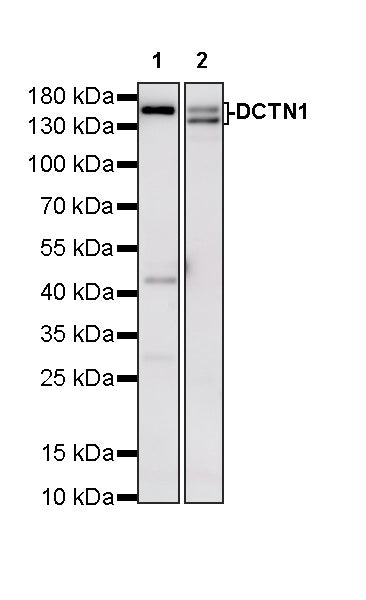
WB result of DCTN1 Rabbit Polyclonal Antibody
Primary antibody: DCTN1 Rabbit Polyclonal Antibody at 1/1000 dilution
Lane 1: PC-12 whole cell lysate 20 µg
Lane 2: rat brain lysate 20 µg
Secondary antibody: Goat Anti-Rabbit IgG (H+L), HRP conjugated at 1/10000 dilution
Predicted MW: 142 kDa
Observed MW: 130, 150 kDa