1μg (R: reducing condition, N:non-reducing condition).
DcR3/TNFRSF6B His Tag Protein, Human
DcR3/TNFRSF6B His Tag Protein, Human
Price:
Regular price
$250 USD
Regular price
Sale price
$250 USD
Unit price
per
For shipping services or bulk orders, you may request a quotation.
Secure checkout with

View full details
Product Details
Product Details
Product Specification
| Species | Human |
| Synonyms | Decoy receptor for Fas ligand, TNFRSF6B, TR6, Decoy receptor 3 |
| Accession | O95407 |
| Amino Acid Sequence | Val30-His300 with His Tag at the C-Terminus |
| Expression System | HEK293 |
| Molecular Weight | 35-40kDa (Reducing) |
| Purity | >95% by SDS-PAGE |
| Conjugation | Unconjugated |
| Tag | His Tag |
| Physical Appearance | Lyophilized Powder |
| Storage Buffer | PBS, PH7.4, 5% trehalose |
| Reconstitution | Reconstitute at 0.1-1 mg/ml according to the size in ultrapure water after rapid centrifugation. |
| Stability & Storage | · 12 months from date of receipt, lyophilized powder stored at -20 to -80℃. |
| Reference | 1.Lin WW, Hsieh SL. Decoy receptor 3: a pleiotropic immunomodulator and biomarker for inflammatory diseases, autoimmune diseases and cancer. Biochem Pharmacol. 2011 Apr 1;81(7):838-47. |
Background
DCR3 (Decoy Receptor 3), also known as TNFRSF6B, is a member of the tumor necrosis factor receptor superfamily. It is a soluble secreted protein lacking both transmembrane and intracellular death domains. DCR3 exerts its "decoy" function by competitively binding to ligands such as FasL, LIGHT, and TL1A, thereby blocking apoptosis signaling induced by these ligands. Beyond its classical anti-apoptotic role, DCR3 can also activate pathways including NF-κB through reverse signaling to regulate dendritic cell differentiation, macrophage polarization, and osteoclast formation, participating in immune modulation and inflammatory responses. Clinical studies have demonstrated that DCR3 is aberrantly elevated in various malignancies (gastric cancer, renal cell carcinoma, pancreatic cancer, etc.) and autoimmune diseases (Crohn's disease, rheumatoid arthritis), serving as a biomarker for disease prognosis assessment. Furthermore, neutralizing antibodies or siRNA-based interventions targeting DCR3 offer potential therapeutic strategies for tumor immunotherapy.
Picture
Picture
SDS-PAGE
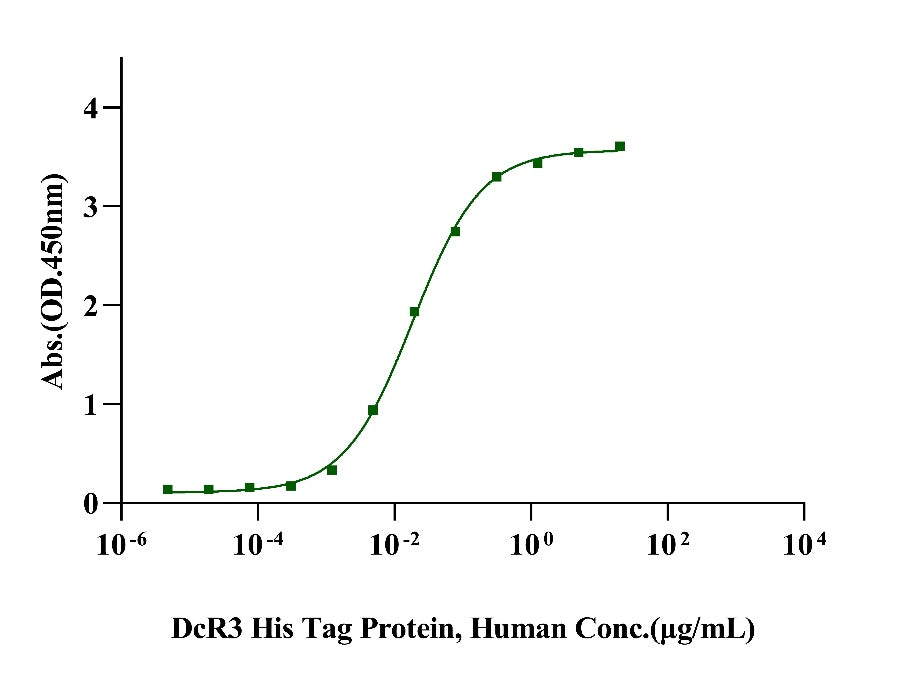
ELISA
Immobilized DcR3 His Tag Protein, Human (Cat. No. UA016058) at 5.0μg/mL (100μL/well) can bind Human TL1A/TNFSF15 Protein, hFc Tag (Cat. No. S0A4084) with EC50 of 1.13-1.70 ng/ml.
Immobilized TL1A/TNFSF15 Protein, hFc Tag (Cat. No. S0A4084) at 5.0μg/mL (100μL/well) can bind Human DcR3 His Tag Protein, Human (Cat. No. UA016058) with EC50 of 16.26-21.17 ng/ml.