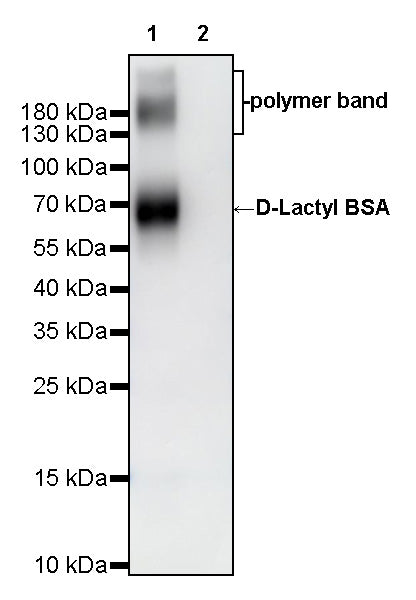
WB result of D-Lactyl Lysine Recombinant Rabbit pAb
Primary antibody: D-Lactyl Lysine Recombinant Rabbit pAb at 1/1000 dilution
Lane 1: D-Lactyl BSA lysate 1 µg
Lane 2: L-Lactyl BSA lysate 1 µg
Secondary antibody: Goat Anti-rabbit IgG, (H+L), HRP conjugated at 1/10000 dilution
Predicted MW: multiple bands
Observed MW: multiple bands
S-RMabMixTM D-Lactyl Lysine Rabbit mAb
S-RMabMixTM D-Lactyl Lysine Rabbit mAb
Price:
Regular price
$200 USD
Regular price
Sale price
$200 USD
Unit price
per
For shipping services or bulk orders, you may request a quotation.
Secure checkout with

View full details
Product Details
Product Details
Product Specification
| Host | Rabbit |
| Synonyms | D-lysine, KD-modification, D-lactylation, D-lactate modification |
| Immunogen | Synthetic Peptide |
| Antibody Type | Recombinant mAb Mix |
| Isotype | IgG |
| Application | WB, Dot blot |
| Reactivity | Species Independent |
| Concentration | 1 mg/ml |
| Conjugation | Unconjugated |
| Physical Appearance | Liquid |
| Storage Buffer | PBS, 40% Glycerol, 0.05% BSA, 0.02% sodium azide |
| Stability & Storage | 12 months from date of receipt / reconstitution, -20 °C as supplied |
Dilution
| application | dilution | species |
| Dot Blot | 1:1000 | Species independent |
| WB | 1:1000 | Species independent |
Background
D-lactyl lysine (abbreviated as K-Dla) is a novel acylative post-translational modification recently discovered on proteins. Unlike L-lactylation, which is driven by L-lactate from glycolysis, D-lactylation occurs primarily through a distinct metabolic pathway: it does not directly derive from D-lactate but instead is formed by the non-enzymatic covalent attachment of a D-lactyl group to lysine residues on proteins via S-D-lactoyl glutathione (SLG), an intermediate of the glyoxalase pathway. This process is significantly triggered under specific physiological conditions, such as during immune cell activation. For example, when NF-κB signaling leads to the downregulation of the key enzyme GLO2, its substrate SLG accumulates within cells, thereby massively inducing D-lactylation modification. This modification is considered a self-regulatory "braking" mechanism of the cell—for instance, by modifying RelA, a key protein in the NF-κB pathway, it suppresses excessive inflammatory responses to restore immune homeostasis. In addition, D-lactate secreted by gut microbiota can also induce D-lactylation in host cells, thereby regulating gene transcription and being associated with the development and progression of various diseases, including hepatocellular carcinoma. Currently, this newly discovered modification opens new perspectives for understanding the connections among cellular metabolism, microbiota, and host epigenetic regulation.
Picture
Picture
Western Blot
Dot Blot
Dot blot result of D-Lactyl Lysine Rabbit Polyclonal Antibody
Lane 1: Modified peptide library (D-lactyl lysine)
Lane 2: Unmodified peptide library
Lane 3: Modified peptide library (L-lactyl lysine)
Lane 4: Modified peptide library (β-hydroxybutyryl lysine)
Lane 5: Modified peptide library (Fumaryl lysine)
Lane 6: Modified peptide library (Crotonyl lysine)
Lane 7: Modified peptide library (Succinyl lysine)
Lane 8: Modified peptide library (Butyryl lysine)
Lane 9: Modified peptide library (Propionyl lysine)
Lane 10: Modified peptide library (Actyl lysine)
Primary antibody: D-Lactyl Lysine Rabbit Polyclonal Antibody at 1/1000 dilution
Secondary antibody: Goat Anti-rabbit IgG, (H+L), HRP conjugated at 1/10000 dilution